
Li Xianting
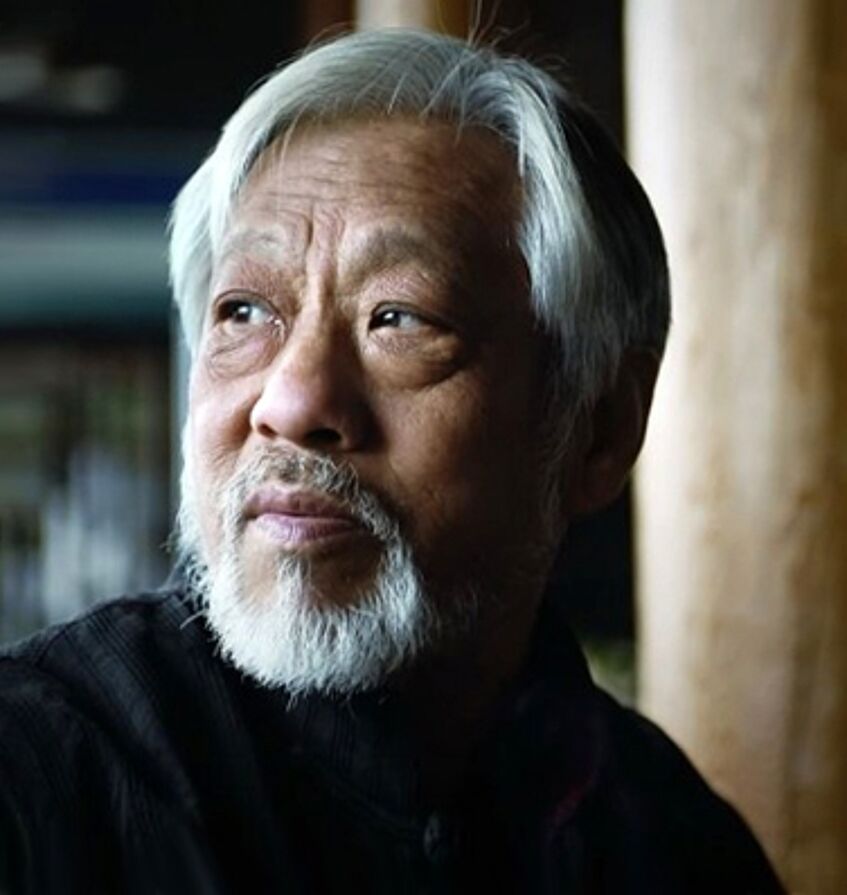
Li Xianting (2012)
Li Xianting
... was born in Jilin Province in 1949. In 1978 he graduated from Beijing's Central Academy of Fine Arts where he had studied traditional Chinese painting. From 1979 to 1983 he was an editor of "Meishu" (Fine Art Magazine). There, at the time of the political and economic opening, he supported a profound reform also for China's arts and culture scene. Li Xianting supported not only the "Scars Art" (dealing with social injuries suffered during the Cultural Revolution), Chinese "Nativismus" and other modernist forms in art, it was him also who published, despite resistance from a number of communist art officials, the first positive review of the "Stars" exhibitions in the national arts magazine he worked for. Li was later forced to leave the officials Artists' Association, but still today he is considered one of the most influential art critics in China.
Interview with Li Xianting (October 29, 2013 in his house in Beijing/Songzhuang town)
Interview with Li Xianting (October 29, 2013 in his house in Beijing/Songzhuang town)
Here you find the Chinese text of the interview.
Li Xianting: In the late 1970s, at the end of the Cultural Revolution and under the influence of the Soviet Union, art had to serve politics. However, unlike the Soviet Union, China put importance on learning from folk art, so its styles incorporated many elements of Chinese folk art.
When the Cultural Revolution ended, a rebellion against it emerged. At the early stage, it was a modernist movement, represented by the “Twelve-Person Art Exhibition” in Shanghai, as well as the “New Spring Oil Painting Exhibition” and the “No-Name Painting Society” in Beijing.
These three shared the same styles, influenced by Western modernism, and emphasizing the purity of art. Purity meant completely apolitical. But such an apolitical nature itself was political.
Interviewer (Helmut Opletal): You said the “Twelve-Person Art Exhibition” in Shanghai took place in 1979?
Li: In February 1979. The exhibition of the “No Name Painting Society” was around April or May. There was another one in Zhongshan Park, with a very long name, called the “New Spring Landscape and Still Life Oil Painting Exhibition.” Like the “Twelve-Person Art Exhibition” in Shanghai, it was all during the Chinese New Year.
These three exhibitions all had similar backgrounds, all were reminiscent of the modernist movement in Shanghai and Hangzhou in the early 1930s. The earliest modernists had been Wu Dayu, Guan Liang, Lin Fengmian, and Liu Haisu. They had a small, private salon for painting and educating young artists.
After China’s opening up in 1979, they suddenly emerged, the first being the “Twelve-Person Art Exhibition” in Shanghai and the “No Name Painting Society” in Beijing that I just mentioned.
They also had mentors, the mentor of the “No Name Painting Society” was a woman named Xiong, actually two sisters named Xiong, but I can't remember their full names [actually Xiong Xianpeng and Xiong Xianling at the Xihua Art Tutoring School.]
They ran a private training class; they had studied in Japan in their early years and were deeply influenced by Fauvism. They were the teachers of two members of the “No-Name Painting Society”; one was Yang Yushu, and the other Zhao Wenliang who both led a group of painters later. They are now over seventy years old.
Interviewer: When you compare their paintings with the “Stars” exhibition, which one was more advanced?
Li: The style of the later “Stars Art Exhibition” was different, but they were both influenced by Western modernism. And they stood for pure of art without politics. The same goes for the “New Spring Oil Painting Exhibition” at Zhongshan Park which had "Landscape and Still Life" In its title. They included members like Lin Fengmian, Tang Shengqin [?] and Wu Guanzhong, who were all influenced by Western modernism in their early years.
These three exhibitions represent that period. In this process, a new group of artists, associated with the Xidan Democracy Wall, grew up and became closely connected with politics. […]
The “Stars” exhibition was different. This group, along with people of the magazine "Today” like Bei Dao and others, were also involved in the poetry movement. They made illustrations for the journal and were active at the Xidan Wall, and many of their activities, including a protest march, were connected to politics.
Wang Keping's works, for example, had a very obvious political angle. This was different from the earlier period of new art. However, they all showed a modernist style. Their motto consisted of two phrases "Raise high the banner of Picasso, and follow the path of Käthe Kollwitz." Käthe Kollwitz was an leftist German woman artist, introduced to China by Lu Xun in the 1930s. During the Anti-Japanese War, they contributed revolutionary mobilization role.
So the new artists on the one hand modernized their style to oppose Soviet influence; on the other hand, politically, they focused on human nature and humanitarianism which implied a strong political stance.
Interviewer: How did you come into contact with the “Stars Art Society?”
Li: It was the people from the “Stars” exhibition who contacted me. When I was an editor at the "Fine Arts" (Meishu) magazine, Ma Desheng came to see me several times at the editors’ office and my home. We had even more contact later, and I also went to see their first exhibition outside the Art Museum.
Interviewer: When they contacted you, you were an editor at the arts magazine. Did you just look at their work and say, "That's great?" Was it somehow like that.
Li: Indeed, I particularly liked their art back then. I was the first to write an article on them. The article included my conversation with each person. This early article emphasized self-expression, something that’s true for them until this day.
Art magazines usually only needed the editor-in-chief to approve an article to be published, but for this one, all the heads of the China Artists Association had to agree, and Hua Junwu, Jiang Feng, Yu Feng, and the others all did so.
Interviewer: When they knew you were going to write this article, they wanted to take a look first, and then...?
Li: They agreed, but they also made some changes.
Interviewer: What modifications did they make?
Chestnut: I can't remember.
Interviewer: Wang Keping's "Idol" could it be shown in the magazine?
Li: That was not possible. It couldn’t be shown. The first exhibition had a political focus, like "Silence," "Ten Thousand Years," and "Bureaucratism" - all vague allusions and not fully direct, yet they caused a huge uproar.
By the time of the second exhibition in 1980, people didn’t pay so much attention to political issues any more. The debates surrounding the exhibition rather focused on the fact that people didn’t understand certain paintings, like abstract art. Emotions had shifted; they weren't as sensitive to political issues as they were during the first exhibition.
Interviewer: So, did the leaders of the Art Association express any other criticism of your article?
Li: No. They only said we should be careful with portraying such tendencies. They didn't consider it a positive trend. Although I had modified my article, they wouldn't let some of the works be published. I had included a few small illustrations, not a full page, but still they disagreed. None of the most provocative works could be shown.
Interviewer: There were people like you in the art world who supported the “Stars” group. But I think there must have been some more conservative art representatives at that time.
Li: Most of them were quite conservative, and I was the only one on the editorial board who supported the “Stars”. I was only in my early twenties then. Some of the older ones were arguing every day.
Interviewer: So how did they react?
Li: I was very vocal about my opinions at that time, and I was fighting for my rights. The editor-in-chief at that time was quite decent. He did listen to some of my opinions, because he had also been imprisoned during the Cultural Revolution. At the end of 1982, they decided to publish my manuscripts, but as soon as it came out in January 1983, I was dismissed.
Wu Guanzhong and Yu Feng strongly requested that I stay at the meeting at the China Artists Association that should decide on my dismissal. Later, I received a private letter from them explaining to me that that they had wanted to protect me. Wu Guanzhong even came to my house and gave me a painting as a gift, telling me that he regretted that he had not being able to protect me.
Interviewer: So you were fired for writing this article?
Li: Not only, there was also something else.
Interviewer: Now that we're talking about this, are there still any problems?
Li: Actually, the problem hasn't been truly solved; there are still issues, different issues, or the same issues. They insist that politics, pornography, and violence are unacceptable in so-called art. It still remains the same, and no fundamental change has occurred. For example, in terms of artistic forms, some particularly provocative performance art still encounters problems.
Interviewer: Can those events from back then, such as the “Stars” exhibition, be openly discussed nowadays? Can their works be shown in papers and magazines?
Li: Privately it's fine. But anything relating to protests and the issues of democracy still can't be openly published. It's only possible online, where there's more freedom.
Interviewer: Do specialized art magazines in China still talk about what happened in 1979 and 1980?
Li: No, they don’t.
Interviewer: And why not? Is it because people aren't interested anymore?
Li: Actually, there is not too much interest today. It's more like archaeology. Just before this interview, I have been in Xiamen to participate in an independent film festival. In one of the groups, there was such a discussion on "archaeology." I talked there on "June Fourth [1989]." About four or five years after these events, some young people didn’t believe any more that it had happened, and this history became buried - within for four or five years! China keeps burying history, so that’s why we have to keep digging.
Interviewer: Another question: At that time, Wang Keping said that his sculpture called “Idol” did not depict Mao, nor was it criticizing the Communist Party. It just represented a Buddha.
Li: Yes, a Buddha is an idol. But if you use Mao as a symbol, it doesn’t have the meaning of an idol. If he wanted to show Mao as an idol, he had to find a way to piece the two together, and it had to appear like a Buddha. Without creating such a feeling, the sculpture wouldn’t have a meaning. In that period, what was the point of making statues of Mao? Talking about Mao and opposing his personality cult, this was very avant-garde at that early time.
Interviewer: Do you still think that the “Stars” exhibition was really so special then?
Li: It was very special!
Interviewer: Was it a starting point for further development in arts?
Li: I think as a starting point it was quite high. The development of contemporary Chinese art is closely related to politics; this is one of its characteristics. Everyone used Western modernism to measure Chinese art. But I think this didn’t have any meaning. Precisely because of this, the emergence of contemporary Chinese art, with its intrinsic pursuit of humanism and its emphasis on breaking free from totalitarianism, was significant for it. Also later, contemporary Chinese art did not escape politics. I don't think it's necessary to cleanse it up. You cannot say, just because it's related to politics it isn’t art. I don't think so.