
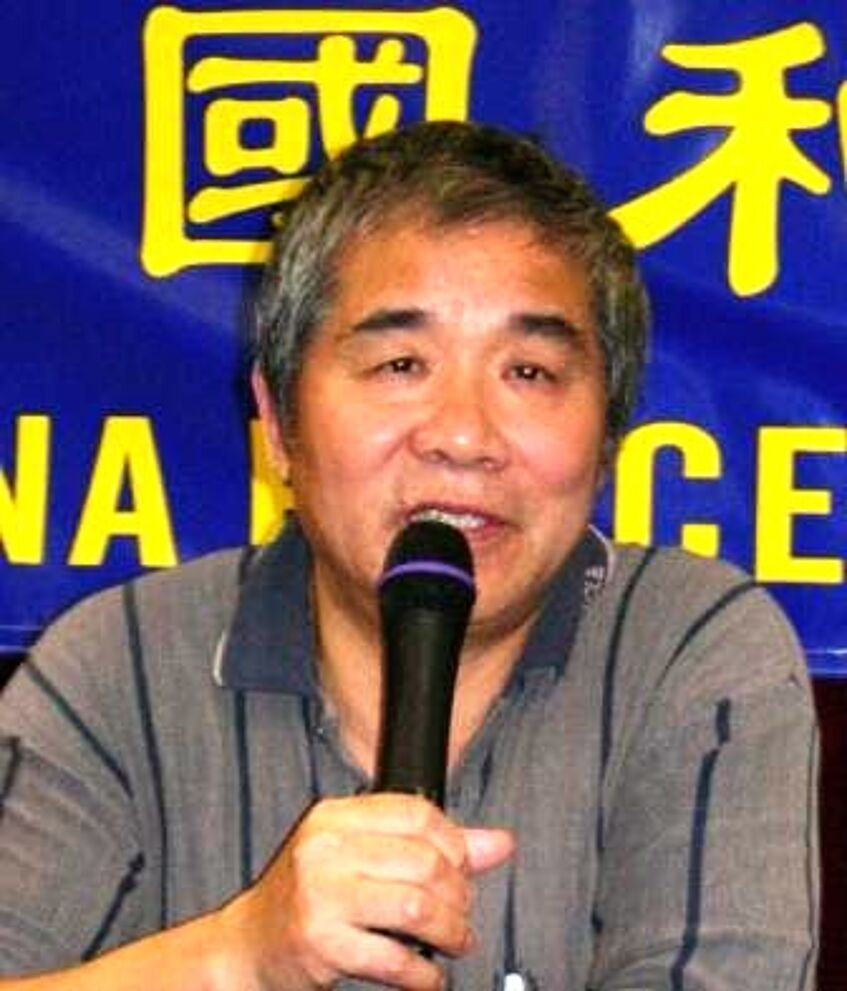
Xu Shuiliang

Xu Shuiliang (2014)

… was born in Fuyang (Zhejiang Province) in 1945. He suffered political persecution because of his opposition against Mao’s deputy Lin Biao, the “Gang of Four” and their allies in Zhejiang Province. In September 1975 he put up a longish dazibao (wall poster) in the center of Nanjing, criticizing privileges of cadres and attacking current political theories. He attacked Mao’s close allies Zhang Chunqiao and Yao Wenyuan by name, spoke of dictatorial bureaucrats and spoke out for democratization. Xu Shuiliang was condemned twice to prison sentences. He now lives in the United States.

Interview with Xu Shuiliang (on May 28, 2014 at the Asiatic Hotel in Flushing, New York)

Here you find the Chinese text of the interview.

Interviewer (Helmut Opletal): Please tell us what happened when you published your anti-Mao big-character posters before 1978.

Xu Shuiliang: Yes, we lived in China under communist control, practicing Marxism-Leninism during the Cultural Revolution. But as the Cultural Revolution progressed, we became increasingly skeptical of Marxism-Leninism and Mao Zedong Thought.

Interviewer: How did you start having doubts? Weren't you also a member of the Red Guards back then?

Xu: The Cultural Revolution threw everything into chaos, and many things were difficult to understand for us, like Mao's concept of ​​"one divides into two." I thought that if "one divides into two" was correct, then "uniting them again into one" should also exist. So why should "one divides into two" be correct, but "uniting them again into one" wrong? It was from such kind of theories that I began to doubt Mao Zedong Thought.

It started even earlier, in the 1960s. China's political system was extremely autocratic then. Rural Party secretaries were like local tyrants, far more autocratic than those during the Kuomintang era or any other time in Chinese history. I lived in the countryside, and during the Great Leap Forward, we were all starving and telling lies.

During the Great Leap Forward and the Great Famine, when I was in middle school, I became particularly skeptical of the whole system of the Chinese Communist Party. I prepared a petition criticizing the collectivization during the Great Leap Forward, but I didn't dare send it, and eventually burned it during the Cultural Revolution.

Later, during this Cultural Revolution, many questions arose for me. I read every book I could get my hands on, including the works of Marx and Lenin. Although what Marx tells in his books is wrong, they still included many other Western theories. I read the books of Marx, Hegel, Kant, and many more. After Lin Biao's downfall [in 1971,] I had come to the strong conclusion that China’s future lay in freedom and democracy, not total dictatorship.

But my story was very twisted. I was originally the initiator and leader of the “Red Uprising” [a Red Guard faction] at Zhejiang University, and a standing committee member of the university's Revolutionary Committee. But later, I was criticized and sent to Nanjing. There the Zhejiang Revolutionary Committee came three times to arrest me, wanting to take me back to Zhejiang and throw me in prison.

Originally I hadn’t been arrested in Zhejiang, just criticized, denounced, and put under investigation. Then, after being assigned to Nanjing, I read books day and night, studying theories, especially the one about the “continuing revolution,” trying to understand this issue. My conclusion was that Mao’s theory of the “continuing revolution” was all wrong.

During the movement in Zhejiang at that time, we were all opposing the Provincial Revolutionary Committee; we were against Lin Biao and Jiang Qing, and also opposing Mao. But our opposition was only in a nascent stage and couldn't be considered a movement for democracy. But the idea of ​​a pro-democracy movement took shape in my mind.

Interviewer: Were you able to discuss these ideas with others back then?

Xu: I only discussed them with one or two very close persons and not anyone else. I had a very good friend then, a classmate from Zhejiang University, named Li Longhua. With him I did discuss these ideas. But when my theories developed further, he couldn't keep up, and we wouldn't discuss them anymore, so I started thinking about all this on my own.

Interviewer: So where was your big-character poster "Against Privileges" written?

Xu: This was in Nanjing. I had been studying this issue ever since 1972. My initial conclusion was that the entire socialist camp was going to collapse. I told my friends in Hangzhou that the future direction was democracy, it had to be implemented, and our China would maybe be the first to achieve democracy. That was my optimistic assessment then.

Interviewer: Where did you get your understanding of democracy from, as books available in China generally didn't talk about it?

Xu: I did study that kind of books and theories. As I said before, I've read and analyzed the books of Marx, Hegel, and Kant, and many other works translated before and after the Cultural Revolution in China, and these studies reinforced my feelings that our direction was wrong. So my conclusion was that the entire socialist camp was wrong, and that it was going to collapse.

I also told a friend in Hangzhou named Zhou that the whole world would move towards democracy in the future; that the socialist camp was about to collapse, but from the collapse to the realization of democracy, China would probably be the first. Why the first? Because we had gone through the Cultural Revolution, and the massive corruption of the Communist Party had been exposed. This made people think about the future direction of China.

I now believe that China will undergo at least two major changes. There will be general opposition to the Communist Party, which would loosen the foundations of socialism. The Communist Party will be seen as something evil and anti-communist parties as something positive. And there will be a decisive battle. China has already experienced two such revolutions: the April Fifth Movement [of 1976] and the 1989 [Tian’anmen] Democracy Movement. A third is still needed, as the previous two were not enough.

Interviewer: But let me ask you again. The notion of democracy did not exist in China?

Xu: At that time, democracy was regarded as a bourgeois idea in China.

Interviewer: But most people didn't really know what democracy was, such as a multi-party systems or freedom of speech. They had no understanding of these concepts. What kind of democracy did you envision at the time?

Xu: For example, we were able to access books on American, German, or French history. We knew about the history of the French Revolution, we had books on British or Russian history. I could even read about ancient Greek and Roman history. There were thick volumes on Roman history or ancient Greek epics. Even though China was under an information blockade, news reports still mentioned elements of American democracy, such as the Senate and House of Representatives, or the British House of Lords and the House of Commons.

So, the concept of democracy, from ancient Greece to the present, formed in our minds through such a complex process. Why did we compare China and the United States? Because there were regular news reports, for example, when a vice president accepted a 400 dollars watch as a gift, that vice president had to resign, such kind of news that was very shocking to us.

Interviewer: Such news was rarely published in media like the People's Daily; only the “Cankao Xiaoxi” (Reference News) published them sometimes. Are you talking about these?

Xu: Yes, the “Reference News” was a main source of our information. I read them almost every day, studying it also between the lines. This way, I was even able to calculate the gap between our GDP and that of others. China's production figures were only a fraction of those of the US; they were four hundred times larger than in China. This was also true for the per capita income and salaries compared to those in America. The paper reported on this.

Interviewer: But how did you get your concept of democracy?

Xu: Democracy originated from where I said. The histories of the French Revolution, of Britain, the American War of Independence, and of the United States itself had been translated into Chinese. Ancient Greek and Roman histories have also been translated. Therefore, our concept of democracy originated from this, and also from news reports, including those in the “Reference News”.

Interviewer: What about Eastern Europe?

Xu: Yes. We did know quite a bit about the US, Britain, and France, because Chinese papers like the “Reference News,” regularly reported on them. That’s where we got our general understanding of their democratic systems from. But we didn’t know much about Eastern Europe because it was closed off, and there wasn’t much reporting on it. Overall, my general concept of democracy was formed through news reports and historical reading, and then greatly improved after going abroad.

The basic concept remains the same. China can block everything for the general populace, but when we want to read on history etc., we see that China cannot block everything. With enough effort, one can always obtain some understanding. But such people are a very small minority.

China's real democratic movement has started with my big-character poster, and later with Li Yizhe's "On Democracy and Legality und Socialism." The original title of my article was "Striving for Socialist Freedom and Democracy." The theoretical basis for this was still Marx's Paris Commune.

Interviewer: I've seen that you wrote big-character posters such as "Against Privileges" and "Combat Manifesto," and maybe some more later, but these two were the main ones from the earlier period. Do these texts still exist? Can they be viewed online?

Xu: I actually don’t have them. I took them with me when I left, but they were confiscated in China. The Jiangsu Party Committee had even printed 100,000 copies as a kind of criticism material, but they weren't distributed, unlike Li Yizhe's big-character poster, which was printed in four million copies and thus became known throughout the country. They only printed 100,000 copies of mine, but they were never circulated.

Interviewer: Do you still have these materials?

Xu: I don't remember if I have them somewhere. They should still be at my home in China. When I was freed first, the police handed me five copies. But when they arrested me a second time, they confiscated them again.

But when they criticized me, excerpts from my big-character posters were included in their pamphlet. Yin Hongbiao must have read them, but I don't have them here. As for texts like "Against Privileges," I wrote and revised them during the posting, so there is an online version of it, but it isn't as complete as the printed version, and some key sentences weren't in the printed text either.

When they published the materials, they censored some of my key sentences, including the one that named Zhang Chunqiao. But the sentences were on my big-character posters, so people in Jiangsu knew that I opposed Zhang Chunqiao, Yao Wenyuan, and the Gang of Four. But they omitted it from the printed materials. Nowadays I could get these only from the Public Security Bureau.

Interviewer: You don't have any photos of the big-character poster either?

Xu: No, I don't have photos, but the police has some. Besides, they tore my dazibao down that very first night; I had just put it up at noon.

Interviewer: You are talking about the one titled "Against Privileges”?

Xu: There were four big-character posters: "Against Privileges," "Combat Manifesto," "Questions and Answers on Theoretical Issues," and "Letter to the Editors of the Red Flag Magazine." I published "Against Privileges" relatively early, but had only partially completed it. The "Combat Manifesto" written in February, I posted on March 2, 1974. It was one of the earliest articles in China advocating democracy.

My basic view at the time was that China's problems didn’t lay in anything else, but in its system, in its hierarchy, its scheme of privileges, its autocracy and bureaucracy. After I left, a friend of mine in Hangzhou printed the whole text of "Against Privileges" and sent it to me via email. He didn't have the "Combat Manifesto." If I went could go to look for it, I might still find it, but it's been too long ago, so I would have to look it up in the police archives.

It was the Jiangsu Propaganda Department that printed my articles. The Nanjing Municipal Propaganda Department also had some, but I am not sure if they still keep them thirty or forty years later. Only the courts and the police would definitely have some in their archives. I gave the "Combat Manifesto" to many friends, but I think they were all lost long ago and only few might remain, also because of demolitions and forced evictions.

This material was also taken to Hong Kong and Guangzhou by Huang Yingshi. An Australian studying in Nanjing also took some with him. He was also the one who smuggled out a dazibao written by Nanjing residents who called for my release in 1978. But now, I don't know where it is.

I found some of my articles from 1979 in the book “Democratic China” published in Hong Kong, but those were not the early ones. I obtained this book in the United States, but parts of my articles are missing, and I can't recover them because I don't have the original manuscripts anymore.

Of Li Yizhe's big-character poster, Zhao Ziyang [then provincial Party leader] had four million copies printed and distributed in Guangzhou. Given the proximity to Hong Kong, the impact was substantial. In contrast, when I was in Nanjing, my posters were reported in Taiwan and Hong Kong, but my materials find a way outside China. The Provincial Party had printed 100,000 copies, but not circulated them. Only an extremely small portion reached the public through ten thousand copies of the "Excerpts from Xu Shuiliang's Reactionary Remarks."

Interviewer: Were these texts printed as “internal reference materials?”

Xu: My "Combat Manifesto" was published for “internal reference.” If you can find the Xinhua News Agency's Internal Reference Materials, the "Combat Manifesto" could still exist there. It was published between March and May 1974. I guess they didn't dare publish the full text, but rather excerpts. I didn't see it myself, but it was in early March when a Xinhua News Agency correspondent came to interview me after I had published the "Combat Manifesto." He asked me to talk about the circumstances to help him write a report for the Internal Reference Materials. He also took my mimeographed copy of the "Combat Manifesto."

I couldn't see the internal material myself, but I knew it had been published because Wu Dasheng, the secretary of Jiangsu Province, and Fang Min, the director of the Nanjing Revolutionary Committee, mentioned this in their speeches, saying that the Reference Materials had published it and they would criticize it shortly. That was in April 1974, so I knew they had already distributed it, and I saw it mentioned on many dazibao criticizing [radical politicians and generals] Xu Shiyou, Wu Dasheng, and Fang Min.

Interviewer: You didn't have any at home at the time?

Xu: [Sigh] They raided my home multiple times and took everything I owned. When I was released the first time, they gave me five copies of the four articles. But when I was detained again, they confiscated them all again, and I can't find them anymore.

I had a copy left at my hometown, but my brother-in-law used it as toilet paper. The police had dozens of my articles and letters in their files. I still had a copy at my home in China, but my brother-in-law tore out the first two pages of "Against Privileges."

Although it wasn't perfect yet, and I don't have the original text, there was a draft, the one my friend sent me. There was also a draft of "Questions and Answers on Theoretical Issues," which was quite different from the big-character poster that I had written, and he also sent it to me. But I can't find the "Combat Manifesto" anywhere.

You know, after the Cultural Revolution, I was one of the earliest to advocate for democracy. In Nanjing, there were two people named Yang Tiefu and Zheng Xing. After reading my articles they produced a small, printed pamphlet of four pages about democracy and the rule of law and the checks and control of power.

The "Combat Manifesto" presented a relatively systematic explanation, stating first that we were in a period of great change. I then argued that China's problems were not external factors, but the systems of privileges, bureaucracy, autocracy, and hierarchy, demanding a democratic system instead.

We hadn't completely departed from Marxism then, so I incorporated the democracy model of the Paris Commune. But it was very clear that we were advocating freedom and democracy, that we opposed privileges and bureaucracy, and we demanded the realization of democracy. Our theoretical model was elaborated quite systematically, four or five thousand characters in total.

When Yang Tiefu and Zheng Xing read my "Combat Manifesto" in Nanjing, they strongly agreed and took some action. Between May and June 1974, they went to a printing factory in Lianyungang to print a small, four-page pamphlet, explaining democracy and the rule of law in a socialist society. I believe Li Yizhe's dazibao "On Democracy and Legality under Socialism" drew on it, because this small pamphlet had three thousand copies printed. It discussed democracy and the rule of law, checks and balances of power, including the public security system, the procurators and judiciary.

Separation and checks and balances of power are the basic concepts of a democratic system. They mainly discussed these, criticizing [Maoist general] Xu Shiyou on one hand and debating this issue on the other. These three thousand copies were sold at the Nanjing Railway Station and on the streets, selling for five cents each, which just covered the costs. But thus they were circulated throughout the country. We were among the earliest members of the Democracy Movement after the Cultural Revolution, only then followed Li Yizhe's big-character poster in November 1974.

Later, the April Fifth Movement [of 1976] also took place in Nanjing. Of the large-scale movements, it was a quasi-democratic movement, not yet a fully democratic one. However, it raised the important point, that the autocracy of “Qin Shi Huang” [China’s first emperor, his name was used to depict Mao] was gone forever, and it demanded freedom and democracy.

Friends in Nanjing who participated in this movement included Qin Feng, Xu Tongxin, and others; they all said they were influenced by my big-character posters. So the April Fifth Movement was the first nationwide movement, and it had started in Nanjing. One participant was Wang Yunde, who also said, after being rehabilitated in 1979, they were all influenced by me.

Interviewer: After you were released, did you go to Beijing?

Xu: Yes, I did. My health was very poor then. Prisons were incredibly cruel at the time. I served three years and two months, from 1975 to 1979. I first went back to my hometown to recover. Then I participated in the democracy movements in Hangzhou and Shanghai.

Friends from Zhejiang invited me to visit them in Hangzhou. They were saying to me that my imprisonment was not in vain, because my views demanding democracy and opposing autocracy and privileges were now widely accepted, and that my time in prison wasn't completely wasted therefore. My friends in Hangzhou and other close friends all said the same thing.

I brought out two articles I had written in prison. The leaders at Zhejiang University at the time also tried their best to protect me. Tao Songrui, the secretary of the university’s Youth League, had been my classmate. He made his career inside the political system and later became the secretary of the Provincial Youth League Committee and the editor-in-chief of the “Oriental Youth” magazine. If he hadn’t been linked to my affair, he could have gone to Hong Kong. So he became the head of the domestic affairs department of the journal.

China has a television channel in Hong Kong, Phoenix TV, which was jointly run by the Central and Zhejiang Propaganda departments. Because of me, he also lost his position as head of the domestic department. He and Zhang Junsheng, a later deputy director of Xinhua News Agency in Hong Kong, behaved very left-wing. Because he had supported very vocally the [1989] June Fourth Movement, he had to use very left-wing slogans afterwards [to protect himself.]

But he was my friend. After I was released from prison, he took care of me; later he became the Dean of Zhejiang University. So the people who cared most of me were a former party secretary and a Vice Dean of Zhejiang University. When I was in prison, they sent my classmate, the Youth League Secretary, to Nanjing to help me, instructing him, "Don't come back unless Xu Shuiliang returns to Zhejiang University."

It’s typical for China that they place great importance on the formulation of a concept and naming of certain things, therefore I also paid special attention to this aspect. In 1979 the Chinese Democracy Movement didn't have a name yet; it was called the “dazibao movement” or “democracy walls,” and activists were called "dissidents” like in Eastern Europe and the Soviet Union. But for me, these names didn’t reflect the essence of our Chinese movement.

So I discussed with people in Nanjing what name we should give this movement. I was sort of their leader, so after my return, they all came to see me. Originally, the Zhejiang University Party Secretary wanted me to return to Zhejiang right away and called the director of the University Hospital to take me for an urgent medical checkup there. But those in Nanjing said, "We finally managed to rescue you from prison, and we wanted you to be our leader, so how can you just pack your bags going back to Zhejiang!" I couldn't really leave after that.

When I returned to Nanjing in 1979, I told everyone that the current designations didn’t reflect the essence of the movement we were undertaking in China, so we needed to choose a suitable name. I suggested "Chinese Democracy Movement."  Deng Xiaoping had spoken about a "democratic faction" or something similar, and my suggestion was similar.

One of my earliest articles in 1979 was about the circumstances of China's democratic movement. However, this article didn’t go public, but only circulated internally. I had given a copy to a foreign student at Nanjing University. He spoke of a "Democracy Movement," which was originally my suggestion. These texts do no longer exist; only my indictment mentioned that I wrote “reactionary articles” like "China’s Democracy Movement" and "The Four Principles of Revolution," which opposed Deng Xiaoping's Four Basic Principles. These “reactionary articles” were all confiscated.

Interviewer: But you have given them to this American exchange student?

Xu: Yes, in Chinese this foreign student at Nanjing University was called Mai Kangmian, in English Barrett McCormick. As for our movement, I used names like “Chinese Democracy Movement” or “Chinese Democrats,” or just "democrats."

Interviewer: Why were you arrested again in 1981?

Xu: I got arrested when they were cracking down on illegal publications. Back then, Xu Wenli ran a publication called “Study Newsletter”. They hadn’t cared about those so-called illegal publications from the past, and for a long time no one was arrested. But after 1981, they detained people who had continued to publish.

“Study Newsletter”, I think it was for issue 6, had asked me for a contribution. So I published my article along with a few others there. That was used as a pretext to arrest me and sentence me: “circulating illegal publications” and “engaging in counter-revolutionary propaganda and incitement.” I had one of my long articles in the Newsletter.

During the interrogation, they also asked me about my 1979 article “The Four Principles of Revolution,” which opposed Deng Xiaoping's Four Cardinal Principles. I said, there was no need to ask me this question, because I had written a 20,000-word article named “Criticizing the Four Cardinal Principles,” where I explained my views. They used it for making up the “crime” to sentence me.

It was also characteristic of the time that I was accused of "clamoring" for revolution in China. Most pro-democracy activists rather advocated “improvements”, but I argued that improvements wouldn’t work in China. My main point in the article and other writings was that the Soviet Union, depending on circumstances, might have pursued a path of reform, because it had always been led by intellectuals, while China had uneducated and uncultured leaders.

Furthermore, the Soviet Union enjoyed relative freedom of speech, while China had none. Therefore, I argued that while the Soviet Union might have pursued reform, China had absolutely no chance, also because China's leaders were extremely conservative and ignorant. So China's future path could only be revolution. This was my view at the time.

There existed several factions within the Democracy Movement. One was the reformists, who believed that reform could lead China to democracy. It was represented by figures like Wang Xizhe, Xu Wenli, and those around Wang Juntao of “Beijing Spring”.

However, my view differed from theirs; I believed China could not be reformed. Of course, we should strive for both reform and modernization, but ultimately, China's path to democracy had to involve revolution. This has always been my view, and was a crucial factor for sentencing me, and the indictment mentioned the "clamor for revolution in China."

So when I received my indictment, I told them they had made a mistake in suing me as a “counter-revolutionary.” They should be suing the prosecutor, because he wrote in his indictment that Xu Shuiliang “clamored for revolution in China.” But the words meant that I advocated revolution, not counter-revolution! The prosecutor would be the counter-revolutionary.

The prosecutor was stunned; the courtroom fell silent, and the judge immediately adjourned. They were completely untenable. They were suing me for counter-revolution, yet they wrote that I clamored for revolution; therefore, the defendant should be the prosecutor, not me, Xu Shuiliang. The courtroom was completely silent at the time, with only a few dozen people in the audience, all of whom were chosen by the judges and many of them were from the court itself.

I don't think I was part of the mainstream, but I did represent the future direction. There was also a group represented by Chen Erjin, who supported the “dictatorship of the proletariat” and Mao Zedong. Chen's article "On the Democratic Revolution of the Proletariat" was a left-wing endorsement of Mao. Then there was another group without much theoretical depth, but very radical views.

So there were three or four groups, one was left-leaning, influenced by the Cultural Revolution, represented by Chen Erjin; another group was the reformists, represented by Xu Wenli and Wang Xizhe; they formed the mainstream. And I was with Wei Jingsheng and his group, but I had a relatively clear concept, while Wei and his people didn't.

Interviewer: You have written that while you were in prison, Hu Yaobang and Yan Mingfu [another reformist leader] cared about you. How did this happen?

Xu:  In prison I wrote an article entitled "Criticizing the Four Cardinal Principles," which was about 20,000 words long. Criticizing these four principles has always been in my thoughts. When Deng Xiaoping proposed the "Four Cardinal Principles" in March 1979, I heard the news in Hangzhou and thought now it was all over.

China had been likely to move towards democracy, but Deng's "Four Cardinal Principles" [upholding the socialist road, the people's democratic dictatorship, the leadership of the Communist Party and Marxism–Leninism and Mao Zedong Thought] now blocked this path. Deng emphasized these four principles, and I resolutely opposed them. When they asked me about them during the interrogation, I told them that there was no need to ask me, because I had already written an article to explain my views, the article "Criticizing the Four Cardinal Principles."

Prisons didn't allow anything to be taken out. My wife had hidden my papers somewhere, but they even used X-rays and confiscated them all. I couldn't take my things out from prison either, so I kept them inside a cotton quilt. Later, when I was imprisoned in Zhenjiang, I managed to secretly give some to my wife to smuggle them out a few times.

When articles like "Criticizing the Four Principles" had been smuggled out, my wife copied and photocopied them every time, and sent them to [well-known Party dissidents] Xu Liangying, Fang Lizhi, and Yan Jiaqi. Through this channel, the article "Criticizing the Four Principles" acquired a considerable impact. Xu Liangying contacted his old friends in the Organization Department, including a deputy minister and [leading economist] Yu Guangyuan. They handed my materials to Hu Yaobang in 1982 and 1983. Hu told them that if Xu Shuiliang wasn’t sentenced yet – that's what Xu Liangying told my wife – he could release him with a single phone call to Nanjing. But if he had already been sentenced, then it would have to go through legal channels. Later, Hu Yaobang told them that he had made a phone call, but a sentence had already been handed down, so it had to go through legal channels.

After that, the prison wardens came to see me, saying, "Xu Shuiliang, your case is different from before; you will soon be released." They thought that since Hu Yaobang had called and given his approval, I would be liberated soon.

At that time, I was at the Zhuzhe Coal Mine, but they transferred me to the Jiangsu Prison No 2 in Zhenjiang, where I was kept in under strict surveillance and separated from other prisoners. I wasn't required to do any labor and could just read all day. So during that period, I studied a lot of books, and Xu Liangying sent me a number of Western books.

Later, Hong Peilin, the Deputy Governor of Jiangsu Province (and also Secretary of the Political and Legal Affairs Commission and head of the Provincial Public Security Department,) as well as Xu Jiatun, the provincial party secretary, kept a close watch on me and refused to let me go. In addition, there was a crackdown, which resulted in many arrests and executions, so my case was again delayed.

I initially thought that Hu Yaobang's approval would secure my release, but it didn't. Hu and the Organization Department sent another delegation to investigate why I hadn't been released. A dozen or so people came to Jiangsu to talk to me. They said they were from Beijing and wanted to check on my ideas. They were very assertive, saying my problem would eventually be resolved.

When they asked me if I had any wishes, and I told them I wanted to read more, they replied that this was no problem, and instructed the prison administration to subscribe to a newspaper for me. They also organized that I could go to the library, and they even took care that I got better meals.

Other inmates and staff at Jiangsu Prison No. 2 didn't understand what was going on; they thought Xu Shuiliang was a kind of vice-ministerial level cadre enjoying a vice-ministerial level treatment. But I wasn't, it was just that Hu Yaobang had sent people to investigate.

They had told me that they had also looked at other people, and many had changed their views. Then they asked if I had changed my views. But I responded that I hadn't, including my criticism of the Four Cardinal Principles. I insisted I was right, not wrong. It was then that they instructed the prison administration to improve my meals. I believe this had also to do with my article, in which I quoted Deng Xiaoping saying that Hu Yaobang didn't uphold the Four Cardinal Principles, as I was criticizing the principles like no one else did.

They still wouldn't release me, but that day the prison warden came up to me and said, "Xu Shuiliang, you'll be released soon." The hospital and the prison kitchen both passed the information to me, that I would be exonerated and released soon, and that they would take care of me.

But then I saw an article in Jiangsu's “Xinhua Daily” about Deng Xiaoping and Wang Zhen inspecting Nanjing, and Hong Peilin wrote an article saying that some counter-revolutionaries were criticizing the "Four Principles," and that some of our leaders didn't understand this and were even defending them.

I thought again, "Oh no, I'm not going to be released." A little over a month later, I received the ruling. Hong Peilin, the Vice Governor of Jiangsu, Secretary of the Political and Legal Affairs Commission, and head of the Jiangsu Public Security Bureau, had reported my criticism of the "Four Principles" to Deng Xiaoping and Wang Zhen. It became clear that there was a difference between Hu Yaobang and Deng Xiaoping and Wang Zhen, so I couldn't be released.

Later, a friend of mine, who studied in the Soviet Union and is now in Moscow, went to see his classmate Ruan Chongwu who had also studied in the Soviet Union. He was Minister of Public Security at the time. He was asked why Xu Shuiliang wasn't released and what the problems were. Ruan replied, "We originally wanted to release him, but it's impossible now. There are still over a hundred other people left, so we have to release them all together."

This was Ruan response to my friend, who remained a close friend of mine after my release. Then the prison again promised my release, but in 1987, another problem arose, when Hu Yaobang was dismissed. After Hu's downfall, I knew I wouldn't be liberated and there was nothing I could do.

In 1988, I wrote a letter suggesting that a large-scale conflict was imminent in China, and to avoid this, I appealed to the CCP Central Committee that Deng Xiaoping and Zhao Ziyang should retire, and Hu Yaobang take over the work of promoting national unity and reconciliation. He should also rehabilitate those who had opposed the "Four Principles" and advocated liberalization.

When I got this letter out of the prison, my wife made copies and sent them to [well-known liberals] Xu Liangying, Fang Lizhi, and Yan Jiaqi. Xu and Fang then issued open letters and appeals, and Xu's also explained my situation in his appeal.

My materials, put together by Xu Liangying and some alumni of Zhejiang University and people from the Chinese Academy of Sciences, were sent to Yan Mingfu [then Secretary of the Central Committee and Minister of the United Front Work Department]. I was assured that the materials would be delivered to the highest leader. That was in 1989.

I think that Yan Mingfu sent them to Zhao Ziyang who held an opinion different from Hu Yaobang’s though. When I learned that Yan Mingfu had sent my letter to the top leader, I started paying attention to the newspapers. Zhao Ziyang was quoted there that some counter-revolutionaries were sowing discord among the central leadership, and things like that.

Upon seeing this, I immediately knew it referred to my demand for their retirement and the reinstatement of Hu Yaobang's authority. Zhao's stance differed from Deng Xiaoping's. Wang Zhen, Deng Xiaoping, and Hong Peilin explicitly called me a counter-revolutionary. Zhao Ziyang also called me a counter-revolutionary, but with different wording.

In 1989, Yan Mingfu stepped down, but he retained the position of Minister of the United Front Work. But in June, at the Central Committee Plenum, Yan Mingfu was also removed from his post as Secretary of the Central Committee, and in 1990, he lost his positions as Minister of the United Front Work Department and Vice Chairman of the Consultative Conference [… …].

At this point, he knew I couldn't be released, so he drafted a document, in the name of the United Front Work Department, and submitted my texts to the Jiangsu Party Committee. The Provincial Higher People's Court then sent two judges to the prison, saying, "Your texts were approved by the United Front Work Department." They asked me how I had submitted the materials, but I didn't know. Because it was during the 1989 crackdown on the pro-democracy movement, […] they couldn't solve the problem. In the end, nothing happened. […]

Interviewer: Looking back now at the Democracy Movement, do you think it was a failure?

Xu: Yes, but we haven't lost yet. I think the pro-democracy movement as a whole will triumph. My entire life has been one of hardship, and I'm still struggling to survive, but I have no regrets because I knew from the beginning I would face immense pressure and huge sacrifices.

Erlier, during the Cultural Revolution, I was threatened by a death sentence. If the Gang of Four had fallen only a little later, I might have lost my head. In prison, I was put in shackles. Why? Because I had spoken negatively of Mao. They immediately handcuffed me.

I had said that Mao had no theoretical understanding, that he pretended to understand, but actually didn't; and that I had analyzed his theories, but my own theories surpassed his by far. This was an act of treason at the time, punishable by death. If the Gang of Four had fallen a little later, I might have been shot. So my life has been difficult, but fortunate in the end, because many people have died, but I wasn't executed.

Interviewer: Would you think today it was worth paying this price?

Xu: I have paid this price, not just any price; I paid with a lifetime of freedom and happiness. But I believe it was worth it, because it was a major development for the Chinese nation and for the whole world. We have indeed suffered repeated defeats, but one victory is enough. The Chinese Democracy Movement was an achievement for the entire nation, for everyone, not just a student movement.

Although the student movement failed, the Democracy Movement as a whole did not fail. Our thoughts and theories are shared by ordinary people today. Think about it, before 1979, no one would have said that democracy would be our future, but now, even in the remotest mountain villages in China, what is the greatest demand? It is democracy which has become a desire of the entire nation.

So, in this theory, we have not failed; on the contrary, we have won. We have disapproved of Marxism. I have systematically criticized Marxism, from philosophy to practice. We have won, and the vast majority of the Chinese people are also seeing this.

Where did we fail? We had no guns, no political power, and no organization. In addition, the communists have sent out a large numbers of spies, destroying all our possibilities of organization. I hold great faith in the power of organization, but there is nothing I could do.

I tried again and again to organize a team, but the Communist Party would immediately send agents to sabotage it. We are facing immense difficulties; we have no funding and no manpower. The majority of our personnel are people they have sent in.

I have made a survey of 270 pro-democracy activists. Excluding those whose identities were uncertain, out of the remaining 220, only 53 were almost certainly on our side and not members of the Party or communist informants. The rest – 75 percent – were almost certainly CCP informants. They were fake ex-prisoners sent in by the Communist Party. Others were ex-prisoners forced into becoming informants, pressured to carry out the CCP's orders within the Democracy Movement.

Information from within the Party suggests that they are not afraid of the Democracy Movement. In an internal speech, Hu Jintao has stated that they controlled 80 percent of the few hundred pro-democracy activists who have emigrated. This means 80 percent are party members, and they control part of our movement. And there are some who are not party members but willing to listen to the informants.

Also, the funding that comes from the US, from Taiwan, and the West in general, over 80 to 90 percent of it is intercepted by the Chinese communists, as far as I know. We only have a few dozen people, and the CCP’s combined mobilized strength is no match for ours.

But I can say that in human history, it is rare that the people of a country resent their own government so deeply. It is on this point, morally and theoretically, that we have not failed; on the contrary, we have triumphed.