
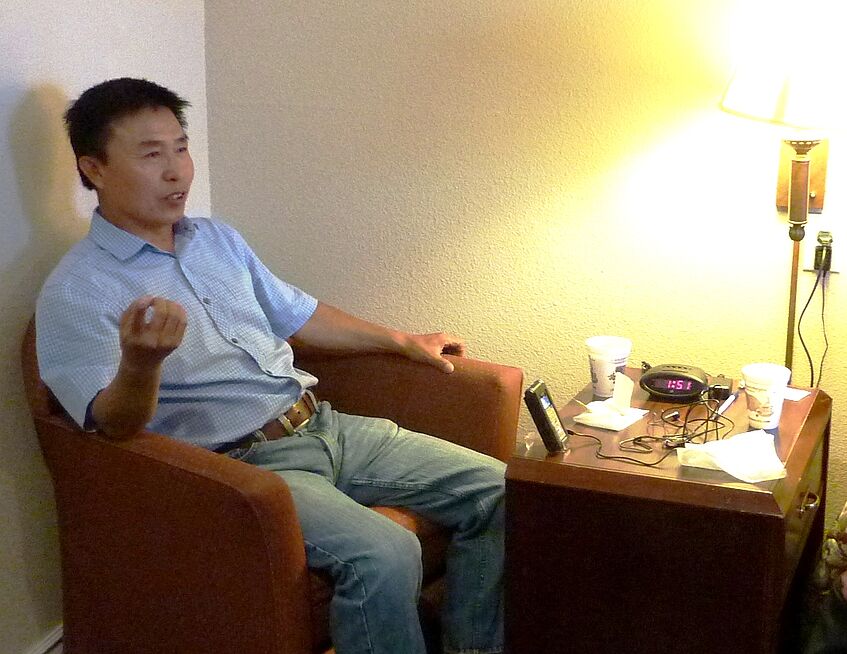
Lü Honglai

Lü Honglai (2014)
Lü Honglai
... was born in 1953, in 1979 he became a leading activist of the Democracy Wall Movement in Tianjin. He was a leading editor of the journals "Bohai Shores" ("Bohai zhi Bin") and "Sketches and Notes" ("Bitan"). Because of his political activities he was arrested four times and sent to labor re-education. In 2008 he went into exile to the United States. He now lives near San Francisco, California.
For many years Lü Honglai has been in conflict with Xu Wenli who accuses him of improper behavior, and there are also differences on political strategies. The conflict is dating back to the time when they were both still in China, and activists from various parts of the country founded the "China Democracy Party".
Interview with Lü Honglai (on June 12, 2014, in a hotel in Berkley, California)
Here you find the Chinese text of the interview.
Lü Honglai: I'm from Tianjin. My parents came from ordinary families. My father was a worker. My childhood was actually quite stable, at least before the Cultural Revolution, when I was in school. There was a “Four Cleanups” campaign [after 1962, “cleaning up” politics, economy, organizations, and ideology in rural China.] During this campaign, our home was raided, and in 1964, our family was classified as “landlords on the run,” and we were persecuted.
I was quite young then, born in 1953, I was only eleven or twelve years old. But I already suffered together with my family and faced discrimination as the son of a “landlord on the run.”
I finished middle school in 1971, in the midst of the Cultural Revolution. But when I started working, I didn't give up learning. By chance, I came across the books of Marx and Engels. There weren't many other books in China then, only those of Marx and Engels and some on the Communist Party of the Soviet Union (Bolsheviks). And there were Soviet books on scientific socialism, historical materialism, and political economy. I read quite many of them.
My salary was low, only about forty Yuan a month. I spent almost all of it for buying books from street vendors. Bookstores in China didn't have any new books then, only some old ones which I bought and read.
They gave me the impression that China, during the Cultural Revolution, had taken a different path than what was described in those books, not to mention the comparison with today's democratic societies. It was different from what Marx had said, and different from the principles of the Communist Party of the Soviet Union (Bolsheviks). That's when my doubts began to arise.
By 1976, China was at its most chaotic, with the April Fifth Movement and Old Mao's death. At that time, my confidence in the country began to waver. My brother and I said that if the country continued to descend into chaos, we would have to do something or die. That’s how we thought in 1976.
Before joining the Democracy Movement, I had read many books and gained a certain understanding and analysis of our society. So I didn't blindly throw myself into it. I had my own opinions.
Interviewer (Helmut Opletal): Were you still in Tianjin at that time?
Lü: Yes. There was a factory in Tianjin called the CRT Factory. I worked there, producing CRTs (cathode ray tubes) for TV sets. It was a large industrial unit in Tianjin, a state-owned enterprise.
I already developed some ideas then. I was reading books, and after 1976, I started writing articles myself and sending them out, for example to a journal in Beijing called “Philosophical Research”, to the “Guangming Daily” or the “Research in Political Economy” run by [famous economist] Yu Guangyuan and his colleagues. None of the articles got published, but they passed my texts on to the “Tianjin Science” magazine of the Science and Technology Commission in Tianjin. That was my situation before 1978 when I already had many ideas.
In the winter of ‘78, the “Xidan Democracy Wall” started in Beijing, and its influence spread to Tianjin. In front of our Municipal Party Committee, people started putting up big-character posters and distributing pro-democracy publications.
On my way to and from work I passed there every day, so I decided to stop and have a look. I agreed with their standpoints, so I kept stopping on my way to look at the dazibaos. All China, I thought, should be like this, with people standing up, speaking out, and pointing out how the country should move forward.
There were many young people, including some “petitioners” who had gone to Beijing after the Cultural Revolution, people who had been wrongly accused of crimes and convicted. Some petitioners also gathered in front of Tianjin’s Party Committee, eventually starting a Democracy Wall in our city, and I also got involved. I think you already translated Wang Xizhe's big-character posters and Li Yizhe's big-character posters into Austrian [German] by then [it was published in Berlin in 1977.] But we still had to copy this dazibao by hand at that time.
Interviewer: Was that in ‘78 or ‘79?
Lü: Yes, around that time, we posted Li Yizhe’s text on the Democracy Wall in Tianjin, because their big-character poster was quite influential at that time. Some principles and views expressed by “Li Yizhe” were really appreciated in certain cliques. That’s why we posted their texts on the Democracy Wall.
At that beginning, our clique in Tianjin consisted mainly of children of high-ranking cadres, and people who had been victims of the Cultural Revolution or who were persecuted during the “April 5th Movement" [of 1976.] It was this kind of activists who created the Democracy Wall in Tianjin.
A small number Tianjin residents had also taken part in the “April 5th Movement” in Beijing. Some were later discriminated because of their participation, or even got arrested and sentenced. This included a group around Li Zhanyuan from the Tianjin station. That's how I got initially involved in the movement.
When I continued in the Chinese Democracy Movement between 1979 and 1980, the authorities still took it very seriously, and the pressure was immense. Children of high-ranking officials received warnings from their superiors. Their parents were asked to speak to them, and through their parents' intervention, they gradually withdrew.
At that time, I met Liu Shixian, whom you also got to know. And there was an elderly man in Tianjin named Tang Gedan, a veteran Communist who had joined the Party in 1928. Because he had always said things that the government didn't want to hear, he was badly treated after the CCP had taken power.
About twenty of us officially started an independent publication in Tianjin called “Bohai Shores”. That connected us with similar journals all over China, like Xu Wenli’s “April 5th Forum” in Beijing, “Exploration” and some from Shanghai and other places. That’s how we became part of a nation-wide movement of independent publication. Tianjin just formed one part of it.
Just after the Cultural Revolution in the late 70s and early 80s, most people didn’t understand or analyze Chinese politics yet from a perspective of modern Western democracy. They were still using Marxist theory which was the prevailing political thinking of the time.
This wasn't “scientific socialism”. But what is true “scientific socialism”? Even Li Yizhe's big-character posters posed this question. They argued that the communist system implemented by the Party was an error, and China should transition to a capitalist society. This was the prevailing view at the time. To achieve such transition, China had to adopt a market economy. Politically, democracy and freedom should be introduced. However, these ideas were not as profound yet as the understanding we have nowadays.
Interviewer: So, were you familiar with the concepts of democracy, human rights, and freedom?
Lü: Yes, we agreed to these ideas and learned about their concepts and terms. But on what kind of mindset this required, or how to transform from a submissive citizen into a true citizen, we just had some very superficial understanding at that time.
We, who joined the movement back then, were all products of the Cultural Revolution, educated in the Communist Party's system. What we had learned was essentially limited to that. We hadn't even studied Marxism; we were more or less following Mao Zedong's approach, using his language. We did propose freedom, democracy, and human rights then, but how to realize them, and on which foundations, our understanding was far from what it is today.
Interviewer: How did you evaluate Mao and the Communist Party at that time? I'm not talking about now, but back then.
Lü: We saw it as a stage of transition from feudal society to capitalism. Mao Zedong led a peasant movement, and he was actually a peasant leader, an emperor without the title of emperor. We had already realized this.
Interviewer: You were really aware of this? And did you discuss it like that among each other?
Lü: Yes, we all had a similar understanding. That he was like an emperor who hadn’t become an emperor, but as the Chairman of the Communist Party, he was essentially acting like an emperor.
Interviewer: But you wouldn't dare write something like this in your publications, would you?
Lü: In the independent journals, we would just indirectly mention these things. The underlying message was strictly one of enlightenment to awaken the public, to make them understand the current stage of the development of our society, and to make suggestions to those in power.
Initially, political leaders supported independent publications and the Democracy Wall. The Cultural Revolution had just ended, and the politicians didn't suppress independent publications in the same way as they do now, labeling them as reactionary. Even when we were dealing with the police back then, they only issued warnings, sometimes they detained people, but there were no specific condemnations from above. Liu Qing was formally arrested, and Wei Jingsheng was also arrested, but not too many people got arrested at the beginning. I was detained once in 1980, just for ten days. The formal condemnation of our activities only came with the Central Committee's Document No. 9 [in April 1981.]
Interviewer: You mentioned that in the early days, in ‘78 or ‘79, you had dozens of people in Tianjin discussing together. Were there any differing opinions or heated debates? And about what?
Lü: Yes, there were debates. People came from different professions, backgrounds, and levels of education, so their understanding of these issues naturally differed. Discussing political theories, people like Tang Gedang, the old man I mentioned who had studied market economics, were quite ahead of the time. But our work was mainly practical, publishing periodicals, putting up dazibaos, and talking to people in the streets.
We sometimes published articles, but back then, there were not many places in China to publish them, only in our independent publications. But sometimes before we could distribute them, the police would already arrive.
Looking back, the actual impact of independent publications on the Chinese public and society wasn't all that widespread during that period. But through foreign broadcasts and our presence in the streets, people became aware that there was an opposition force in China, that independent publications existed who made different voices being heard. This was the role they played, but it didn’t go deeper, because this was beyond our limits of what we could do, under the pressure and control of the Communist Party.
Interviewer: In Tianjin at that time, were there any cadres or leaders who supported you, besides the old gentleman you just mentioned?
Lü: In the general public, we did encounter an attitude of sympathy and understanding. Look at how many people stood up for us. University professors, teachers, students all joined us. But there wasn’t any leading cadre how had publicly expressed support for us. But many sympathized and understood, including police officers handling our cases at the time who were also sympathetic.
They had to carry out the instructions from above, to search for us, give warnings, or detain us. They were performing their duties. But as individuals, many police officers had experienced the Cultural Revolution. Cadres had been sacked and persecuted and only later released. We had the impression that they were actually quite sympathetic and understanding towards us.
I also explained this to the police officers who arrested me, and they said they understood. But they insisted that they were state employees now, who had to carry out instructions, no matter what we said. They were paid by the state, so they had to serve the country. That was their mindset. But privately, they acted differently. For example, because I was in my twenties at the time, after my arrest, they even went to my father telling him that they admired me, saying I was a good kid. On the surface, they had to arrest me, but behind their back they acted differently.
I was just a factory worker at the time of my arrest. This happened in 1980. When I was arrested, they immediately went to the factory and told them that shouldn’t be a simple worker, but rather a cadre. When I was later released and returned to the factory, I was actually made a cadre.
So on the surface, they were carrying out the orders from their superiors, but deep down, they still had the experiences of the Cultural Revolution in mind, and they knew what had happened in China before. They also felt that our ideas were right. Even today, these people are very clear about the path China should take. They admired us, and they wanted to provide us with as good conditions as they could. That's how it was, how people thought.
Ordinary people felt the same way. At first, they didn't understand either, saying, "You're just workers, not national leaders or intellectuals. What's the use of all this? Just focus on your job." That was a common mentality, just focus on our own lives, why worry about all these things? Even at my work, people thought the same way.
But what really impressed me was how they completely changed their attitude after the 1989 Tian’anmen Square crackdown. Now they said, "You did the right thing! We never thought the Communist Party could be like this, using machine guns and tanks to suppress the student movement." This is how an event can change people. At first, they might not understand, but as time goes on, a particular event may shock and transform people's thinking.
Between ‘79 and ‘81, our impact on society was not all that deep and significant. But from contacts and conversations, it was clear that people were very conscious that our society had to develop in this direction and that we did the right thing. But people couldn't articulate this at the time, and a majority thought that we had no chance under the Communist Party's autocracy.
Interviewer: In 1981, when activists were arrested all over China, what happened to you?
Lü: Back then in Tianjin, it was mainly three so-called key members who got arrested: myself, Liu Shixian, and Tang Gedan, whom I mentioned earlier. Liu Shixian and I were both sentenced to three years of re-education through labor, while Tang Gedan was sentenced to four years in prison.
Interviewer: Hadn’t he already gotten old?
Lü: Yes, but they didn't even let the old ones off the hook. When the Communist Party comes to act, they always try to find a ringleader, to assign someone as the main instigator, even if there isn't one, they'll still designate one. Then they may report to their superiors how well they've done, how big a case they've solved. That's their way of reasoning when they handle a case.
In reality, Tang Gedan had only written a few articles, and he didn't participate in any activities. However, they considered him influential because of his seniority and connections with other parts of China. Furthermore, as a veteran communist who had consistently opposed the Party, he was labeled a “historical counter-revolutionary.” That's how they treated him, branding him a counter-revolutionary and believing he had always been one.
Liu Shixian and I were younger at that time. They thought that as junior members, although key figures, we could still be educated. Our doings were still considered an “internal contradiction among the people,” and we were not labeled “enemies.” They always acted according to this mindset. Therefore, we were arrested as “key figures” in Tianjin. Nationwide, dozens of people were detained in April 1981. In Beijing they started arresting Xu Wenli and his group on April 9th. We were arrested a day later, on April 10th, but all in the framework of a concerted action.
Interviewer: And once sentenced, no one was released quickly again?
Lü: Not many. Some were released a month or two before their prison term expired, followed by re-education. Liu Shixian had escaped from prison, which aggravated his things. I heard he wasn't released even a day earlier.
Interviewer: After you got out, did you continue to engage in political activities?
Lü: When I was released in 1984, I got married and started engaging in economy, running a small business, or taking odd jobs sometimes. But I was always keeping an eye on what was happening. I even went to Beijing with Liu Shixian. Most people we knew there were still in prison. We were all in one group, as you know, it's just that we got out first, while others, like Xu Wenli and Wei Jingsheng, were still behind bars. Sometime in the early 80s, Liu Qing got out. He was released early because he had been arrested early.
After my arrest in 1981, I only took part in activities again around 1989. Before, I was doing some business for my living, reading books, and meeting people until around 1989. After the student movement broke out in 1989, we all paid very close attention to it and went straight to Beijing contacting with friends who were all following the movement.
Tianjin also saw its own 1989 movement when students and some officials took to the streets. But we were only observing from the outside at that time because the students didn't want us to participate. But when the movement was suppressed, most of our friends manifested themselves.
In 1993, we started to organize again with friends from all over the country. One way for us was to travel around China to meet with these friends. You might call it networking. During my research for a doctoral thesis in 1993, I traveled all over southeastern China, meeting [Wang] Xizhe and others in Guangzhou, going also to Hangzhou, Anyang, Henan and Wuhan, covering the whole region.
Friends in Beijing proposed to establish an “economic entity” for us. [Wang] Xizhe was in the forefront of the idea that united pro-democracy activists. Xizhe was in contact with a certain Kang Yuan from the US. That was the activity in southern China. In Beijing, [Liu] Shixian, Yang Jing, Liu Nianchun [Liu Qing's brother], and I also planned something together, trying to coordinate efforts between the north and the south.
We organized a trip to Qingdao for democracy activists from across China, but this attracted serious attention from the authorities. They wouldn't allow democracy activists from all over the country to gather again. They summoned us all for separate talks, including Liu Shixian, strictly warning us not go to Qingdao. They said, "How many of you are planning to travel to Qingdao? If you send a few dozen, we'll send hundreds."
We still set a date – I forgot exactly which one – for our trip to Qingdao. When the day approached, they detained me and Liu Shixian as “ringleaders,” because the idea had started from Tianjin and I was the initiator and main contact. They locked us up in a hotel, and there were five or six people prohibiting us from going outside. I heard that some friends who went to Qingdao were also arrested.
So the Qingdao trip didn't materialize and neither did Wang Xizhe’s plan. The authorities definitely wouldn't allow it, and they wouldn't allow pro-democracy political activists to establish an economic foundation.
When our plan had failed, Qin Yongmin from Wuhan came to Tianjin. That happened at the time, when China was bidding for the Olympics. Qin Yongmin was the first to publicly express opposition. I had invited him to stay at my place, and we agreed that this would also serve as his contact address. Then he left for Beijing.
All his communication arrived at my place then. But when these things became more and more, there was no way to hide it and escape official surveillance. So they eventually came to my home. Back then, I lived in an apartment building, and there was police personnel all around. Some neighbors told me that they were embarrassed by that, saying that they had also been asked to monitor me, but they just turned a blind eye on us. Some told us, and others didn't, so in the end all our moves were monitored, and the police knew perfectly well what we were doing.
Then in 1993, everything piled up again, including Liu Shixian's flight to Hong Kong around June 1993. It was then that the Tianjin police started closely watching me again. After about a month, I thought I might do like Liu and also run away. One day, when they weren't looking, I left through the balcony. They had only observed the front of our building, so I could leave through the balcony and go straight to Hong Kong. When I arrived there, I had nothing with me, and they said, "You don't have anything..."
Interviewer: But how did you manage to get to Hong Kong?
Lü: A place to cross into Hong Kong was near Shenzhen, called Shatoujiao [Sha Tau Kok, a village divided between the British and the Chinese side, off limits to outsiders, while local residents could move freely.] I wasn’t allowed to enter the Shenzhen economic zone without proper papers, so I had to find a local smuggler. Chinese smugglers were quite efficient. They just took me to Shenzhen by motorcycle for a small fee. I spent the night there and went to Sha Tau Kok the next day.
I had to go through a smuggler again who procured a pass for me to enter this place. The village itself was divided by the Chung Ying Street, the “Chinese-English Street.” I saw a few British guarding their side, probably police. I wandered around this Chung Ying Street. Because I was from the north, I was afraid of being detected by the police, so I had changed into a colorful shirt like the locals. I didn’t want to look like an outsider. When I arrived at the passageway to Hong Kong, I just tried to cross as inconspicuously as possible. I didn't bring any luggage, just a phone and some money, and they didn't stop me. I just went through like that.
After having passed into the British side, I looked for a phone booth to contact my friends in Hong Kong. But I couldn’t get through, or maybe I didn't know how to use it properly.
I didn't understand much about the situation in Sha Tau Kok. When I saw a bus arriving, I just stepped on. After only a kilometer or two, it stopped at a checkpoint. At this first one, the police only nodded their heads and didn't check anyone, so I passed through. But at a second checkpoint, they examined everyone's ID cards. As I didn't have one, I was arrested by the Hong Kong police.
They brought mo to something like a detention center near Sha Tau Kok and kept me in Hong Kong for about ten days. When they couldn't verify my identity, I was eventually deported back to mainland China where I was sent to a Chinese detention center in Zhangmutou near Shenzhen. There they kept me for a month when, finally, people from the Tianjin Public Security Bureau came to escort me back, where I was sentenced to three more years of re-education through labor.
Besides my first arrest and re-education experience, this was my second. I was released in 1996, but I didn’t have my job any more. Tang Gedan had died meanwhile because of old age, and Liu Shixian had fled abroad. And most of my other good friends had disappeared under high pressure.
When I went to Beijing that time, Fu Shenqi in Shanghai and Xu Wenli in Beijing had also been released. Xu Wenli was freed around the same time as me. That was when another small surge in the pro-democracy movement occurred, and people began to plan new activities. The earliest one was a "Human Rights Watch," led by Qin Yongmin. He wanted people all over the country to become his observers.
Interviewer: “Human Rights Watch”?
Lü: Yes, Qin Yongmin had organized it from Wuhan. Activists in other parts of the country made plans for a “Political Opposition Movement.” It was when Bill Clinton was about to visit China. Xu Wenli became nominated by the activists as the representative of the Chinese political opposition, who was to meet with Clinton. That period between ‘96 and ‘98 was another small peak for our movement.
In the latter half of 1998, a nationwide campaign to create political parties began, culminating in the formation of the “Democracy Party”. Before that, the “Political Opposition Movement” had been the highlight. But for the first time after the Xidan Wall Movement, people dared to come out.
It was a transitional phase when Deng Xiaoping had stepped down, and Jiang Zemin just came to power. That's how things work in China. Whenever there's a change of power or leadership, there's a period of relative political relaxation. A pro-democracy movement or a political opposition movement may develop and see a bigger or smaller upsurge during such a period of change or relative relaxation.
This was the case also in 1981, when the Gang of Four had fallen and Deng Xiaoping took over the leadership, followed by a period of relative opening up. In 1986, when Hu Yaobang came to power, there was also a sense of liberalization, and then another wave in 1989. Around 1998, we went through a kind of transition again, and we saw the formation of an opposition movement and of political parties, first in regions like Zhejiang.
At that time, I must say, I didn't quite agree with forming a political party. I thought that conditions weren't ripe yet. Without control of the public opinion, without even one newspaper or magazine, a few people cannot create a political party by just working together. They cannot reach out to the masses and make much social impact. It means simply elevating a pro-democracy movement or a political opposition into a political party. Therefore we thought that founding a party came too early and it was not the right time yet.
Our understanding was largely aligned with Xu Wenli's then. Xu had also expressed his disagreement with forming a party. Initially, none of us publicly joined the party movement, but we were still actively preparing for the founding of a democratic political party.
We started a journal that we called “Sketches and Notes”. I founded it, and it was funded by Xu Wenli. We worked together, but it seemed inconvenient to run it in Beijing. Xu Wenli knew that I was still studying and that I was good at writing. I was charged with organizing “Sketches and Notes”. After collecting the manuscripts, I took them to Langfang, a town close to Beijing.
That place had looser regulations and private printing plants that were more focused on economic profits. I found a private company to print several hundred copies of each issue. After printing, we took them back to Beijing and delivered them nationwide as an internal publication for theoretical exchange among pro-democracy activists. It was also intended to build a consensus among friends who prepared for the formation of a political party. That was the purpose why we started this publication and continued to work on it.
By the latter half of 1998, the movement to form political parties saw some success across the country, mainly within our group, but not in the society as a whole. Our people in various regions, even as individuals or groups of two, started to establish party branches. In reality, they lacked any real basis or influence, but they sensed that the political climate had become more relaxed. When a party was founded in Zhejiang, for example, the communist leadership did not suppress it or arrest anyone. Only later, Wang Youcai was arrested, but released again after some protests.
This created the misconception that the Communist Party tacitly approved of the formation of other political parties. People in perhaps a dozen Chinese provinces applied to establish a “Democracy Party”, although depending on the region, they only called it a “preparatory group” or “preparatory committee.”
On the surface, from the Communist Party's perspective, it simply meant that preparatory committees for a Democracy Party had been established in over a dozen provinces. But external reports, such as those from the Voice of America or Radio France Internationale (RFI), informed that a new party had been founded in various places in China.
In reality, the general public, including academic and intellectual circles, remained completely unaware of this. In China there was a complete news blackout. Therefore, the founding a party was merely a declaration to the CCP authorities, meaning that the opposition was demanding the formation of parties, challenging the one-party dictatorship. It only served that purpose.
The impact was negligible because there was no influence, no public support, nothing, no social foundation. But this situation had already developed its own dynamic. Because of my many years of participating in political movements, I understood this quite well, and I knew it wouldn't succeed.
My friends in Beijing agreed with me that we shouldn't publicly participate in this affair, but pay attention, especially to Xu Wenli who was the symbolic leader at that time, among his friends in China, and also in the eyes of the Communist Party.
In China, Wei Jingsheng was also released. He had considerable influence around 1978 and became also internationally known, but in our circles, he was considered too radical. Most of us thought at that time, that it was better to reach some kind of compromise with the Communist Party and refrain from putting forward radical slogans. Such slogans were easy to shout but useless if not followed by acts. So, in our group, we thought that Wei Jingsheng wasn't very mature. But his influence was there, and he was still a representative figure.
But when he was released, we had higher hopes for Xu Wenli. He had acted more steadily and had shown better organizational skills during the Democracy Wall Movement of 1978. So we all supported Xu Wenli and regarded him as a leading figure in the opposition movement in China now.
I told Xu Wenli directly, "Everyone is watching you, the Party is watching you, and your friends are watching you. If you don't start any action now, the Communist Party will also be blocked. Doing nothing now will be more effective than starting any action." He also thought so, that there wasn’t the time yet to openly form a party, that it was not yet mature.
Interviewer: But in the end, he still did it?
Lü: So what was his motive? Later analysis revealed that one reason why he took this step was that he had somehow disconnected from Beijing's intellectual circles, from Xu Liangying and others, the university intellectuals who had participated in the 1989 Tian’anmen Square protests. He was out of touch with them.
At that time, his circle of friends included Zha Jianguo, who was a newcomer. There was also Gao Hongming, another newcomer. And there was Liu Shizun from Liaoning, a student representative who had also emerged during the 1989 Tian’anmen Square protests. Another one was Zhang Hui. These were the few people around him.
His other friends weren't around then. When the idea of forming political parties was being proposed across the country, Xu Wenli thought that he should be the leader. In fact, he already was the leader, but perhaps he lacked some confidence, so he said that he would convene the First National Congress of the China Democracy Party.
He established a preparatory group, including Zha Jianguo and his people. So he was the leader, preparing for the First National Congress of the China Democracy Party. Once in Beijing, I told him it was too early to hold a “first congress,” everyone would be arrested, as the conditions weren't right yet. But he said, no, it's only preparation. The congress won't be held for another two or three or even four years.
His preparations were met with resistance. Friends from other provinces and cities were against it, especially those from Zhejiang, who had strong opinions. They told him, “You're not a member of the Democracy Party,” as Xu Wenli hadn't formed this party, “what entitles you have to prepare for a First National Congress? You are not in position to do so.” This logic was actually sound. He was not a member, so he couldn’t call for the First National Congress of the Democracy Party. This put Xu Wenli in a very awkward position, bat making it also difficult for him to back down.
I was thinking myself, Xu Wenli, don't try to be the first to step forward. If the China Democracy Party is ever established, everyone will nominate you as its chairman, so don’t try to grab the title yourself. You are qualified, and you have the prestige and the influence. When that day comes, your friends will actively propose you, and it would be ok.
Looking back, Xu Wenli probably didn't think that way. He thought, "Friends all over the country are against my preparations, and they doubt my qualifications." He also meant Ren Wanding who was organizing another preparatory committee for the Democracy Party in Beijing. The two opposed each other at that time.
Ren Wanding was considered an elder experienced activist, and he directly questioned Xu Wenli in Beijing. So Xu felt pressured with an unexpected result. I was still in Beijing on the 7th of that month, and on the 9th he publically announced the founding of the “Beijing-Tianjin branch” of the China Democracy Party, with himself as chairman, and Zha Jianguo, Gao Hongming, and I as vice-chairmen. He really surprised us with this announcement.
I wasn’t immediately up to date because I had returned to Tianjin at that time. But he called me and said, “Come to Beijing, I need to see you. We have a meeting this afternoon.” I received this call in the morning, bought a train ticket for noon, and arrived in Beijing that evening. But by that time, he had already announced everything, but I didn't know yet.
He lived in Beijing at No. 4, Baiguang Road. As soon as I entered the courtyard, I was detained by the Public Security Bureau. They followed me to Xu Wenli's apartment, and I knocked on their door. He Xintong [Xu Wenli's wife] came out and waved to me. There was a large group of people standing behind her. I said, "I must have come to the wrong door." But they knew as I was already under police control.
I was taken to Niujie Police Station and detained there for a day and a night. The Beijing Public Security just said, "Oh, who are you? Aren’t you Vice Chairman Lü?" I replied, "What Vice Chairman Lü?" I sincerely didn't understand anything at that time. They said, "You're playing dumb. Xu Wenli has officially announced the establishment of the China Democracy Party, the Beijing-Tianjin regional branch, and you're the vice chairman." I replied again, "I don't believe what you're saying. You’ve just made this up. I haven’t heard Xu Wenli say it himself. So let me see Xu Wenli, I want to talk to him."
But they refused and insisted it was already a fact: “You've formed a party, not just prepared to do so.” I was transferred to Tianjin then, where the Public Security office took care of me, and they didn’t let me free. They put me in a hotel where I had to stay for a week.
During that week, they were inquiring with the Party’s Central Committee for instructions on how to classify and handle your case. I kept negotiating with them, saying I wanted to meet Xu Wenli and talk to him because I didn't know anything about what had happened. I insisted Xu Wenli wouldn't do this out of the blue. But they replied, "Then you don't know Xu Wenli at all. We are telling you, the facts are the facts."
I remained in a state of isolation. I couldn’t meet with Xu Wenli, I couldn’t listen to any broadcasts, and I knew nothing. I said, “I am just hearing what you guys are saying.” And they repeated, "We've told you, that's the situation. Now we're waiting for instructions from above to see how to handle this."
I had to wait over a week. Xu Wenli was also arrested, and more arrests took place across the country. Looking back now, I still think Xu’s action was somewhat inappropriate. Historical conditions weren't ripe yet, really.
Even up to this day, some friends in China think this way, including respectable people like Cha Jianguo in Beijing. But from the beginning, I had some doubts about Cha and also Gao Hongming. Why didn't they offer better advice to Xu Wenli? Why did they give him such bad ideas? I think they were encouraging Xu Wenli to act because they were newcomers and wanted the country to move more quickly. And they needed a leader, so they pushed Xu Wenli to be the one.
Interviewer: What were the consequences for you afterwards? Were you released again?
Lü: Yes, they released me after about a week. But they were still apprehensive and monitored my moves every day. They followed me wherever I went. I wasn’t able to do my business I needed for survival. At first, I had sold fresh fruits and vegetables, but they sent me the industry and commerce office and the tax bureau to scrutinize my small commerce. Later, I sold clothes. I had met a guy from Wenzhou named Deng Huanwu. He had a relative in there who owned a shoe factory, and they had a lot of unsold shoes piled up in the markets. Deng Huanwu was nice and said, “Take these shoes first, and pay me back when you have sold them.” So I bought shoes from him, but again they wouldn't let me do this business. They were constantly making things difficult for me, preventing me from activities.
I really couldn't survive in Tianjin anymore, so I sold my home. Then I traded with fruit in Zhejiang province for a while. Friends there helped me, but I owned little capital and lacked experience, so I didn't make any money. When I returned to Tianjin, my finances were on the verge of collapse. I had no job, I couldn't run a business, and had no chance to earn any money. Plus, they were harassing me.
I had even sold my home. My wife Li Jiyan’s family was from Dacheng County in Hebei. So I went there to raise pigs and sell some preserved meats like sausages. Dacheng borders Tianjin, so they were still monitoring me when I left. I hired a car to take some furniture with me, but they found the driver and copied down his license plate and phone number. So I knew they were still going to follow me wherever I went. […] But they didn’t find me in Dacheng which was outside Tianjin in the neighboring province.
In Dacheng, I lived for six years. I raised pigs there, and it was a tough life. In the beginning, I lived in the pigsty. When I gradually earned some money, I renovated the pigsty, and built a house next to it. During this time, I arranged for my sister and brother to leave China. My sister left first. She went to Australia on a tour, and then stayed back there. Later, I arranged for my brother to leave, and made some preparations for myself.
By 2006, the authorities had found me through my child. It attended school, so they went there to make inquiries, carrying a letter from the Tianjin Public Security Bureau. The teachers weren’t aware of anything, so they passed this letter of introduction to my ex-wife, telling her that the Public Security Bureau was looking for us. That letter ended up in my hands. But following my ex-wife, they eventually detected me. There was no point for me any more in staying in Dacheng, so I returned to Tianjin. Because I didn't own a place any more I had to move around and rented an apartment eventually.
In 2008, I organized a new protest with friends in Beijing demanding the release of Qin Yongmin. Another protest was related to the Olympic torch relay. When I participated in such activities, it probably aroused their suspicion again. I got arrested once more and detained for over a week. I was released on bail pending trial, but they told me the matter wasn't over.
That’s when I thought, since my brother and my sister had already gone abroad, I might as well leave. At a moment when they weren't paying much attention, I left my home and went straight to Jinghai [a rural district of Tianjin] from where I took a train south. As I had been to Kunming before and knew my way there, I went straight to Kunming, and then to Xishuangbanna, the border area between China and Laos. There I found a smuggler who I paid over 30,000 Yuan to be taken directly to Thailand.
Interviewer: You paid more than 30,000 Yuan?
Lü: Yes, there was no other way. When I arrived at the hotel, they asked me to pay even more. They charged me another three or four thousand Yuan, maybe three thousand six hundred. But there was no other solution for me. I couldn’t get out without them. It would have been too difficult to do this alone.
Chinese smugglers are like this. You agree on a deal, you pay, and they're generally quite trustworthy. They used a boat on the Mekong River, then a car. We crossed Laos, and on the other side of the Mekong, I stayed one night in the Golden Triangle before they took me directly to Bangkok. I had asked them to find me a small hotel in Bangkok. I stayed in Thailand for three years, applied to the UNHCR, and eventually arrived here in the US two years ago, during the Chinese New Year in 2012.
Interviewer: So going back in time again, what were the differences between the Democracy Movement in Tianjin in 1979 and 1980 and the one in Beijing?
Lü: First, Beijing was the capital. There was a lot of contact with foreign journalists, you know as you were also there. It had a significant international impact. Second, Beijing was the political center, attracting people from all over the country. So it also had a certain influence domestically, not only internationally. Third, because it was the political center, activists from other parts of China also went to Beijing, and the Xidan Wall became the epicenter of the movement. In this respect, Tianjin could not compare with Beijing.
Interviewer: Have any foreign journalists, or other foreigners or international students ever contacted you in Tianjin?
Lü: Very few, almost none, we were very closed off. Tianjin was neither a political nor an economic center, not even a provincial capital. It wasn’t yet as important as Shanghai or Guangzhou that were internationally known and attracted a large number of foreign visitors. Tianjin didn’t have all that. It was a much closed society, and few high-ranking officials came from there. It wasn’t a center in any sense. Being close to Beijing, only 120 kilometers away, and it was overshadowed by it. Also, officials were conservative and afraid of trouble.
In Tianjin, we only had a few activists who voiced their opinions as part of the national movement. This was our role in Tianjin, nothing more. At the beginning, some of our activists were children of high-ranking cadres, but they later withdrew. Most were people who had suffered during the Cultural Revolution or other political campaigns seeking justice now. There weren't too many intellectuals.
Interviewer: When you came to the US, you also participated in the Democracy Movement in exile. What do you think of this movement?
Lü: This is a very difficult question, because I joined this movement at a very young age, and with great hope. This also marked the beginning of my political career. I can honestly say that this movement has become a part of my life, because it is something I've always lived for. Still I'm torn between two feelings.
The Chinese Democracy Movement today is quite far from what I initially imagined and hoped for. One reason is the destructive sabotage by the Chinese authorities. Another factor, I think, lies with the immaturity of us individuals.
People of our age have lived through the Cultural Revolution, and everyone, including myself, had – to varying degrees – a little Mao in their mind. If people had truly acquired a high level of democratic awareness and understanding, the Chinese Democracy Movement would never be in its current state.
Interviewer: What do you mean by “a little Mao”?
Lü: I mean the deep-seated authoritarian ideology and totalitarian consciousness within us that were impossible to eradicate. We all think very authoritarian and subjective and lack the democratic literacy and concepts of modern Westerners. Although we may verbally express it, but subconsciously, it's not what we think. There is an enormous gap, and when I first got involved in this movement, I never imagined that twenty or thirty years later, things would still be like this.
Interviewer: Do you believe it’s a failure?
Lü: Well, not exactly a failure. Maybe it is natural that we are at this point now. Unlike Eastern Europe, China has lacked comparable democratization efforts. Eastern Europe, after all, went through the early stages of capitalism. China, on the other hand, was a feudal society, a small-scale peasant society, with no history of national industrial development.
Although China had a small number of workers when the People's Republic was founded in 1949, it was at a very low level, no large-scale industry, nor a true artisan class like in the West, in Europe. China didn't have what we would call an aristocracy either. We had landlords, and it was very feudal.
Moreover, Chinese cultural consciousness has traditionally been very conservative, and for thousands of years it was a centralized system. In the subconscious part of their mind, people still prefer a good emperor to an elected leader because they believe that this might lead to social unrest. That’s how common people think. It is obvious, many involved in our movement, don't want to be just citizens who make contributions to society, but they all want to be leaders. It's ingrained in their bones. Something else would mean a break with tradition.
Looking this way, China still has a long way to go on its path to democracy. It needs the development of a commodity society to create a genuine Chinese civil society, producing a genuine class of entrepreneurs, or you may also call it upper class or gentry. In other words, China needs further economic development and the evolution of a civic movement.
I have high hopes for the new civic movement led by Xu Zhiyong and his group. [Xu was a civil rights lawyer born in 1973. He campaigned against corruption and planned for a “transition to democracy.” In 2023 he was for “subversion” sentenced to 14 years in jail.] I think, China needs genuine citizens and a class of owners, people who will know about their historical mission in the future.
The older generation, like us, simply voiced opinions and political views while the Communist Party was in power. It was just like when the Communists started their revolution, demanding the end of the Kuomintang's one-party rule and the establishment of a democratic republic. But once they came to power, they also established a one-party system.
Our generation of democracy activists is very similar to the early Communists. We've put forward all the slogans the Communists had used back then. But in practice, we haven't demonstrated genuine democratic style or followed democratic procedures like in today's democratic societies. So we're essentially the same as the Communists. That's why I say that these activists in the Democracy Movement are all like little Mao Zedongs. That's how I understand it.
I believe that even if a major upheaval occurs in China tomorrow, and the Communist Party falls from power, or even if the pro-democracy forces come to power, China will not become a democratic society instantly. It cannot, because it lacks a genuine democratic class with a corresponding consciousness and literacy. This simply doesn't exist.
The best approach is, first, to cultivate a truly mature political opposition force among Chinese intellectuals and elites. This is crucial. Social change in China will not be possible without a mature political opposition force centered on China's elite class.
Secondly, on this basis, the best outcome would be to push the Chinese government and authorities to undertake top-down reforms to prevent social chaos, allowing for selective and gradual reforms, thus ensuring social order and genuine change.
When we look at it now, Xi Jinping's anti-corruption campaign has been quite vigorous since he took office, but political reforms have lacked momentum. It seems that social forces would be needed to drive progress, including rights activists, but a truly powerful and effective political force has not yet materialized.
I'm not saying the Chinese Communist Party is monolithic. I don't think so, because they are also humans, including Xi Jinping. The CCP practices one-party rule, but when others gain more power and the Party can no longer maintain its rule, when a strong impetus comes from the society, it might also be forced to change.
Some friends may disagree with me and rather favor an outright revolution. I am not against revolution, but I still think a thorough social reform could be beneficial for China. For a qualitative change in our society, reform cannot be avoided. For a major social change, this is an inevitable process.
No society can be completely transformed overnight, but it needs to be thoroughly changed down to the roots. Even if you completely overthrow it, ordinary people and upper classes must first push for reform. Only when changes fail, this could create a revolution. Therefore, pushing for some reform and transformation first, is unavoidable.
So I do hope to see a mature political force emerge in Chinese society, driving genuine social change from top to bottom. This would be beneficial for Chinese society and for world peace. If a country as large as China were to spiral out of control one day, and the opposition forces were not mature enough, anything could happen. We cannot predict it.
Interviewer: From exile, how can you contribute?
Lü: I've been abroad for the past two years, and things seem rather chaotic to me. Everyone has their own ideas, and there are too many factions, although we are only a few hundred people. With so many factions, it's difficult to reach some unity.
Back in China, with just a few like-minded friends, we thought we could actually form a political party that would also unite the overseas Chinese communities and create a political force abroad. That was the idea; doing it is much more difficult now.
The pro-democracy movement in exile is very isolated and disconnected from overseas Chinese communities as a whole. There are actually 60 million overseas Chinese. Domestically, the Democracy Movement is restricted by the communist political repression and by a news monopoly and censorship of communicating with the society and the people. Such a problem doesn't exist overseas, but even without it, the pro-democracy movement in exile remains isolated within the Chinese-speaking world, unable to truly connect with the Chinese abroad.
Many pro-democracy organizations currently struggle to define their positions, and very often they are merely chanting slogans. But how do they want to act? No one is offering a concrete roadmap. Slogans are good; establishing a political party and a platform is easy. Constitutionalism, taking the path of democracy, Western-style democracy, all these are very easy to come up with, and the slogans are easy to shout. But the question is, how could a political party in China apply these policies? What path could this take?
To date, as much as I can see, no overseas political party has been able to propose a clear roadmap suitable for China. This is my observation.
And why have there been so many factions emerging? It’s because everyone wants to be the leader, and there is no way to get them off that idea. Because for them, it is a burden they've already accepted. “I'm from a political party, I'm the chairman of this party; he's from another party, he's the chairman of that party.” Now we need to unite, but how do we unite? It is very difficult. Even if it's only one person, they still want to be the chairman. It's in their heads, a subconscious desire.
And there is also the infiltration by the Communist Party. Some of our people might be experienced democracy activists, but many more just sneaked in. Of course, we often don't possess clear-cut evidence of who has sneaked in, but it is something we can easily imagine.
Interviewer: What exactly do you mean by “sneaked in"?
Lü: There are people who infiltrated the Democracy Movement, posing as democracy activists. Some organizations have just been formed to obtain money. To get funding, they bring in refugees who pretend to be democracy activists. They establish political parties, but they just to put on a show, shouting slogans, but not making any effort to strengthen or expand their parties, or truly attract people for their propositions. These organizations have only been set up to absorb refugees and make money.
With such fragmented interests and factionalism, it becomes extremely difficult to unite the Democracy Movement in exile into a combative and politically influential organization. It's not impossible, but from my current perspective, it is very difficult. Therefore, the pro-democracy movement abroad lacks an influential organization, a charismatic political figure, and a core team with thirty years of experience. This has been our biggest failure of these past thirty years.
A political movement that has lasted such a long time should have developed some leading personalities able to unite its people; it should have a mature political core team. Even if the leaders are immature, a mature team is still acceptable. Or, to put it another way, it should have formed a leading political party or organization with a certain influence internationally, in China and among the overseas Chinese. We haven't succeeded with any of that over these thirty years. That certainly constitutes a failure.
So what comes next? You asked me about the future. I'd say I'm more optimistic about the future development of China's private economy, the emergence of genuine private entrepreneurs, a group of social elites, modern lawyers, intellectuals, and economic elites. When these people become aware of their political mission, I think there can be hope.
I am not discouraged. The Democracy Movement has reached this point. Historically this was inevitable, and as a group of people, we were destined to reach this point. But Chinese society is developing, and it won't stop developing because of us. New social groups, new elites, and new political representatives are poised to emerge, and on this new foundation, they will drive China's democratic cause and the cause of happiness forward. In reality, our current perspective is limited. We only see our Democracy Movement in exile. We should actually look further, deeper, and broader. That would be better.
