
Chen Ziming
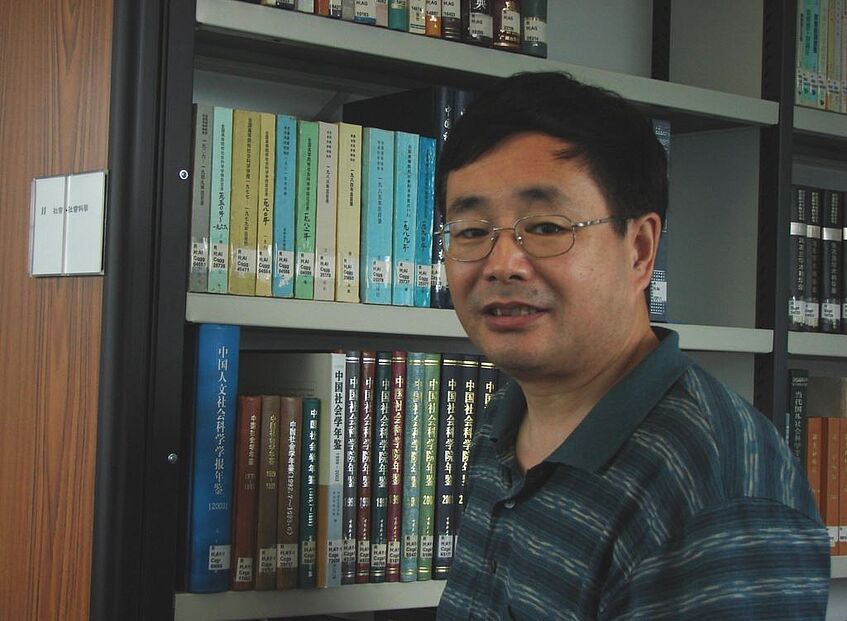
Chen Ziming (2013)
Chen Ziming
Born in 1952 in Shanghai, Chen grew up in Beijing. During the Cultural Revolution he spent six years in a "construction Brigade" in Inner Mongolia, before he was admitted in 1974 as a "worker-peasant-soldier" student at the Chemical Industry College in Beijing. But a year later he was expelled from the college and the Communist Youth League because of critical remarks he had made on the political situation in a private letter. In 1976 he joined the "April 5th" movement (to mourn Zhou Enlai and to protest against radical Maoists) at the Tian'anmen Square. As a consequence he was ordered to be sent for "re-education through labor", but the informal verdict was not enforced.
In 1978 Chen was rehabilitated together with other activists of the "April 5th Movement", he immediately joined the Democracy Wall Movement and became one of the editors of the independent journal "The Spring of Peking".
In 1980 Chen received a post-graduate post at the Science and Technology Academy, in a pluralistic campaign (like at other Beijing colleges and universities) he won a seat as "people's representative" at the People's Congress of Haidian District.
During the 1980s Chen Ziming worked for several reform-orientated think tanks and publications, in 1989 he joined the Tiananmen student protests. After June 4, authorities searched for him as one of the "black hands behind the scene", after spending several weeks underground, he was eventually arrested in South China and sentenced to 13 years in jail for "counter-revolutionary incitement" and "attempt to overthrow the government".
After 1994 Chen, was eventually released to house arrest for medical treatment. When his sentence formally ended in 2002, he became a political blogger and published (in Hong Kong) books on the history of the Chinese Democracy Movement. In January 2014 Chen Ziming was allowed to travel to the US to get treatment for his cancer illness, in 2015 he returned to Beijing where he deceased in October of the same year.
Interview with Chen Ziming (on October 27, 2013 in his Beijing home)
(Here you find the Chinese text of the interview)
Interviewer (Helmut Opletal): I have followed your past activities and I have read some of your texts. So I want to ask you: When you look back now on those years – 1978, 1979 or 1980 - what were the most important elements in your opinion? In your eyes, what did actually happen?
Chen Ziming: I call my book "Emerging Constitutionalism". We regard this movement as a very important part of China's course to constitutional democracy. And we were prepared to make sacrifices for it. In fact, after the “April 5th Movement” [referring to the Tian’anmen events of 1976] was rehabilitated, Zhou Weimin of the "Spring of Beijing" magazine became a member of the Central Committee of the Communist Youth League, Wang Juntao became an alternate member.
Later, when I was at the Chinese Academy of Sciences, they asked me to be the chairman of the Graduate Students’ Association. The prospects for our careers seemed very good if we wanted to stay on this path. For example, Li Keqiang [a future prime minister who studied economics at Peking University] had not been a Central Committee member of the Youth League nor an alternate member, so Wang Juntao was ahead of him.
But after the “April 5th Movement,” some decided that since they had already sacrificed themselves once, they could take one more step. To strengthen civilian political power, they published “people’s magazines” and held election campaigns based on these ideas. They were not afraid of getting arrested or punished; they would probably not have any regrets.
These people belonged to the group that had been rehabilitated after participating in the April 5th protests. When a large number of other activists were arrested in 1981, we were not. It was as if the Communist Party looked at us with a higher regard. They couldn’t just make us heroes first, and then make us criminals again. That didn’t seem reasonable. So they didn't arrest us and let us continue some activities. That gave us the opportunity to further promote the Democracy Movement. So people like me and Wang Juntao were tried and sentenced only in 1989. Of course many more people were arrested then.
Interviewer: It seems that only some of these activists came from a Party or Youth League origin. Others had different backgrounds and some had suffered during the Cultural Revolution...
Chen: I wouldn’t say that they were different. In fact, we were all the same during the “April 5th Movement”. Some of our activists were not so well known and didn’t get arrested, but they had the same ideas and acted the same way. They would go to Tian’anmen Square if they had the opportunity, and they acted in a similar way. When some were arrested, Hu Yaobang lost his temper at the Tenth National Congress of the Youth League [Hu was its Chairman from 1952 to 1966.] The preparatory team of the Central Committee also complained, and they were not happy.
Interviewer: You are talking about 1976 now?
Chen: No, I am talking about 1978. Hu Yaobang said that none of those arrested after April 5th could be elected to the Youth League Central Committee. I disagreed and didn't accept it. Others, like Wang Juntao, were only added later. They should have been treated all the same, but some of them were absorbed into the system when the participants Tian’anmen Incident were rehabilitated in 1978.
Moreover, most of these people had already been admitted to universities in 1976. In fact, the main force of the “April 5th Movement” was young workers and youth who had just returned from the countryside. College students were the exception, I only knew three: Zhou Weimin from Tsinghua University, one was me who studied at the Beijing Institute of Chemical Technology. I had just been expelled by them; I was officially notified on April 2nd. So I went to the square on April 5th. The third person was Zhao Shijian from Beijing Normal University [an author of popular poetry].
I haven't met him since, but I later read some of his memoirs. He was a member of a group of activists, while Xu Wenli, Wei Jingsheng or Ren Wanding rather belonged to the category of young workers. But we were university students, some in postgraduate courses, like Hu Ping at Peking University. This was a little difference, not during the “April 5th Movement” where we were all the same, but in 1979.
Interviewer: How did this difference show?
Chen: I should say, in terms of performance, most were not different. Like Xu Wenli and others. You have mentioned Lü Pu. He was associated with two journals at the same time. He was one of three acting editors of the “April 5th Forum”, Liu Qing, Xu Wenli and Lü Pu. He was also an editor of “The Spring of Beijing” [the original English title as printed on the cover of the journal] which means that his views corresponded to both “Beijing Spring” and Xu Wenli. That's why he could do that.
Secondly, when Wei Jingsheng posted his big-character posters, it was something we certainly wouldn’t post. Xu Wenli didn't share Wei’s opinion either, and he also criticized him. So we can't say that we were the same kind of people. It is said that those who were arrested in 1981 were people who had criticized Deng Xiaoping, while those from “Beijing Spring” did not support targeting Deng. That's not correct. At that time, only a few people thought that Deng Xiaoping should be criticized. Most people at the Democracy Wall, including Hu Ping's “Fertile Soil”, my “Beijing Spring”, Xu Wenli and Lü Pu's “April 5 Forum”, also He Defu's “Beijing Youth”, they all believed that Deng Xiaoping should not be a target.
Interviewer: Why that?
Chen: Because Deng Xiaoping was not the main enemy. Hua Guofeng had not stepped down yet at that time, and Wang Dongxing was still the Vice Chairman. So the attacks should be clearly focused. If all of us just shout, "Down with the Communist Party," then we would have gone straight to jail. There would have been no need to publish any independent magazine.
Interviewer: Did you discuss these issues with each other?
Chen: We did discuss them. But we, such as Wang Juntao, me or Zhou Weimin, would not discuss them with Wei Jingsheng. At that time a regular “joint conference” was established. As all of us had been detained not too long ago, so we didn’t fancy this method...
We are talking about the end of 1978 and early 1979. The Democracy Wall only lasted for one year. That’s when this “joint conference” existed. “Beijing Spring” nominally participated, but none of our main leaders ever went. We only sent our youngest person, Lin Gang, who had been 14 years old when he was arrested during the April 5th Movement [of 1976.] Lin Gang was just sent to listen and to report back from the meetings. But he did not express his own opinions. At one of the meetings, Xu Wenli discussed with Wei Jingsheng, Liu Qing and others, which politicians were to target, but we did not participate in this debate.
Interviewer: “Beijing Spring” and Wang Juntao…
Chen: We did not attend this meeting. But when Wei Jingsheng was arrested, we wrote articles and put up big-character posters to stand up for Wei Jingsheng. For example, you find several articles in the “Beijing Spring” collection that I have written that addressed Wei Jingsheng’s arrest.
Interviewer: Did you write under a pseudonym at that time?
Chen: Who used which pseudonym in “Beijing Spring”, which are mine and which stand for others, you can find all in the book. Of course, I don’t know about some of them who had just sent us their manuscripts.
Interviewer: Here I’d like to ask a question: I still remember that “Beijing Spring” published a fiction called “A Tragedy in the Year 2000” [by a person who used the name “Su Ming”.]
Chen: I didn’t get to know the author, and I still don’t know who he is. He submitted the article to us anonymously, and maybe he has not met anyone of us. And I was not charge for this. We had literary editors, political editors, and others. Our colleague Liu Di passed away two years ago, he could have known, but I am not sure. Many people have already asked this question.
Interviewer: So it seems that he didn’t come out later either.
Chen: For example, there is a photo called "Unite for Tomorrow", which is the most famous photo of the April 5th Movement, showing people holding hands in Tiananmen Square. Of many in the first row we still do not know who they are. I stayed in the second row, because I was already considered a counter-revolutionary, so I didn't dare to be in the front. When I saw a person taking pictures, I quickly hid behind someone. Later, I was shown two photos at Wang Yong’an's place. He was a reporter from the People's Daily. In one of the pictures, I only showed half of my head, and the other photo is the one that can be seen on the Internet now.
Interviewer: In some articles I have read, it is said that people in the Communist Party also backed the Democracy Movement, either supporting or tolerating it. How did you become conscious of such backing from above at that time?
Chen: From above, Deng Xiaoping had clearly expressed that he supported it. A foreign correspondent [US columnist Robert Novak] told people at the Democracy Wall that Deng had asked him to convey that. In addition, Ye Jianying [senior leader, one othe “ten great marshals”] also said so at the end of a Central Working Conference, but in the official account that was published later these words have been left out. But recently his daughter Ye Xiangzhen mentioned them again. Both in the original draft prepared for him and in the text he read at the meeting, it says that the model for inner-party democracy was the Central Working Conference, and the model for extra-party democracy was the Xidan Democracy Wall. So clearly, Ye Jianying has said this.
Another example: Because of the specific character of “Beijing Spring” journal and the people who worked with us, they communicated with us in a very positive way. That included some organizations and representatives, such as Tang Xin who wrote for the “Beijing Daily Internal Report” or Tang Ruojun of the Policy Research Office of the Communist Youth League who also wrote for their internal publication.
After talking to us, they thought that our positions were quite similar to theirs, so they all sent internal reports to their higher-ups, telling that some activists were good, others were more problematic, and some might constitute bigger problems. That’s how they classified them. Among the “good” ones were “Beijing Spring” and the “April 5th Forum”. They said essentially they were good, and only some of the arguments seemed problematic.
Xu Wenli has also met Wang Ruoshui, the most powerful person in the Party he came in contact with. Xu had simply gone to the People's Daily office to find Wang Ruoshui. When Wang received him, his attitude was very positive.
Moreover, in the "Chronology of Hu Yaobang's Thoughts", edited by Li Shengping and others, Hu is quoted as clearly stating that he did not advocate arresting people. Our magazines, he said, should not be called “underground publications.” This way, he actually somehow approved them. People have called Hu “right-wing” or something like that, but he said he did not regret these remarks. He has spoken like this.
The one who wanted to stop us publishing was Hu Qili, then secretary of the Youth League Central Committee. When he came to talk to us, he said he was entrusted by “Sister Deng”, that was Deng Yingchao [Zhou Enlai’s widow] and “Comrade Peng Zhen” [Mayor and Party Secretary of Beijing] to contact us. His main objective was to make us stop publishing “Beijing Spring”. But because his attitude was relatively positive, and he respected us and praised our previous achievements, we decided – after some discussion – to stop publication. This happened in October and November 1979.
Interviewer: Only "Beijing Spring"?
Chen: Yes, they didn't go to see the “April 5th Forum”, so they continued to run until 1980. But when the pressure mounted, they also had to stop. When the situation got better again after a while, the “April 5th Forum” resumed publication, so it was an up and down for them. But we decided to maintain the suspension. Of course, afterwards came the election campaign, and we participated there.
Interviewer: How did you discuss the suspension internally at among the “Beijing Spring” people? And why did you agree to stop publication?
Chen: I don't remember very clearly now, but some people still remember it. They say that I was the one who opposed the halt. But when we discussed it, a majority backed the suspension. So in the end, it was stopped. Probably a minority was against, and I was one of them.
Interviewer: Why did you want to continue?
Chen: We had only been “persuaded” to cease publication, it wasn’t an order, or a threat that if we continued, this or that would happen. Nobody said that it was an obvious instruction by the Party Central Committee. Then why the “April 5th Forum”? That was because the police had come to see them. It is hard to say what had more weight, the politicians’ advice or the police. Anyway, the appearance of the police may have seemed rough, and the way the leaders did was certainly better. But in the end it also meant that we had to stop publishing.
In any case, the politicians had made up their minds on this issue and wanted us to stop publishing, no doubt about this. Even if there was an internal disagreement, we had to abide by it. If Hu Yaobang had a different opinion, and there were people who supported our publishing activity, we would of course have continued. But as I said, opinions from above seemed quite clear and unified on this. Had we insisted, we would have to bear obvious consequences.
Interviewer: So when Deng Xiaoping said these famous words that dazibao were a “good thing” [in November 1978,] did you have the feeling he really supported you?
Chen: No, he didn’t. Deng Xiaoping spoke again in March [1979.] His positive remarks were said in November. In March, Ren Wanding and Wei Jingsheng were already arrested, and Deng’s words were quite different then. From what we heard, we all knew that he pronounced bad things about us.
Interviewer: So why did he support you at first?
Chen: Because the power in the Party was still in the hands of the "whatever faction" [the old Maoists]. Only after the Third Plenary Session of the Central Committee, Deng was able to take over the power. One indication was that Hu Yaobang had become the Party Secretary General and Yao Yilin and Hu Qiaomu his Deputies, both were his people. Chen Yun also became Vice-Chairman of the Party.
Interviewer: So you were no longer needed?
Chen: I don't think it was quite like that. I have just compiled a series of books on the constitutional democracy movement together with Lei Yi, Zhang Yaojie, Fan Hong and others, six of us all together. It is now in the proofreading stage. [It was published in 2014 in Hong Kong.] I have included a quote from Deng Xiaoping which you also find in the "Chronology of Hu Yaobang's Thoughts". Hu just paraphrased it, and we quoted this passage according to his statement at the beginning of the "Forum on Theory Work". That was one of his best sayings of Hu Yaobang on the issue of democracy. In essence he said that Western democracy had been truly democratic over the years, and China should also have such kind of democracy in the future, maybe make it even better. So I think, in the end of 1978, Deng Xiaoping really wanted to have some democracy.
When Mao Zedong initiated the campaign "Let a Hundred Flowers Bloom and a Hundred Schools of Thought Contend" and the following rectification movement [in 1957 when those who had come out with liberal ideas were persecuted,] he also did not think much in advance. That was only specified later, but there was no plan at first to catch a bunch of “bad fish.” Mao actually thought that there were no bad fish anymore, and that had already been resolved by the power of his thoughts. He did not expect the situation was all that bad. At the end of 1978, Deng Xiaoping also wanted to take a step in the direction of democracy, but the question is why did he not continue in this direction by February?
The demonstration [on October 1, 1979] was not the big problem. The bigger worries came from the large-scale activities of the “educated youth” who had returned from Xinjiang or Yunnan. On February 6 [1979] some of them occupied the railway tracks in Shanghai, which interrupted the Beijing-Shanghai line. In this situation, many of the newly reorganized provincial and municipal committees called for help, saying if things continued like this, it would be disastrous. Deng Xiaoping feared a return of the Cultural Revolution, that’s why he changed his mind, and we now know this specific reason. Peng Zhen [the Beij9ing Mayor] also showed Wei Jingsheng's writings to him, saying, "Wei Jingsheng called you a dictator, and there is also criticism from others. Do you care? If not, it will get out of control." So Deng took care of it.
Interviewer: So it was Wei Jingsheng’ poster after all?
Chen: I think Wei Jingsheng's text was secondary, really. Do you know how many intellectuals spoke up in 1957 and frightened Mao? Or was it the 519 Student Movement [a series of big-character posters that triggered the anti-right campaign of 1957.] Did it scare Mao Zedong? Or was it the workers' strikes in Shanghai [in March 1957, a protest of nearly 30,000 workers?] Whas it giving Mao a scare? [......]
Many at the Democracy Wall also thought it was not a good strategy by Wei Jingsheng to go so far as to provoke Deng Xiaoping. But I don't think that was the main reason, the bigger factor was this trouble in various places, the warnings that something was going to happen. Deng had lived through the Cultural Revolution, so he was very afraid of these things.
Interviewer: A different question: This Democracy Movement of 1978 and 1979, even though some got arrested and all these independent journals were eventually shut down, would you still think it influenced later concepts of political reform in the society or in the Party?
Chen: I first want to mention one more element to that question before. The main person who really formed a connection between the Democracy Wall and the Party's internal activities, was [the political scientist] Yan Jiaqi. He was also a participant at the in "Forum on Theory Work" and an initiator of the “Beijing Spring” journal. He gave the name “Beijing Spring” to our group, but he was not involved in the editorial board after it had been established, but Yan Jiaqi was a kind of spiritual mentor.
I didn't attend that meeting where the name was decided, but Yan Jiaqi was there. He also published two anonymous articles in our magazine, one that was printed in our issue no. 9, was his speech criticizing the life tenure system at the Theory Forum. So he was the one who somehow linked the democratic forces inside the Party with those outside the Party at that time.
Interviewer: The first one was Yan Jiaqi, were there others... ?
Chen: There wasn't really a second person then. Yan Jiaqi was one of the youngest participants in the Theory Forum. Only the youngest had the drive and possibility to participate also in the movement outside the system. Someone a little older wouldn't have had such an idea. Like Wang Ruoshui [Editor-in-Chief of the People’s Daily] who could have never played such a role.
Interviewer: But what influence did Yan really have within the Party?
Chen: Abolishing the life tenure system [for high-rankiung leaders] was one of the biggest achievements of the late 70s, and it was Yan Jiaqi who had proposed it. Because of that he would later become the director of the Institute of Political Science. [……]
Interviewer: So later on, in the early eighties, did these ideas continue to be discussed or ...... were there any think tanks within the Party?
Chen: Your question more complicated. What is a think tank within the Party? There are two kinds; one is very formal, like a Policy Research Office, the Political Research Office of the State Council under Yu Guangyuan for example. This kind of think tanks didn’t work too well later because it was controlled Deng Liqun who was an old leftist in the Party, the leftist king, the leftist marshal. So this kind of organization was not very useful for Zhao Ziyang or Hu Yaobang. [……]
There was another think tank around Chen Yizi. [......] He is also in the US now. In the beginning, they were actually a civil society grouping called the China Rural Issues Research Institute (CRIRI). Later they were absorbed and became the China Institute for Economic System Reform. And later again, a group of them joined Bao Tong's Central Political System Research Office [Bao Tong was the Policy Secretary of Premier Zhao Ziyang.] So many of them were like our generation.
From the very beginning, when it just started, these people had regular contacts with us. For example, Wu Wei who was Bao Tong's secretary, and others, such as Chen Xiaolu, communicated all with each other. When they were designing the report on political reform for the 13th National Congress in 1986, we actively contributed, and many of our ideas were included by them.
Our group who has been discussing politics since 1983, like Wang Juntao, me, Li Shengping or Yang Baikui, also published some books, for example explaining the Western civil service. Later, we organized a Youth Political Research Association. Half of the members came from “outside the system”, the other half came from inside, including several deputy ministers still in office like the Vice Minister of the Organization Department, and others. So there was adequate communication of ideas between the young and middle-aged people within the system and those from outside.
For example, when did I talk about constitutionalism? During the period of the Democracy Wall I did not use this term, I did not know much about constitutionalism. Afterwards I spent half a year reading in the Capital Library. I read many Chinese accounts, including the political science books that had come out in the 1930s and 1940s. Maybe I read two or three hundred of them. Then, between 1981 and 1982, I wrote an article devoted to the rule of law.
So the process of ideological improvement in 1980 was carried out from both inside and outside the system. The activists from the Democracy Wall were able to talk about democracy, but not about constitutionalism. What came closest at the Democracy Wall was Hu Ping's text on freedom of speech.
There are some other things you may not know. In 1980, there was Xu Wenli's "Study Newsletter" that later separated from the "April 5th Forum.” [……] Xu Wenli really had something to say. When I was running for the election, I made an appeal for a direct ballot for the President and all the people's representatives. That was in 1980. I drafted it, but it was posted as Wang Juntao's campaign materials. I ran for election. My sister also ran for election, and so did Li Shengping. All of us used these materials.
Interviewer: So please tell me more about the elections.
Chen: You’ve asked whether the ideas of 1979 had any relevance for the 1980s. People outside don’t know much about these elections, only the Democracy Wall is well known. For me they all together make up for the Beijing Spring Movement. Some foreigners also say so.
In fact, the Beijing Spring Movement consists of three parts. The first is the Democracy Wall Movement. There were many walls all over the country. Of course, the Xidan Democracy Wall was the center. The second was the independent publications movement. There were dozens or hundreds of such journals all over the country. Among them you may count four major publications that gained importance. The third part was the election campaign to chose people's deputies.
Because the election campaign took place in colleges and universities, the actual impact on the ideas of people in the 1980s was greater than that of the Democracy Wall. So how did the continuity from the Democracy Wall to the election show? Because the main participants in the voting campaign came from two independent magazines, one was "Fertile Soil" where Hu Ping worked, and the other was "Beijing Spring" where Wang Juntao and I worked.
Wang Juntao, Hu Ping and I discussed these campaigns beforehand, also with Zhang Wei. At one occasion in Xiangshan, at the founding meeting of a “Talent Academy”, Wang Juntao and I met with Zhang Wei. We told him we were going to run for election, and everyone should participate. In the end, there were nine of us running for seats at various academic institutions. I was at the Graduate School of the University of Science and Technology, which later became part of the Academy of Sciences, while the University itself remained in Anhui.
Interviewer: From some visits, I mainly know about the election campaign at Peking University. How did you run it?
Chen: Peking University is a liberal arts university. We prepared things very thoroughly. The first elections took place at the Peking University Number One Branch School, where "Beijing Spring" editor Li Shengping was a candidate. The branch school was in Xicheng District, the others in Haidian. Xicheng District started half a month earlier, so Li Shengping was the first of us to participate in an ballot. We all went to support him. When he held a presentation meeting, we and other people from outside institutions were all there. Wang Juntao and I went, and also Li Jiamin and others from “Beijing Spring”.
We supported him, half a month before the election at Peking University. When we had our vote at Beida, Li Shengping had already been elected. At Peking University we had agreed at the beginning to mainly promote Wang Juntao. Hu Ping should just be an advisor. But when we saw that there were two seats to fill, and Hu Ping might also have a chance to become elected if he ran, he also presented himself as a candidate. We had said we would mainly support Wang, but then Hu Ping got elected, and Wang Juntao just missed it by a few dozen votes.
Even in those meetings, we still kept to the procedures. Those who agreed raised their hands, others disagreed or abstained. We held some common activities and I drafted a plan. There were ten of us at the time. I was also elected to become a member of the Standing Committee of the [local] People's Congress. [……] Haidian District has its own People’s Congress. Student representatives unanimously elected and supported me to become a member of its Standing Committee.
But the higher-ups were already quite embarrassed, and they definitely didn’t want me to get elected. So they pushed someone from Tsinghua University, saying that this person had always cooperated with the Communist Party. They opposed our ideas and actions, so in the end the higher-ups nominated that person to the Standing Committee. [……] and I was not elected to the Standing Committee. [……] But I got elected [as an ordinary deputy] for a term of four or three years.
Interviewer: So you were able to go there?
Chen: Yes, I did go. But later I was not interested any more. Why? I had put forward many ideas at the meetings, and I also made some commitments for my constituency. But when I went to the office of the Standing Committee of the Haidian People’s Congress and asked for a letter that confirmed that I was an elected people’s representative, they refused to issue it.
At that time, there was no representative card, just a kind of certificate. It was also printed, but it wasn’t a card. So when I went somewhere to obtain information and introduced myself as a people's deputy, they would usually ask for a written proof. That’s why wanted to obtain a formal letter of introduction, but they refused.
It looked as if they didn’t want to let me do my work and act as a deputy. They held three sessions in total. I went to the first and second one, but not to the third any more. I guess Hu Ping went to the second session, but when the third session was held, he had already graduated. So he didn't participate.
Another person present interrupts: [It is Xu Youyu, formerly from the Institute of Philosophy at the Chinese Academy of Social Sciences]: Hu Ping told me that when he went fact-finding as a people's representative, everything was prepared beforehand as if he were a great enemy; it was like receiving a foreigner. The whole presentation was prepared in advance. We were regarded like hostile elements.
Chen: Yes, they arranged everything. I didn’t often participate in such activities. They won't let me do it. And they won't give me a proper ID card, so I wasn’t able to do it.
Interviewer: Why do you think that among the three aspects of the Beijing Spring Movement, the elections were the most important?
Chen: They were not necessarily the most important. I mentioned these three in my book. There were other activities, but I didn’t participate in them, so I didn’t write much about them. For example, there was a group lobbying to form a party, something that has not taken shape, it was just in the preparatory stage. But an organization, the "China Association for Democracy and People's Government" and a “China Association for Publications” with an East China Branch and a North China Branch, had been established. They had more than ten branches across the country, which was quite important. But without participating, I didn’t know too many details.
There was more than one group wanting to form a party. For names and details, look into this book. One was the author of the essay “Discussing the Theory of a Proletarian Democratic Revolution”, his name is Chen Erjin. [……] He also campaigned to form a party. Another one was Xu Wenli. They held a meeting called Erligou [he probably means the Ganjiakou meeting]. There were four of them, and they prepared the formation of a party.
They wanted to set up an association first. Xu Wenli has told me also that he wanted some kind of parallel cross-strait interaction [with the Taiwanese democracy movement] and set up a cross-strait friendship association to promote the unification of China from outside the Communist Party. Of course, this also contained the intention of forming a party.
Interviewer: I don’t know, but can one say that the democracy movement has failed in the end, that it had no chance to continue? Why so, and why did people eventually get arrested and suppressed?
Chen: There were three rounds of suppression. The first was the detention of Wei Jingsheng and Ren Wanding at the end of March 1979. Did they have the intention in the first round to continue with more arrests? In fact, we, the editors of various magazines, also had our doubts whether we would be able to continue publishing. But we could.
Then came the second round, which also became troublesome. I have mentioned earlier that one important reason for arresting Wei Jingsheng was the blocking of railway tracks in Shanghai. There were two additional important factors for arresting Wei Jingsheng. One was the October 1st march, which you know [to protest the banning of the Stars Art Exhibition.] The second one was the demonstrations at the People's University around October 10th that demanded the departure of the Second Artillery Corps.
Interviewer: What happened?
Chen: The command of the Second Artillery Corps still occupied part of the People's University campus. So they demonstrated, and the University also sent a car. [The army presence on the campus dated back to 1970. At first the troops only wanted to return a small part of the school buildings.] It was indeed connected. Three days later, Wei Jingsheng was sentenced, a sort of direct response to these two demonstrations. After that, quite a number of people got arrested, and independent publications were stopped, including "Beijing Spring".
Later, the situation improved again. Deng Xiaoping had made a speech on August 18. Some journals from other cities had never stopped publishing. So publishing slowly resumed. When the “Forum April 4th” in Beijing was suspended, there were demands for its resumption, and that was what actually happened.
Then the election campaigns were launched which encouraged many people again. But then followed a third wave of suppression. The attacks came directly from Chen Yun [Vice Premier and powerful associate of Deng.] He said two things at the Central Working Conference in 1980. The first was that if the economic situation was unstable, there would be big problems; the second was that if ideology and propaganda work could not be controlled, there would also be big problems.
At this conference, Deng Xiaoping quite exceptionally praised Comrade Chen Yun's speech seven times, adding that we should follow his words in the future, etc. Later, when Deng Liqun [influential Party theorist] wrote his memoirs, he said that the Central Working Conference in 1980 was the culmination of the Deng-Chen alliance. This culmination led to a complete suppression of the Democracy Wall. Hu Yaobang was asked to issue a central directive, but Hu refused.
In the end, it was Hu Qiaomu [important conservative Party theoretician] who edited the famous “Central Document No. 9”. Its main intention was to disallow any political cross-linkages between lower work-units and institutions, blocking those completely because any democratic movement had to be cross-unit by definition. Elections seemed a bit better. Although we, the organizers, worked between units, the activities were still happening at individual universities, not “cross-unit”. But the independent publications were considered “cross-unit” and therefore not allowed any more.
There were thousands of people arrested throughout the country at that time. Not all of them were sentenced to prison terms, but there were more than a dozen that received prison sentences of more than ten years. Xu Wenli’s verdict was fifteen years, the same as Wei Jingsheng’s. Wang Xizhe was sentenced to twelve years, others received fourteen years, ten years, and so on, sometimes eight or nine years. Many were temporarily detained. Some were sent back to their work units to receive disciplinary punishment there. The total number of those sanctioned reached several thousands. All those who still published their journals at that time, were among those arrested.
Later I heard that some publications with minor influence survived until 1982 and 1983. There were small underground publications in some medium-sized cities, and the number of people who got to read these local journals was very limited. But it was still going on, secretly, and the longest ones lasted until 1982 and 1983.
Interviewer: At the beginning, the Democracy Movement was closely linked to some artists and literary figures, who participated in both aspects. Later, they separated.
Chen: We must not call it a separation. The authorities spared those people and did not arrest the artists. They had always claimed that they did not engage in politics, but in fact, the way they did things was also political. Their magazine was called "Today", one of the so-called “four famous journals". It’s authors insisted in their words and writings that they were only engaged in art. Still they initiated several key activities, such as the October 1st march where they were also main participants.
They had contacted Xu Wenli. If it were not for them, Xu Wenli would not have participated. They were also confined, their art works in the Fine Arts Gallery were held back, so they went to inquire about this matter. They participated in various other democracy activities. Still they kept saying, we are not involved in politics, just doing art.
So when the wave of arrests happened, art people were spared. It was like putting them in two different groups. Another group was us, those who were already members of the Youth League ot Student Union leadership. We had some connection with their system and had been promoted in previous years. So they didn’t arrest us, but we were criticized. For example, Hu Ping wasn’t assigned a job. My sister Chen Zihua had been allowed from the Beijing Boiler Factory to attend the Business College, but she didn’t receive a job when she graduated. So in the end, she had to return to the boiler factory.
Interviewer: Why didn’t she get a job?
Chen: Because she had also been a candidate in the elections, an official candidate. Her situation was the same as Wang Juntao’s. She had been selected as an official candidate from among several, but she didn’t get enough votes. There was another person, Jiang Yu, who was Jiang Hong’s younger brother and one of the main editors of “Fertile Soil”.
He was at People’s University and also wanted to become an official candidate, but he didn’t succeed. Then he was told to return to his original work unit. Jiang Yu was at the Economics Department of People’s University, but then he was assigned to the Shijingshan Power Plant where he had come from. He and my sister both studied economics and business, but in the end they had to return to the factories. This was also a kind of punishment.
Interviewer: How does the Chinese government today treat all those events? Were former activists able to publish articles again? Were there still restrictions?
Chen: I think there weren’t too many restrictions. The “Today” people had a good time again. In the mid-1980s, when the political system saw a new climax, Hu Ping's article on freedom of speech could be published in the official journal "Youth Forum" in 1986. Wang Ruoshui's work [Wang was a reformist editor-in-chief of the People’s Daily] could also be published as a series of books. In 1986, "Today" was recognized as part of the authentic history of contemporary literary, and it was referred to in the literary history books.
The righteous status of these people was recognized in China and abroad in 1986 and 1987. Later, of course, Hu Ping again lost his recognition because of his association with the “China Democratic League” [in exile] when he had left China. Wang Ruoshui had links to the "June 4th" events [Tian’anmen 1989] and also participated in a signature campaign. In fact, those of the "Today" journal were not persecuted after 1986, and they remained active.
Of course, they received some critical comments individually, but this didn’t concern the "Today" magazine as a whole. And literary history is treated differently from ideological history and political history, therefore people like Hu Ping and us will never be included in the official history of ideas. But "Today" has become part of the history of literature.
Interviewer: But how does the government think today about the Democracy Wall Movement or the independent journals of that time?
Chen: Let me give you a more illustrative example, the “April 5th Movement” [of 1976.] This movement has been officially rehabilitated. But when the tenth anniversary arrived, except for Cao Zhijie, the author of the first eulogy from the Beijing Trade Unions, we, the activists of this movement, were no longer invited to the official commemorative meetings in the Great Hall of the People. When Cao Zhijie went to this meeting, Xu Weicheng, then the deputy secretary of the Beijing Municipal Party Committee and later deputy minister of the Propaganda Department, asked him to see his manuscript. So what was he trying to check? In fact, Cao was not allowed to use the expression “April 5th Movement”. Imagine, at the tenth anniversary of the “April 5th Movement”, he was not allowed to mention the “April 5th Movement”! He was only allowed to speak about the “attachment to the people” in the year 1976.
Even now, the “April 5th Movement” has not become part of the history, it’s not allowed to be mentioned. Of course, we cannot deny it be mentioned in the annals of events, because Deng Xiaoping was dismissed from office after this movement happened. But in reality, the “April 5th Movement” was a mass movement. The People's Daily wrote a long article of more than 10,000 words on the third anniversary, describing and praising the spirit of this movement. After the third anniversary it stopped. The official narrative no longer says that this movement was a good one.
Interviewer: Not as a good movement, but as a historical phenomenon, can it still be discussed?
Chen: No, because those who were criticized by this movement [the so-called Gang of Four] later became “bad elements”, another reason not to talk about it.
Interviewer: What about the historical perspective?
Chen: The official history does not mention it. Of course, we are also trying to write a “people’s history”, but we cannot officially publish it. So they are writing their history, and we are writing ours. We can only publish it in Hong Kong, so there can’t be a face to face confrontation with them.
Interviewer: Do the young people today know what happened at that time?
Chen: Young people know very little about this. Apart from those who were involved in the Democracy Movement themselves or who are studying history, people know almost nothing about these events.
Interviewer: What about history students in college?
Chen: For those who study history, like my son, these events do not appear in their textbooks. For one who studies contemporary history, "June 4th" will be mentioned, but it will be described in a very official and formal way.
Xu Youyu wants to add something: In my opinion, the Chinese Communist Party is quite successful in erasing history, at least for now. But I believe that in the long run, it will not succeed. The Soviet Union eradicated history during the Stalin era, and now all Soviet history has to be rewritten. Looking at things today, the eradication has been very successful.
Chen: They just don't want to talk about it anymore. They also have erased from memory the fact that 30 million people have died [in the 1950s.] Senior officials have admitted in their memoirs 10 or 20 million. Bo Yibo [a former Vice Premier] mentions more than 10 million in his book. But now, for example, the “China Social Sciences Daily” or the “Global Times” pretend to have no idea. They write that “millions” died, or “two and a half million people”. The censorship of these facts is still very strong.
Interviewer: In official research and debates on history, do they treat the Democracy Movement and the Cultural Revolution differently at all?
Chen: This is the question now. The Cultural Revolution happened earlier. Even the five big chiefs [Red Guard “rebel” leaders in the early days] are now legal citizens, so they are allowed to publish books now. It’s a kind of research, although publications are not “official”. Yan Jiaqi's book [a dissident political scientist, now in the US] is not allowed to publish in China. Xu Youyu's books cannot be published in China now. There are more and more memoirs that are privately printed or published in Hong Kong. But the scope of the Democracy Movement was much smaller than that of the Cultural Revolution. Activists who continued in various actions, got arrested again. Some who had participated in the Democracy Wall Movement were sentenced again. After ten years in prison they were sentenced again.
People like Ren Wanding, Xu Wenli or Wei Jingsheng were the most important figures at the time. After they had left China, they had to survive abroad and did not have the time to write memoirs. They had other priorities. There are in fact very few people who could write these histories, and they were not in the same position as those from the Cultural Revolution who had became entrepreneurs like Kuai Dafu [a famous Red Guard leader] who later opened a business company.
As bosses they could support old friends in publishing books. But the fate of our people is often that we don’t even have money to see a doctor. And they won’t give us passports. One recently asked the Supreme People’s Court for a ruling because the Beijing Public Security Bureau persistently refused to issue a passport to him. This is illegal and unconstitutional. So people have had very bad experiences. This one just happened recently, less than a month ago.
Xu Youyu: Generally speaking, discussing the Democracy Movement has become more sensitive than the Cultural Revolution. Talking on the Cultural Revolution is also subject to certain restrictions, but the Democracy Movement is much more sensitive, with much greater restrictions. This is the first point. The second is that those who participated in the Democracy Movement are in a more miserable situation than those who participated in the Cultural Revolution. So it is more difficult for them to look back on their own histories and express what happened at that time. That’s why we hear much less from them. There is a new development that people talk a lot about the Cultural Revolution, but all happens overseas. Here it is still much more difficult to talk about the Democracy Movement.
Chen: Most of our people are continuing their revolutionary activities and participate in the movement, they are always busy and don’t find the time to write. Many who were active in the Cultural Revolution have arrived beyond this point, and they are writing about their experiences. But the Democracy Movement is still going on, people can't write about what they are doing because they would risk getting arrested again.
Interviewer: Have you personally ever thought about going abroad like others?
Chen: I am a bit special. I don't really want to emigrate, but I've traveled as a tourist to Australia, to Switzerland and France recently. But they won’t let me go to certain conferences. I need to apply for a passport for that. For example, I wanted to go to Hong Kong, once in two years, but I missed the event. They took the money for the passport, but they didn't send it to me because they knew I was going to Hong Kong for a conference.