
Ma Desheng
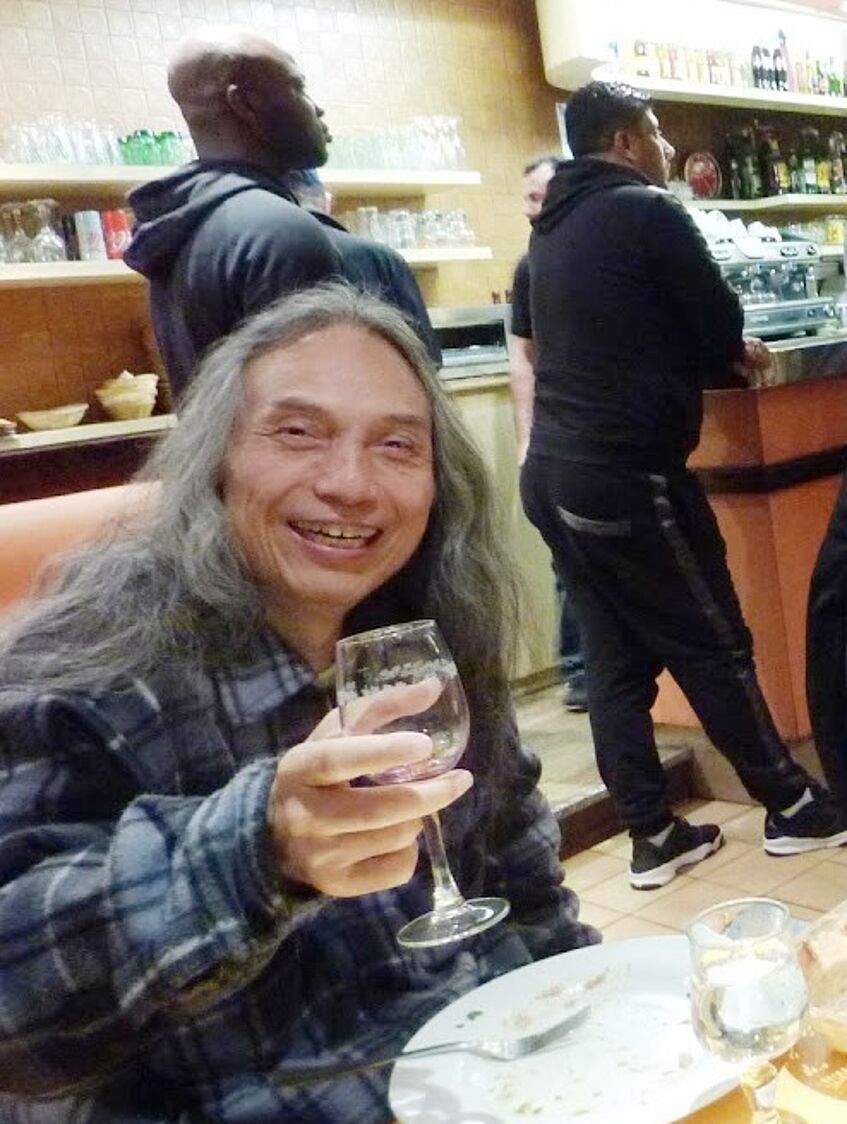
Ma Desheng (2014 in a pub near his studio in Paris)
Ma Desheng
Ma Desheng was born in 1952 in Beijing. He is a poet, a painter, a performer, a calligrapher and a woodblock print maker. He also became a key figure in the "Beijing Spring" democracy movement of 1978-1981. A childhood polio disease left him with a handicap, his wooden crutches would later become his trademark when he appeared in public together with his fellow artists.
In 1971, Ma was assigned a post as an industrial draftsman in a machinery factory in Beijing, where he obtained important manual precision skills, but his dream was to become a trained artist. When he applied to study at the just re-opened Beijing Academy of Fine Arts though, he was bluntly rejected due to his physical handicap (which was at that time still a general obstacle to being admitted to a university or college).
Hence Ma Desheng started to make woodblock prints, and he joined a course for amateur artists at a workers' cultural center in Beijing. There he met and became friends with Huang Rui who also was a self-tought artist. Huang Rui was responsible for the layout and illustrations of the independent journal "Today" (Jintian) that just prepared its first edition. He introduced Ma Desheng to his collegues. Ma was subsequently invited to contribute woodblock prints and some of his lyrical texts for the new magazine.
Ma Desheng also became a founding member of the "Stars Artists Association", he took part in the exhibitions and also in the famous street demonstration for political and artistic freedoms on October, 1, 1979, holding a speech and wielding his wooden crutches during the march.
In 1982, Ma also started his own style of ink wash paintings, but in 1983 he was personally targeted during the Anti-Spiritual Pollution Campaign (when Western influences on Chinese arts also got ctriticized). Ma Desheng saw no future any more in China, but it was only in 1985 that he managed to obtain a passport. He first traveled to Switzerland, in 1986 he moved to Paris. He was invited to exhibit his ink work in galleries and museums (and recite his poems) all over Europe and North America, Hong Kong and Taiwan.
Ma Desheng's life and artistic career was tragically interrupted in 1992, when in a car accident in the US, his companion Barbara Holstein (a neurologist from Germany) was killed, and he himself suffered serious injuries that left his arms and legs completely paralized at first. It took two years of special treatments and therapies in hospitals before Ma could partly use his arms and a few fingers again, just enough to hold and move a thick paintbrush and restart some artwork.
Sitting in his wheelchair, Ma Desheng meanwhile spends several days a week again painting in his Paris studio, but he still needs daily assistance from nurses and doctors. He continues to write poems, and he is regularly invited to recite them with with his powerful voice to public audiences.
Interview with Ma Desheng (on April 24, 2014 in his studio in Paris)
Ma Desheng: Now more than 30 years have passed. When I think back to that period of my life, honestly, I feel like in a play. Why do I say it's like a play? It wasn’t supposed to happen, but each of us got into a role. The high political pressure at that time became just a little relaxed after Mao's death. All the young people wanted to express themselves, so everyone became an actor. In fact, this shouldn't have happened in that situation. It was a very normal thing, but at that time it seemed so great, so shocking, and progressive. But it was a very normal thing in the world and couldn’t be more normal.
From an artistic point of view, some of the works we painted were very modern, avant-garde, and pioneering at the time. Quite a few also had a political touch, even if they seem a bit childish now. Most of what could be seen looked Western and was influenced by the West. As for their artistic value, a few works were particularly political. But our most important contribution was not in art, but in politics, when we all participated in the street march to demand democracy, liberties and artistic freedom.
Interviewer (Helmut Opletal): That was on October 1, 1979, right?
Ma: Yes, that was the most important thing. It was the first time since the founding of the People's Republic of China that a group of fearless young people went for a protest march. This is something that will go down in history. It was a kind of art performance; it was both artistic and political. It was at the time more important than anything else, I think. In China, artistically speaking, the eight model operas [of the Cultural Revolution] had been constantly performed during ten years. All the paintings had to be red and bright, glorifying those things. But in our group we wanted to express ourselves and speak our own language. That should have been very normal. But now I understand that at that time very normal things could become abnormal, and some even ridiculous.
Interviewer: What made your art seem so special and progressive at that time?
Ma: Because we always wanted to be different from the official line. For example, the officials wanted red, but we liked black. We didn’t necessarily want to contradict the official position, but we just didn't like it. They all had a narrative, everything was so great, and art had to serve politics. But what we painted had nothing to do with their politics, but with our politics. Our politics was freedom, just this one word. So it was a ridiculous movement because freedom is something that everyone should have, it is a natural must. For us it was normal to do and to paint like we did. But this became abnormal. So it was ridiculous.
Now when I think back to what happened more than thirty years ago, I find it rather ridiculous, especially in the light of what I got to see in the West later. Here, street marches, strikes, demonstrations, expressing different opinions, painting what you want, political satire, even about the president, they can all exist, including satire of religious things, although this is a controversial topic. Our movement happened under the specific historical conditions in China at that time. But having lived in the West for many years, it seems to me that it was rather ridiculous.
The isolation under the Communists has lasted too long, they were much too authoritarian. It was a one-man show. Mao said let a hundred flowers blossom, but in fact, there was only one flower, and other flowers were not allowed to exist. Everyone wore the same clothes, either gray or green, the color of military uniforms. Everyone sang the same songs. The only plays were those eight model operas that were also made into movies and ballet performances. Under such circumstances, as you can imagine, lives were too monotonous and terrifying. So we, the so-called underground artists, wanted to paint the real things we experienced. We went to the countryside every year to paint the farmers there. We went to Tongxian, only 20 kilometers away from Beijing. We had thought that our lives in Beijing were quite bad, but their lives were even poorer, so we painted a lot of portraits of peasants.
We could see the differences in our society. Although the Communists always claimed that they had liberated all of China, that they had liberated workers and farmers, it actually were the workers and farmers who suffered. Even today they are suffering. After liberation, the Communists secured the greatest benefits for themselves. During the era of reform and opening, they still reaped great benefits. Their families obtained hundreds of millions or even billions of assets, including some abroad. In today’s China, there are still many rural children who cannot go to school. Why are people so unhappy today? Why is there a new leftists movement that wants to incite people to rise up again? It’s because this soil has been prepared before.
Interviewer: How did you start painting, writing poems, and then participating in the movement of the 1970s?
Ma: When I was a child, I contracted polio and had to use crutches to walk, so I couldn’t play with other children. I often stayed at home, copying children’s books and comic strips. I didn’t have the idea yet to become an artist. I was seven, eight, nine years old then. What I wanted most at that time was to become a scientist, and there is a story about that. I was in the fourth grade, and in the neighborhood there was a kid in the fifth grade. Together we wrote a letter to Zhou Enlai, pretending that we had invented something and claiming support and some funds. Zhou Enlai actually did send people to our home, but when they saw that we were children, they just admonished us to study hard and then maybe to do research later.
The thing we had explored was something walking on the road, could press a button that allowed to fly, and when it fell into the sea, it could flip up and walk on the sea. So at that time, I wanted to become a scientist, not an artist. Then the Cultural Revolution arrived. We had barely finished elementary school, in middle school we just learned "Long, long live Chairman Mao", and before we could finish, we were already sent to the countryside to work. Because of my health problem, I could stay in the school-run factory, making some spare parts. Later, classes resumed. After finishing school, I was assigned to a typewriter factory. At the beginning, I worked as a warehouse keeper in Bamiancao [near Wangfujing, Beijing]. The situation got a bit better, and intellectuals who had been sent to countryside gradually returned to the cities. Later, my factory merged with a Business College to form the Commercial Machinery Research Institute, which made electronic calculators like those used in stores.
I started as a welder, and later became a tracer because they knew I was good at drawing. Tracing meant drawings for the electronics. These designs dried outside in the sun before the factory would produce them according to these drawings. Later, they asked me to design the outside body of an electronic device. When we started to publish a commercial machinery journal, I worked there as art editor and drew illustrations for them. They first wanted to recruit someone from outside, but I said I could do it. After one or two issues, they considered it was ok.
Later, on my free days, I often went out with friends who were painting. My earliest own art work I did just before the Stars Exhibition, in the magazine "Today". Liu Qing came to see me and spoke about their magazine. He asked me whether I could help with illustrations. I did two woodprints for the first issue, one was a cleaner rolling a cigarette, and the other was a person kneeling and shouting. The first issue of the journal was posted on the Democracy Wall at the end of 1978, if I remember correctly. Passing the Xidan intersection by bus, I could clearly notice these two woodprints of mine. From then on, I began to create more art works trying to express myself. I sketched landscapes and portraits. Only later, I started to write poetry.
Interviewer: Please tell me, what kind of family do you come from?
Ma: My parents were both workers. If there hadn’t been “liberation”, they would have probably become entrepreneurs. But their factory was confiscated and they were obliged to work with the state.
Interviewer: How were they affected by the Cultural Revolution?
Ma: My father suffered. They sometimes called him a capitalist, sometimes a small business owner. He was attacked, but not arrested. Later I started to paint and engage in art with others. At this point I can tell you another story. As I worked very well in my unit, they put up a slogan "Learn from Wang Jinxi from a distance and from Ma Desheng from near." Wang Jinxi had been an oil worker and national hero. [Mao Zedong called him a model worker for the whole country to learn from. He became a member of the Central Committee during the Cultural Revolution.]
To be honest, I was a little ambitious. Because I had polio as a child, I couldn't play with other children. I always stayed with adults and listened to them talk. They discussed for example that the US President Roosevelt was in a wheelchair during World War II, so I thought I could also become a president, because I was disabled. When I had this dream, I thought I had to enter into this system. But this changed. The June 4th Movement [Tian’anmen 1989] criticized corruption committed by officials. Before the reform and opening up era, people called it “going through the backdoors”, which had become a common phenomenon after Mao’s death.
Children of high-ranking officials and intellectuals were all allowed to return to the cities, attend college, or get into good work units. People from ordinary families did not have such opportunities. When I noticed this, I felt that something was wrong. Comparing communism with what Mao Zedong said, it was not the same thing at all. I was against “going through backdoors” in my unit.
At that time, my company asked me to write an application to join the Party, saying that they would approve it immediately. I wanted to wait a little longer. We had an old party member over 50. He already had his opinions on Marxism-Leninism and Mao. He secretly discussed his ideas with me. In the end, we thought that Marx made a mistake when he investigated changes in society from the perspective of capital saying that it was the people’s jobs that transformed their ideas. But he forgot about human nature that arises from inner feelings. From an economic perspective, Marx’s study was correct, but he forgot about human nature, a perspective that Marx had lacked we thought. Later his ideas produced revolutions, such as the Russian Revolution, which then influenced the revolutions in Asia.
Interviewer: When did you start to think like that?
Ma: That came when I was doing my sketches in all sorts of places when I lived in the countryside. I experienced the lives of the peasants. Mao Zedong had proclaimed that he wanted to liberate all mankind, workers and peasants. During the Cultural Revolution, he had also emphasized that workers should lead everything. Later, I noticed that their lives were still very poor. For me that was far away from what had been promised, and it was different from what Marx had written. Marx's theories on "surplus value” and "surplus distribution" were also not consistent with the Chinese society at that time.
Interviewer: Is this your personal conclusion or one you reached after discussing with others?
Ma: I did discuss it with people in my work unit and friends around me. But it was also something I came to realize myself. I felt that something was wrong and my ideas began to change. After Mao Zedong’s death, we often painted together, and the Stars Exhibition and the Democracy Wall began to take shape. We often gathered at “No. 76” [Liu Qing's home in Beijing, at No. 76, Dongsi, Lane Ten.] There were Mang Ke, Bei Dao, people from “Today” and the “April 5th Forum”. It was like our base camp where we often debated democracy. The first meeting of our Stars Group was also held there. And we discussed how to establish our “Painting Society”, how to hold exhibitions, etc. We were young and often spoke about social and artistic issues. That's how things became moving.
Interviewer: Some artists seemed to think that art should only express what was in their heart, it had nothing to do with politics. So some of you artists didn’t want to demonstrate, write dazibao and hold protests with the people from the Democracy Wall Movement. How did you debate the relationship between art and politics?
Ma: There was a "No Name Painting Society" then that had their own views and ideas on politics. For them this was different from art, they wanted artistic expression, but no participation in marches or writing of post big-character posters.
Interviewer: Did you know the people from the "No Name Painting Society"?
Ma: I knew them all, and I was very familiar with them. They engaged in pure art. As for us, we were more diverse and we were friends with some involved in politics. We also appreciated their activities, and for us politics and arts were closely connected.
Through our art we tried to express what we saw, things different from what the Communist propaganda said. We only wanted to express our own ideas then and didn’t think about opposing the Communist Party which wouldn’t have been possible at that time anyway. I have been in the West for many years now. In fact, we did have creative freedom at that time, a freedom that came from everyone’s inner heart. Many masters in the West never experienced an era of freedom, but they created great works. Same in China, writers like Cao Xueqin [author of the classical novel “Dream of the Red Chamber”] or Ba Jin [author and political activist of the 20th century] were not free.
But artists are always free in their hearts. The outside world only gives them pressure. An artist, who wants freedom, can always write and paint at home. As for the lack of public freedom or the freedom to publish, I admit that this may be a problem. But the freedom of creation is always there as long as you want it yourself.
That many Chinese do not seek this freedom and follow a path of not wanting freedom, is a different matter. If a person wants this freedom, he will definitely have it. Thinking back, we had no pressure at the time, and of course we did not want to publish, and it was impossible to sell, so we just painted and wrote our texts when we were happy, that's how it was. Later we developed a more rebellious thinking. The more we were asked to paint red, the more we wanted to paint black. There was this mentality of resistance. In our Stars Art Exhibition, there were also people like Wu Manhou [? ], who expressed their self, but we also had people whose works were more closely connected with society.
Interviewer: Most of the people in the Stars Art Society were influenced by Western artists. Where did these influences come from?
Ma: I can tell you my own experience at the beginning. My art teacher in school was labeled a rightist during the Cultural Revolution. She had to sweep the floor and most people teased her or ignored her. But I would always greet her politely whenI passed next to her. She would usually nod, but sometimes she glared at me and said, “Aren’t you scared?” Later on things got better and classes started again. One day she passed me a note and stuffed it into my hand. I didn’t dare to read it right away and left it in my pocket. At home I saw that it was an address, so I went to look for it. It turned out to be her home.
Her husband was a professor at the Central Academy of Fine Arts, teaching perspective. She herself was a music teacher. She had quite a few art books at home, Soviet art books, more than twenty of them. Her family home was raided [during the Cultural Revolution], but there were still some books left. She showed me publications of Western art and offered me a meal at noon, as I spent the whole day at their home. I had learned that such fine books, all from the Soviet Union, were still there, like on Isaac Levitan, who painted landscapes, and Ilya Repin's "Barge Haulers on the Volga". For me it was just beautiful, and that day left me very happy. It was a great inspiration for me, and I seriously wanted to do art.
Later, after Mao’s death, new Chinese publications gradually appeared, such as the "Art Magazine", which also published some modern Western paintings, even some abstract or Cubist works of art, like Edvard Munch's. They reproduced a mix of revolutionary items, and some more modern. That’s where we all found them. When the university entrance exams resumed later, some of my friends were admitted. But I was not allowed to take the exam, because of my physical condition and the ideas I had expressed. But my classmates secretly brought some books they found in the school and showed them to me. For example, abstract paintings by Wassily Kandinsky or works by the German artist Käthe Kollwitz. The famous writer Lu Xun had translated and praised Kollwitz's works, and also published some of her prints. That’s how young people like us were influenced by some Western art.
Interviewer: What about influences from Western political thought?
Ma: For us, political thought came from the real life. I had noticed the inequality in our society, such as backdoor dealings and corrupt officials. The fighting against it was not so different from today. The Communist Party has always said that it wanted to liberate all mankind, that workers and peasants should do this and that, and that they had given them high power. In fact, those were the most miserable. Every day when I saw my "Cigarette-rolling Cleaner" on the Democracy Wall, it made me think that Chinese cleaners led a very miserable life. There was nothing that could make their burden easier like it is today. They had to sweep the floors, and people threw garbage on the streets. When the garbage truck arrived, they had to shovel the garbage onto the truck and the wait for the next one in the cold. So they rolled cigarettes on the roadside and smoked.
It was even worse what I saw in the farmers' homes. My relative luxury when I lived in the city made me feel guilty because I ate and slept much better than them. How could it be like this? The Communist Party had been in power for so many years, how could it become like this? The social injustice was a big motivation for me and at the same time a big blow. This made me interested in politics. But when I was not allowed to take the college entrance exam, this dream of a political career seemed over. I would definitely not be able to get promoted because the Communist Party required an all-round development of morality, intelligence and physical fitness, as it was stated. It looked impossible for me to pursue this “American dream” and maybe become a president like Roosevelt. So I started seriously to engage in art. Things had changed for me. Since I was young, I had a lot of contact with adults, which had a great influence on me in terms of ideology and knowledge. And I am still very sad about some developments in China.
Although in some aspects, such as food security or housing, people are much better off now than before. Also freedoms are somehow better. If you start a conversation with a foreigner, police might just question you, which is better than before.
But people still feel the pressure in their hearts. If you let them honestly answer your questions, not many people have a high esteem of the Communist Party. The Party protects many vested interests. You may write all what I say, I am not afraid. The real profiteers are still the children of officials, the children of high-ranking cadres, and the children of high-level intellectuals. That’s how it was right after liberation, and it’s still like this now.
Workers and farmers continue to be the real poor people. They have never been the masters of their own affairs. In the war, Mao Zedong used workers and peasants to fight and conquer the land for him. Later, Mao Zedong used them to carry out the Cultural Revolution and get rid of his opponents. Now Deng Xiaoping is using workers and farmers again, but the real beneficiaries are still his folks who are engaged now in state capitalism. They all have their vested interests, so why should they oppose the Communist Party? Therefore, not many will oppose it, and only a few intellectuals and people with conscience will show commitment for the workers.
Interviewer: In 1978 and 1979, you got involved in the publication of the magazine "Today", making illustrations and contributing poems, right?
Ma: I wrote poems. I also wrote a novel.
Interviewer: When did you start to become worried that your involvement in this movement might get you into trouble, and that participants could be arrested?
Ma: I have never been afraid. When we first organized the Stars Art Exhibition and the protest march [on Oct. 1, 1979], I removed everything from my pockets, quietly said goodbye to my family. That was it. I wasn’t expecting to be able to return home. After that, there was nothing to be afraid of, until now.
Interviewer: So you didn't expect to come back that day?
Ma: No, I didn't.
Interviewer: You thought you would be arrested?
Ma: Yes. I emptied all my belongings. And the way I said goodbye to my parents was telling them that maybe I would not come back.
Interviewer: Did your parents say anything to you at that time?
Ma: They didn’t really know what I was doing, and I didn’t dare to tell them. If they knew, first, they would be scared, and second, they would not let me go out at all. I think most of us were in a similar situation. Huang Rui’s mother was also against it and didn’t let him participate. There was also a group that opposed the march, but I supported it. There was no question of being scared or not at that time. In other words, once we had embarked on this path, we could not have any regrets.
I was not against my country, just against some of the practices of the Communist Party, which is a different concept. The country is mine, the people are mine, and I like the country and the people. What I didn’t like were some practices of the Communist Party. To arrest me or beat me to death, nobody could stop them doing. Many people thought like me at that time. It was very simple, not such a big thing.
You also remember what happened around Wei Jingsheng that year [apparently talking about his trial on Oct. 16, 1979]. It was a coincidence that day. I had nothing else to do after getting off work, so I went to see Qu Leilei in his home, as it was only three or four stops away. I had just sat down, when he said, "Wei Jingsheng will be interrogated tomorrow, and I will be the lighting technician there." I asked, if this was really true. He confirmed. So I immediately went to “No. 76”, to Liu Qing's "April 5 Forum," to transmit these news to him, that Wei Jingsheng would be tried the following day. He also wouldn’t believe it first, but I confirmed. He asked again, is it true? I said yes, Qu Leilei is dispatched there by CCTV [Central Chinese TV], and he was asked to do the lighting.
So Liu Qing went to see Qu Leilei the same evening to verify the facts, and they informed other people. They contacted Bai Tianxiang [Chinese name of the French diplomat and sinologist Emmanuel Bellefroid] who apparently gave them a tape recorder. The small recorder was handed to Qu Leilei, who brought it to the court venue the next day and secretly recorded the proceedings. Afterwards he passed it to Liu Qing, where they transcribed the recordings overnight to post them [on the Democracy Wall] the next day.
If I hadn't passed on this information, this could have never happened. For me it seemed a good opportunity, but it also put Qu Leilei into danger. Thinking about it now, I do feel sorry for him. But this matter has passed. It eventually had repercussions around the world. It was important to know how the trial was conducted and how Wei Jingsheng defended himself.
Interviewer: After Wei Jingsheng’s arrest, the Democracy Wall was banned and the private publications gradually disappeared. Later, many editors of the private journals and participants in the political movement were arrested and sentenced to many years in prison. It seems the artists were not arrested. Why?
Ma: This was thanks to the brilliance of Deng Xiaoping. He had participated in a student movement and demonstrations himself, so he understood this. He separated art from politics, which would win him sympathies. When we marched to the Municipal Party Committee, we heard from inside that we would all be arrested if we stayed for another twenty minutes. So after we had handed our protest letter to them, we knew that we were not getting an immediate response, no matter what else we did.
Maybe we reacted wiser than those from "June 4th" [1989]. So we withdrew, in order not to be arrested. That was the situation. Deng Xiaoping was a very smart person and he knew what he wanted and what he didn't want. So he arrested a bunch of people who were involved in politics. But those in the arts were not as influential for him, and ordinary folks would not have understood their imprisonment.
Interviewer: How did you get to know such views and remarks of Deng Xiaoping? Were they your own interpretations or did you know more?
Ma: I had no precise information at all. Only later, when I analyzed what happened, I gradually got to feel that they had made this distinction. Even now, you can see that they treat them differently. Those who engage in politics are rigorously put into prison, but about artists, even those who ridicule Mao Zedong, they don’t care. But don’t make fun of Hu Jintao, don’t make fun of Xi Jinping. If you do, you will be arrested.
Fooling around with Mao, is still okay now. They make a clear distinction. If you criticize the Cultural Revolution, it’s okay. But if you make comments on the current system or create trouble, it’s not okay. They are very clear in separating politics from art. Few people pay attention to art. But politics is very inciting, so we took advantage of this. They didn’t detain artists, because it would have been ridiculous, if they had also arrested artists at that time.
Interviewer: In which year did you leave China?
Ma: I left in 1985.
Interviewer: Were there political struggles in China also between 1980 and 1985?
Ma: Oh yes. Like the campaign against "spiritual pollution" for example. In 1983, Huang Rui, Wang Keping and I held an exhibition at Beijing Zixin Road Primary School. It should have lasted for a week, but it was closed after three days. Later, I prepared an exhibition in Shanghai together with two others. It was closed before it was even opened. Exhibitions in China were not possible any more.
A "Stars Art Exhibition" was only held twice in China, before it was over. Jiang Feng [the President of the Chinese Artists' Association who had authorized the exhibition] was also said to be in trouble because of us. He may have felt so humiliated because of this, that he died soon. Without his support, we couldn't have entered the Fine Arts Museum at all. When he was young, he had been a left-wing artist, so he understood the mentality of artists. After seeing our works, he thought there wasn’t any problem, so he allowed them into the Museum. He acted in the spirit of reform and opening up, quite different from Mao’s “Hundred Flowers”. But he was a little naive. He didn't realize that Deng Xiaoping was mainly interested in developing the economy, everything else remained secondary. Once the economy improved, other things would be discussed later.
Interviewer: That was the time when you went abroad. Was it because you felt a bit disappointed...?
Ma: I really wanted to go abroad. I had applied for three years, but was not given a passport. From 1983 on until 1985, I went to the police office regularly. At that time, we still called each other “comrades”. They told me, "Comrade Ma, it’s no use to queue up. We can't issue your passport if it's not approved by the higher authorities." I later said, "We should follow the Constitution of the People's Republic of China. If I broke a law, arrest me immediately; if not, I am entitled to obtain a passport from you."
At that time, many countries had promised me visas, including the US, Germany or Italy, also France and Japan. In these embassies they said, "As soon as you have a passport, we will give you a visa immediately." But for three years, I couldn't obtain a passport. So how did I get it afterwards? That is another story.
I knew a French person named Bernadette. When Deng Pufang visited France, she was his translator. Deng Pufang is Deng Xiaoping's son, and he is physically handicapped and in a wheelchair because he had jumped off a building during the Cultural Revolution. Someone had suggested that the translator mention to Deng Pufang the case of Ma Desheng who was also disabled and wanted a passport. At the final banquet, personal matters should not be discussed any more, according to a rule by the French Foreign Ministry. But she still brought up my case, saying that she had a disabled friend in China who wanted to go abroad. Deng Pufang said, write it down for me.
I still remember that one day when I was at home, the police knocked on my door, and my mother got very scared. The officer said, "Come to the Public Security Bureau tomorrow." When I asked what the matter was, he just remarked, "No matter what it is, just come." I also thought it was something bad, there might be trouble. And it scared my family...
So I went to the Public Security Bureau next day. The first thing the police asked me was, "Do you want a passport?" I confirmed. He told me, "Don't go through the back door." But how had I gone through a back door? I didn't realize what was going on. He went on to say, that after going abroad, I should not to do any things that harm China, I was not allowed to do this or that, to collude with foreign reactionary forces or with Taiwan, and so on. And I should not say bad things about China. I said okay, signed, and they gave me the passport.
Interviewer: So they gave it to you right away?
Ma: Yes, right away. Everything had been prepared. Through the backdoor, things become ready instantly. When Deng Pufang had returned to China and gave the instructions, it must have felt strange for them. When I got home, my mother also gave me three advices: Don’t go out, don’t talk, and keep away from people. Take your passport and leave as quickly as you can. I really didn't dare to see anyone at that time, and very few people knew that I had received my passport. Meanwhile, all the countries had come to the conclusion that I was a hopeless case, after having been refused a passport for three years. So why did the Swiss ambassador still support me? It had to do with the fact that he was an collector who owned many paintings from abroad [Swiss ambassador at that time was the businessman and famous art collector Uli Sigg] . He had told me, "Whenever you get your passport, I will give you a visa." I left fifteen days after receiving my visa stamp.
Interviewer: Have you ever been back to China?
Ma: No, never. To travel to China, I would have been obliged to write some sort of letter of compliance. I know that many have written such letters. They only allow you into China if you sign a guarantee like that. I didn't write it. I should have promised not to make reactionary remarks, not to contact anyone, and not to do anything. Only if you give these promises, sign them, get them endorsed, they will let you in.
Interviewer: Have you ever met Chinese officials?
Ma: Never.
Interviewer: They didn’t contact you either?
Ma: No, there has never been any contact. But they definitely know about me, my activities and actions here. During the time of the Tian’anmen incident on June 4th [1989] there were a lot of activities. Now they are held every year to commemorate the June 4th. At one such occasion, I recited Liu Xiaobo’s poems in a theater. They had also been translated into French. Last year, I also recited his poems in Avignon in southern France, and this year in Paris. The embassy knows all about these.
Interviewer: It seems that the Chinese media sometimes mention your name or your works. How do they speak about you?
Ma: Maybe you know Phoenix TV from Hong Kong. They produced a documentary on “30 Years of Modern Chinese Art”. The first episode talked about the Stars Art Exhibition, using also photos of our street march. They mainly interviewed Huang Rui, because he was in Beijing at that time. He talked on many aspects and explained the historical background of the exhibition. Phoenix satellite TV is said to be pro-communist, but it is still quite open and dares to broadcasts many things, including historical events or interviews with figures from before that had played a role in Hong Kong.
Interviewer: Are there many people in China who can watch Phoenix TV?
Ma: Yes, because the station has a Communist Party background. And the Party uses it sometimes to send out signals. They are definitely controlled by the Communists, but certainly a bit little freer than the Central Chinese TV or other stations.
Interviewer: Have domestic art magazines mentioned the Stars Art Exhibition?
Ma: The domestic academic community does not really focus on the "Stars". They think that the real modern art in China only started after 1985, everything before 1985 does not seriously count. I don't know what Li Xianting's opinion is. He may be a little more favorable. He had a good impression of the Stars Art Exhibition. Other curators, such as Fei Dawei and Hou Hanru, all believe that the real beginning of modern art was after 1985. But they can’t just ignore the "Stars". Some magazines did mention the contributions by the "Stars" in 1979. The “No Name Painting Society” is also mentioned sometimes. They narrative tells about some young people, who painted somehow different from the society then. Only those after 1985 talked about in a more comprehensive way, such as Zhao Xiaogang, Wang Guangyi or Feng Zhengjie. Performance art, installation art or body art done by young people, were considered even more and very modern.
Interviewer: Did reporters from the mainland never interview you?
Ma: None from the mainland, but some from Hong Kong. I have been to Hong Kong twice and gave some interviews. But no mainland journalists contacted me.
Interviewer: Have your family members been affected because of your actions?
Ma: I don’t know too much about how my family has been touched. I have been abroad for more than twenty years. I did keep much contact with them. When phone calls were still difficult, I wrote letters. But my letters became less frequent. Later, when I made phone calls, I just said that everything was fine. That was it, and nothing else was said.
Interviewer: Are your parents still alive?
Ma: They have both passed away some time ago. I have two brothers, and two sisters who are still there, but we don’t have much contact either.
Interviewer: Would you like to go back now?
Ma: I don’t want to go back. As I said, to go back, they want a written statement first. What should I write after so many years? This is number one. Number two, if I go back, I definitely want to speak up. I am not like others, maybe my art is not as good as Ai Weiwei’s, but I can discuss as well as Ai Weiwei. And if I go back, I need to speak about everything I see in France that I am not satisfied with, and I will also start to argue about other things. It would definitely cause trouble.
For example, Wen Jiabao keeps talking about reform and opening up, but he has amassed 2.6 billion Yuan. That’s what a journalist wrote. I would never say that he was greedy, just that according to an investigation his family possessed 2.6 billion Yuan. He keeps talking about reform and opening up, and preventing another Cultural Revolution. How can he explain this? Of course people will ask. The Cultural Revolution they created, provides the foundation, the soil, and if some people in China really want a new Cultural Revolution, they will definitely be able to do it. This is the situation. Giving red envelopes everywhere, throwing around with gifts, that is all too scary.
If I wanted to go back, I would have to speak out about everything I see. So that’s why I think, I forget it, I focus more on my art. I am in a wheelchair, but I could live to be 80 or 90. I don’t know when I will die. But as long as I am here, I will speak to whoever I meet, and I wouldn’t make a difference between what I say abroad and what I say in China. When I discuss with friends, I do express my views, even if they may report them back to China. I am not afraid of anything, nor do I feel hopeless. If I want to achieve something, I can do it anywhere.
For example, Liu Xiaobo’s poems I recited in the south of France, they all supported China’s democratic process. Everyone has his own way. I have changed. Before, I wanted to get involved in politics. I joined the Communist Youth League, but not the Party. When I should have joined the Communist Party, I already saw its problems. In my crazy dreams, I wanted to become the president of China. I was really attracted by politics because I saw so much injustice. But later I lost hope, because of my physical handicap. A disabled person in China was not even allowed to go to university, let alone becoming the president.
Interviewer: When you look back at the democracy movement of the late 1970s, do you think it has failed? Or did it still influence what happened in China later?
Ma: I think we were at an early stage of democracy that was still very immature and imperfect. Nevertheless it played a role in promoting China's progress, and also gave a lesson to the Communist Party, that they should not underestimate democracy. They began to think about why China had become like this. The leaders are not stupid, they often go abroad, where they see Western ways of life, and they experience the social gaps in China. Deep in their hearts they know all that. Be it the Democracy Wall Movement or our engagement in modern art, including the New Arts Movement from 1985, they all pushed China forward and played a certain role, although it’s difficult to say how big this role was.
We may include the powerful "June 4th" events of 1989. Millions of people took to the streets. It seemed such a promising situation, but in the end it failed. This shows that the Communist Party's fortune has not yet ended, and its iron fist is still very powerful, and it is still based on Mao.
I am happy that our groups were very up-to-date then, and were able to accomplish some things. But was it successful? Did it contribute? May it play a role in the future developments? Maybe very slightly it does, it is yes and no at the same time, something in between, not black or white but gray. This evaluation seems to be in line with history and reality.
Wei Jingsheng's theory of a "Fifth Modernization", no longer exists, logically speaking. Wei has said that without a fifth modernization, democracy, or the other Four Modernizations [in economic fields] would not be possible. Meanwhile China has become the second largest economy in the world, but it is still a dictatorship. Wei’s theory was discussed not only in China, but in the whole world. Can there be modernization without democracy? But in fact, many such countries were also dictatorships, such as Singapore. Countries do not necessarily have to be democratic to move towards modernization. To Wei Jingsheng I said at that time that when his Fifth Modernization was not possible, one had to think of a better theory. He has lived in the West for so long, but in China he is still considered the son of a Communist Party cadre...
Interviewer: Did you discuss this issue with him?
Ma: Of course.
Interviewer: Has he also come here?
Ma: Oh, yes, we meet every time he comes. For me, Sun Yat-sen's Three Principles of the People [nationalism, democracy and livelihood of the people] are still applicable today, and they apply to any country. Do we need new ideas, how to develop China's democracy, how China can take a democratic path? China is more open now. But can one just go back and set up a party, how? I am very sad now. These political activists have been out of China for more than twenty years, whether they talk theory or practical democracy, in fact they can propose neither a theory nor a concrete action, despite the large amount of money they have received.
So many people very sadly died in Tian'anmen Square. People certainly didn’t just put on a show, so I can't really blame them. But some people's actions and statements are really too much. For example, Chai Ling [one of the leaders of the 1989 movement] said, she has now forgiven Li Peng and Deng Xiaoping. She has converted to Christianity and seems to have become tolerant. But what forgiveness is this? Could we also just forgive Hitler? Tian’anmen Square killed people! Civilians! Tanks shot at civilians like this! It's not something that can be simply forgiven. Only when the Communist Party repents can we forgive. If your child died in Tian'anmen Square, will you forgive and explain this to the "Tian’anmen Mothers" and to brothers and sisters? How will you explain your words to them?
So reading these, I sometimes feel terrible, sad, pitiful, even infuriated. Saying such things, and even more exaggerated, they ask the whole world, the French, the Germans, the Hong Kong people, to donate money. When I speak about such things in meetings, some of the people hate me, but others tell me, Ma Desheng, you already said it earlier. So how can we change the situation in China? I think change still has to come from within the Communist Party.