
Wang Min (David Wong)
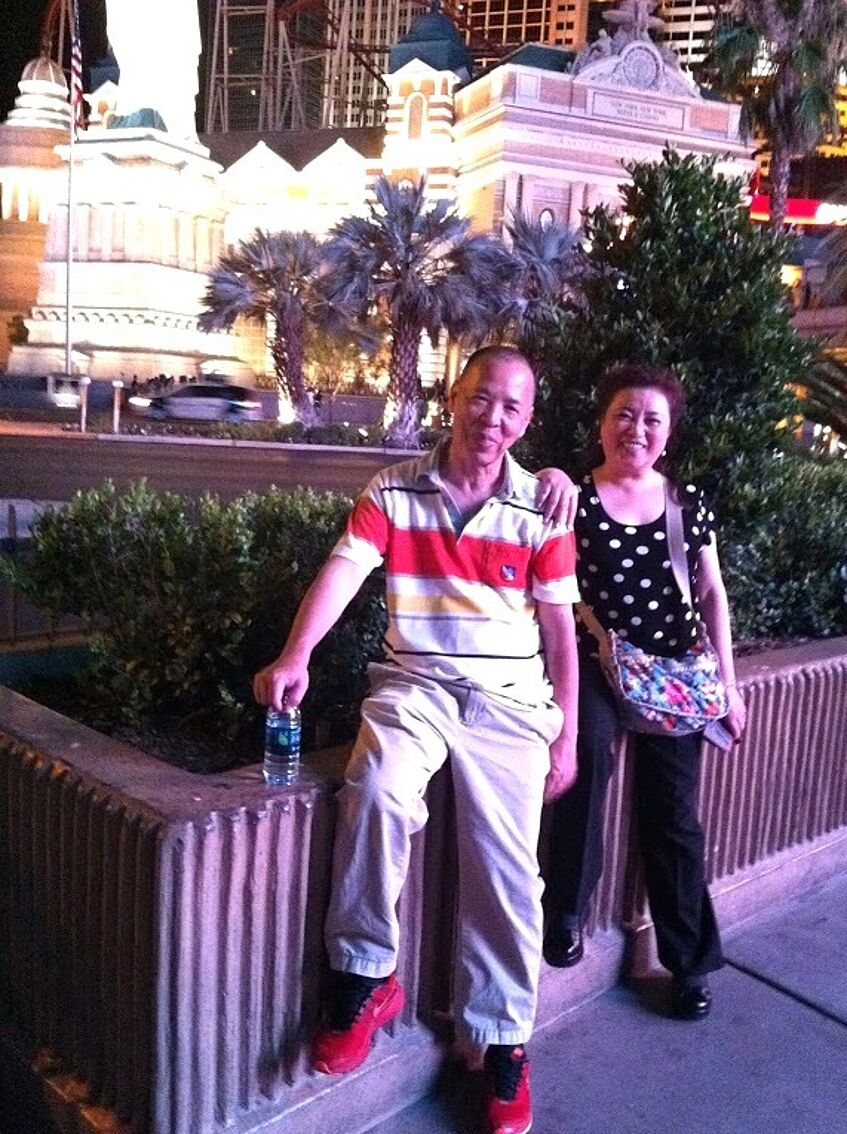
Wang Min (David Wong) and his wife in Las Vegas (2014)
Wang Min (David Wong)
... was born in 1947 and worked as a secondary school teacher in in the southern Chinese city of Guangzhou. In 1968 he was accused of "counter-revolutionary propaganda" because he had criticized the military training, and sentenced to eight years of "re-education". Wang lost his job and was put under "surveillance by the masses".
During the "Beijing Spring" in 1979, he became one of the editors of the independent journal "Weilai" (Future) in Guangzhou. In the early 80s he left China to study in the US, where he founded - together with other Chinese students - a magazine called "China Spring" (Zhongguo zhi Chun), and he took up leading positions in various political movements in exile. Wang Min now lives in in Las Vegas, Nevada.
Interview with Wang Min (on June 15, 2014, in his house in Las Vegas, Nevada)
Here you find the Chinese text of the interview.
Interviewer (Helmut Opletal): You participated in the 1978-1979 Democracy Movement in Guangzhou. Looking back on this period now, what are your main feelings and thoughts?
Wang Min: I joined the social movements during the Cultural Revolution between 1966 and 1967 when I was 19. I had many friends from middle schools in Guangzhou, such as Wang Xizhe or Liu Guokai, all of whom I met in ‘66 and ‘67. We became very close and exchanged ideas.
However, in 1968, I opposed the entry of the Chinese army into the schools. It was called "military supporting the left" which meant the army taking over the management of the schools. I was at Guangzhou No. 16 Middle School then, and engaged in writing dazibaos. Then the People's Liberation Army entered the school, established a Revolutionary Committee to manage it, and gathered teachers and pupils for “Mao Zedong Thought training classes”, which was nothing but brainwashing.
I resisted and refused to participate. To escape the “Mao Zedong Thought training class,” I went to Beijing. As a result, the Guangzhou police issued a nationwide arrest warrant, and I was hunted down. Eventually they caught me on a train back. Between 1968 and 1976, I was not allowed to attend school and labeled a "counter-revolutionary” who had to do labor under “supervision by the masses." My daily work consisted of cleaning toilets, digging defense tunnels, or farming at a branch school during those eight years.
Interviewer: You weren't formally arrested, so were you still at home?
Wang: No, I was not allowed to go home, but confined at my school. Every day when I had finished work, two people with sticks followed behind me.
Interviewer: Which group did you join in 1966 and 1967?
Wang: I joined the Guangzhou Production and Construction Corps.
Interviewer: What kind of organization was this?
Wang: There was a power struggle between two major factions of Red Guards, one of which was the “rebels.” They opposed the army and the Guangdong provincial government, when Zhao Ziyang was the provincial party secretary. We opposed the provincial government and the military region leaders. I even led people to storm into the Guangzhou Military Region compound and staged a sit-in. It was a very fierce affair.
Interviewer: How fierce was this?
Wang: It got so fierce that it turned into a physical fight. Both sides had weapons and fought each other.
Interviewer: Did you also seize weapons when you stormed into the military compound?
Wang: Yes, we also took away some weapons. But not for the purpose of fighting; it was more a protest against the army entering the schools.
Interviewer: You weren’t arrested yet in 1966 or 1967?
Wang: No. Only in August 1968, because of my opposition, I was expelled from the “Mao Zedong Thought training class” run by the military, then labeled a “counter-revolutionary” and finally arrested by the Guangzhou Garrison Command.
However, I was never sentenced because I hadn't committed any other criminal offenses; I had only written dazibaos as a protest. So after being arrested, I spent a year in prison and then was released without any sentencing. I had been detained by the Guangzhou Garrison Command for a year, but without consequences. Then I was sent back to the school for eight years of supervised labor. That lasted until 1976, after the downfall of the Gang of Four.
In 1977, I returned to teaching at the No. 16 Middle School. I was also a student at a teachers' college, but hadn't graduated yet, so I was working while attending university at night. Finally free after my release in 1976, I reconnected with old friends like Liu Guokai.
During Li Yizhe's dazibao campaign, I had already been released, but I didn't dare join their group because I was still under surveillance. Around ‘78 and ‘79, we learned about the new Democracy Wall Movement in Beijing, and together with several classmates […] from South China Normal University, a total of twenty-six or twenty-seven people, we started a magazine called “Future” (Weilai). Only four issues were published; they were mimeographed, as we couldn’t get it regularly printed in a printing press.
Interviewer: When was this?
Wang: From early 1979 to early 1980. By the end of 1979, the Guangdong Party Committee had found out about us. There were many independent publications in Guangzhou then, one was run by Wang Xizhe [of the Li Yizhe group] called “Xueyou Tongxun” (Study Mates Newsletter), which he ran all by himself. He started later than us, as he had just been released by the Guangzhou Party Committee. We already published our “Future” at that time, so Li Zhengtian [another “Li Yizhe” member] and I brought him this magazine.
Li Zhengtian wasn't very interested, but Wang Xizhe was. He didn't join us, but started his own magazine. Liu Guokai ran “Renmin Zhisheng” (Voice of the People) at that time, but later he had a dispute with his deputy He Qiu, and the two separated. He Qiu then started another magazine called “Renmin Zhilu” (The Road of the People). And there were also Chen Qing and Shu Wei from Sun Yat-sen University who ran “Hongdou” (Red Bean), named after the Tang Dynasty poem “Red beans grow in the south.” […] The student journal was run by several people. And at [Guangzhou’s] Jinan University there were several overseas Chinese students from Hong Kong and Macau who published a magazine called “Poetry Journal”. One of those in charge is now a legislator in Macau. Those were the most active independent publications in Guangzhou.
After printing our magazine, we distributed it in various places, at the universities, or in front of the Finance Bureau and the Martyrs' Park in downtown Guangzhou.
Li Zhengtian and his colleagues also gave speeches, and we also organized a seminar at Guangzhou Normal University. […] Wang Xizhe also gave a speech criticizing Mao at that event, and this discourse attracted the attention of the Guangdong Party Committee. They said that we had gone astray, that we had gone too far.
At the end of 1979, the Guangdong Party Committee summoned the people in charge of several independent magazines for a talk. A man named Li Gang represented the Party. I think Wang Xizhe and Liu Guokai went there. Our “Future” magazine was represented by Yao Xuezheng, a student from the teachers' college. At the meeting, they said that the Central Committee had already ordered the restriction of independent publications, and since we were all publishing underground publications, they were giving us a warning. If we did not stop publishing immediately, they would notify our schools to consider suspending our student status. Although we were about to enter society, we were disrupting the social order.
After that, we basically stopped publishing, only Wang Xizhe and his group remained active. Also, news from Beijing seemed to be getting more and more serious. So we hid at home when we printed our publication, and we were afraid that our neighbors would find out and report us. The street committees could easily discover who was engaging in “illegal activities.” I remember when we were mimeographing, we closed all the windows, and we used wax stencils, because it was very hard work to engrave steel plates. And we couldn’t print many copies because the wax stencils wore out quickly.
Interviewer: How many copies did you print?
Wang: It differed for each issue. When the stencils were of good quality and we were very careful, we could print several hundred copies. If the stencils became quickly damaged, it was only one or two hundred.
Interviewer: So you were still afraid of the authorities...
Wang: Of course. If the police found out, they would arrest us. But Guangzhou wasn't as strict as Beijing and didn't take as drastic measures. But some local regulations were even stricter than Beijing's. That’s why we were afraid and covered the windows with blankets, turning on only a small light when we printed, so no one could see us.
Also, back then, some parents weren't supportive of their youngsters, and they would try to stop us. We changed the venue, sometimes we were here, sometimes there. I was better off because my parents lived in Hong Kong, and I didn't have any elders to supervise me.
Interviewer: So your parents were already in Hong Kong then?
Wang: Yes, they had always lived there. A long time before, when I was in middle school, my father came back to teach painting in Guangzhou. He only stayed until 1956 [?] before going back to Hong Kong. So I wasn't afraid of being alone. I was already a teacher then, and I had my own school accomodation.
Interviewer: You said that the news coming from Beijing was getting increasingly irritating. What kind of news was it, and how did you receive them?
Wang: First, I heard about them through radio, from the Voice of America. It was this way that I learned of Wei Jingsheng's arrest quite early. There was also a Vietnamese radio station that specifically reported on the situation in China. And there was Radio Moscow. And because Guangzhou is very close to Hong Kong, we could also receive many radio broadcasts from there, but no TV. We received information very early about Fu Yuehua, and then that Wei Jingsheng had been arrested. We reported this news in our “Future” magazine, and also passed it on to some people by letter.
Later, Fu Shenqi planned to launch a nationwide independent publication, and representatives of 13 magazines went to Wuhan to discuss this. I wasn't involved, but a friend of ours named Wang Yifei from Guangzhou Railway Middle School went. He was also an old buddy of our Guangzhou Red Guard group. But the plan wasn’t realized in the end. Wang Yifei is now in New York, and he has changed his name to Wang Xiang.
The independent publications in Guangzhou continued. When Wei Jingsheng was arrested, Liu Qing took over the “Exploration” magazine in Beijing. After his arrest, activities in Guangzhou went on. Liu Qing had worked for Wei Jingsheng’s release, later we had to organize a committee for Liu Qing’s release. This committee was based in Guangzhou. Wang Xizhe and his friends participated, but I had already gone abroad by then.
I was quite lucky because my father taught at the University of Hawaii, so he wrote me an invitation to study abroad to get some degree. I was fortunate to leave China in early 1980, so I couldn’t participate in the latter part of the activities.
Interviewer: When your parents were in Hong Kong, did you never go to Hong Kong?
Wang: No, I wasn't allowed. My younger brother was studying at Jinan University, and he could go back and forth. He regularly brought our “Future” journal that contained Wang Xizhe's speeches, to Hong Kong to a magazine called “Zhengming” (Debate) whose owner, Wen Hui. also knew my father. Wen was from Peking University and also an artist.
My brother and students at Jinan University from Hong Kong, Macao and other overseas Chinese could freely travel between Guangzhou and Hong Kong, and they transported many texts for publication in “Zhengming”. Our “Future” journal was also sent to Hong Kong through this channel. It contained for example, Wang Xizhe's speech at the Guangzhou Teachers College. If I remember correctly, its title was "Mao Zedong and the Cultural Revolution." I hosted that speech, and he delivered it.
My overall impression is that the Democracy Wall Movement of 1979 was a post-Cultural Revolution public movement for liberalization, directed against the central government. It wasn't limited to Beijing, but spread throughout the country. Guangzhou was just one city among many all over China.
For example, there was a magazine called “Sea Spray” (Hailanghua) published by Sun Weibang and his colleagues in Shandong. Another magazine in Guizhou was run by Huang Xiang and his team. You can see, this Democracy Wall Movement was nationwide, not just limited to Beijing.
Interviewer: Were there places in Guangzhou where people put up their dazibaos and sold independent publications like the Xidan Wall in Beijing?
Wang: There wasn't a fixed location. But the editors of our magazines often gave speeches and distributed their texts at universities. I remember that Liu Guokai and his group went to the Martyrs' Park or to Zhongshan Fifth Road, a business district like Beijing’s Wangfujing, to speak to people and sell publications. I know about these activities, but there wasn't a fixed location like the Democracy Wall in Beijing.
I just counted, there existed as many as seven or eight independent journals in Guangzhou, so quite a lot, and I think only Beijing had more. Also, because of Li Yizhe's famous big-character posters, Guangzhou's independent publications enjoyed national recognition and gave them a privileged position nationwide.
Interviewer: In terms of content, what were the main topics in your magazine “Future”?
Wang: It was primarily literary, plus some political commentaries. But politics was not its main content; it was roughly half politics and half literature. But the literary texts also included political fiction that expressed dissatisfaction with the status quo.
Interviewer: What aspects of the situation caused discontent then?
Wang: It was mainly the lack of freedom of speech.
Interviewer: Was democratization a focus?
Wang: It was mentioned as well.
Interviewer: In which form did you bring it up?
Wang: I think we reprinted Wei Jingsheng's "The Fifth Modernization." There was a kind of consensus among the independent publications in China for a need for democratization as proposed in the “Fifth Modernization.” In Guangzhou, we all agreed upon it and believed we had to go beyond Deng Xiaoping's “Four Modernizations.”
Many of our students of humanities like Chinese literature or political science valued Hu Ping's article "On Freedom of Speech." For them freedom of speech seemed an important means to break through the political impasses of the time.
Interviewer: So what did you think at that time of the Communist Party, the one-party system, and Mao?
Wang: As I said, Guangzhou is relatively close to Hong Kong and Macau, and we listened to Hong Kong broadcasts every day. So we were probably more "reactionary" than people in the north. Many of us had tried to cross the border illegally. For example, I once tried to clandestinely cross into Hong Kong, but I didn’t succeed and was returned to Guangzhou.
We were probably all anti-Mao then, except for Wang Xizhe, who hadn't gone as far as we. But Liu Guokai and I were both staunchly anti-Mao and anti-Communist. Of course, we didn't dare to write this in our articles, but in our ideological debates, we were very anti-Party, to the point of wanting to escape and illegally cross the border. It seems that in the north they hadn't reached that point of being anti-Communist and wanting to flee.
In our group, our first priority was to oppose Mao, because we believed that Mao Zedong was the greatest culprit in the Cultural Revolution. Secondly, we began to doubt the one-party dictatorship, but we didn't dare yet propose forming a new political party. It was only after I had gone abroad that I felt the need to create a new party, to have a new publishing law with freedom of press and freedom of speech – that was our consensus at the time.
First, we needed freedom of publication; second, freedom of speech; and third, it was essential to criticize Mao. Without opposing and criticizing Mao, China had no hope. We also discussed organizing labor unions. Forming a party was something we started thinking about, but we didn't dare debate it too much.
Wang Xizhe later met Xu Wenli in Ganjiakou to discuss forming a party. But in Guangzhou, this was still in the preliminary stage, and I only thought about it more strongly after going abroad. But I saw the need for independent labor and student unions. The school leadership shouldn't lead student unions, and factory party secretaries shouldn't lead the labor unions. For example, at our No. 16 Middle School, we demanded that our teachers' labor union should be independent and elect its own chairman; that’s how far we went at that time.
Interviewer: So the external influences mainly came through Hong Kong?
Wang: Yes, through radio and television, and also through the many students from Hong Kong and Macau. I remember two persons called Wu Zhongxian and Liu Sanqing who came from Hong Kong at that time. Later, Liu Sanqing was arrested in Guangzhou. He is now with the “Hong Kong Alliance in Support of Patriotic Democratic Movements of China”.
He came to Guangzhou to establish contacts. He had met Wang Xizhe, and when Wang Xizhe was arrested, he openly demanded to visit him in prison. He openly demanded to see Wang in jail. As a result, the Guangzhou police arrested him as well and sentenced him to twelve years. Only after his release they sent him back to Hong Kong.
There were also magazine editors. There is a Hong Kong legislator now named Leung Kwok-hung, nicknamed "Long Hair.” They published a magazine in Hong Kong called "October Review.” “Long Hair” was in charge, and his deputy was a certain Chen Si. They also sent people to contact our pro-democracy movement in Guangzhou. This way, our independent publications were also greatly influenced by liberal figures and magazines in Hong Kong. We received news from Hong Kong media faster than people in Beijing or in other cities.
Interviewer: Back then, were you able to get your hands on newspapers and magazines from Hong Kong?
Wang: I was able to obtain some through many of the people I just mentioned, through students and colleagues who regularly passed through the border at Shenzhen. All my copies of “Zhengming” were brought by my younger brother who could freely travel in and out to Hong Kong.
Interviewer: Did you think of participating when Li Yizhe published their big-character poster in 1974?
Wang: Not really, because I was only rehabilitated in 1976.
Interviewer: So you didn't have the chance to participate in the 1973 or 1974 activities?
Wang: I did attend some of their rallies, but I didn't really dare join them because I still had to report to my school every day and attend meetings where I was to be criticized. But I sometimes sneaked out to take part in rallies. Things became more relaxed in 1974; in the years before, I could not leave the school at all. But after the Lin Biao incident in 1974, things loosened up a bit, and I was allowed leave the school, but I still had to go back to report every day. So I did join rallies of “Li Yizhe,” but I didn't dare to register with them, sign anything, or participate in the writing of dazibaos.
Interviewer: Were you aware what their big-character posters demanded?
Wang: I knew all these people, and I knew everything they said. Li Zhengtian and Chen Yiyang were my friends. We talked about it, but I didn't join their group. If I had, I probably wouldn't have been freed in 1976, nor would I have been able to get back my job as a teacher.
Interviewer: I do see some contradiction. You said you started your publication in 1979, when you rejected the Communist Party and opposed Mao Zedong. But originally you were a Red Guard…
Wang: Yes, yes, the Red Guards supported Mao and were the most loyal to him.
Interviewer: When did you begin to have doubts?
Wang: In August 1968, when I was arrested by the Guangzhou Security Command and imprisoned for a year before being released. While in prison, I thought, "We have supported Mao Zedong so much, pledging we would follow him and oppose the capitalist road. Why did he turn around and attack us? We thought we hadn't made a mistake in supporting him in 1966 and 1967, so why did he turn around and attack us?"
During my whole year in prison, I kept reading Mao's works. I discovered a big problem, and in the end, I felt that I couldn't fully trust him when he single-handedly commanded the whole country and created such a big chaos. That's when I started to doubt him.
I thought he made serious mistakes later on. One was sending soldiers into factories and schools. I got arrested for criticizing this. From this alone, this person couldn’t be a “god.” A god wouldn't commit such mistakes, but this was a very serious error, and he continued to do so. That's where my suspicions came from.
Interviewer: It's quite obvious, that you were against some of Mao's policies and ideas. What other aspects also made you doubt?
Wang: I had also doubts about his "Down to the Countryside" policy which drove all the educated young people nationwide to rural areas, students from universities and middle schools who were the most advanced young intellectuals in society, the group that should make China stronger and more prosperous, thus preventing them from becoming a major force and future leaders in the cities. I think this deeply violated the basics of our society.
Even earlier, before I was sent to prison, during the Cultural Revolution's campaign to destroy the “Four Olds” [against “bourgeois” and traditional culture,] all the libraries were closed. But because I was a Red Guard leader, I had the right to break the seals and go inside. So I went to the library every evening to read, and I read a lot of European and American novels that I couldn't see outside. It included Victor Hugo's “Ninety-Three” which I read during the most chaotic period of the Cultural Revolution in 1967.
I was greatly influenced then by Western liberal intellectuals through literature and art, novels and paintings. So before I got arrested by the army, I had already begun to realize that some of Mao’s ideas, such as the “Yan'an Forum on Literature and Art” [demanding that cultural activity to be in the interest of the proletariat,] were wrong.
The Party spirit, discipline, and communist thought he promoted seemed very distant from the ideas of Western novelists and thinkers. From a humanistic perspective, I felt more inclined towards these. Emotionally and politically, I still followed Mao's Cultural Revolution line of thinking; on the other hand, from a humanistic perspective, it seemed that the Western ideas might suit me better, and I was more inclined to human nature and humanitarianism as the foundation.
When I was imprisoned, I combined this pursuit of Western civilization and humanity, and I thought they should also be integrated into our politics. That’s when I began to doubt Mao Zedong's political line and his humanistic thought. And after a year of hard labor, I became convinced that he was completely wrong.
Interviewer: What did you think at that time about the rebellion during the Cultural Revolution you had participated in?
Wang: I felt deceived. After this year, I realized I had been deceived by Mao.
Interviewer: But your “rebellion” also included violence against people?
Wang: I never physically assaulted anyone, but there were in fact fights between the two factions. I was the editor-in-chief of the “Guangzhou Corps Daily,” a Red Guard paper organized by middle school students, so I was rather writing articles than responsible for violence.
One who participated in the fighting was Liu Guokai's brother, Liu Guoxuan, who was one of the ringleaders. Later, the Party and the army not only looked into the armed confrontations but also into my articles, even more so because I had written all the editorials.
Interviewer: So in prison, you started to doubt these activities of yours?
Wang: I began to suspect that we had been deceived by Mao, that we had been tricked into what we have done.
Interviewer: Did you already think so at that time?
Wang: Yes, and I burst into tears, not because of my unfair treatment, but I cried all night because I felt cheated by Mao. It was a turning point in my life. From fervently following Mao Zedong, I realized he had deceived me, and not just me, but all the students and young intellectuals in the country. This “god” completely fell to pieces in my heart, and I began to doubt the entire Communist Party.
Later I realized it wasn't just one person, nor could a single person cause such a massive disaster as in the Cultural Revolution. It was a party, and not just a party, but a system; their entire theory was wrong. After that, I completely changed.
So when the “Li Yizhe” group published “On Democracy and Legality under Socialism” in 1974, I admired their courage to write it. But deep down, I still disagreed and believed we should oppose Mao and the Communist Party. I didn't quite agree with their talk of “rule of law and democracy under socialism”; I thought the entire party and system needed to be changed.
Later, I told Li Zhengtian and others, and also Liu Guokai and Liu Guoxuan that I planned to clandestinely cross the border. They didn’t like this and said that I was a traitor which had completely gone to the other extreme.
But I couldn't stand this society anymore. From Li Yizhe's big-character poster, I still realized that some intellectuals and youths in Guangzhou had already taken a step forward, actually quite a few steps when they concluded that Mao Zedong was not a true Marxist, and that Mao's mistakes were a breach of Marxism.
But we had already begun to believe that Marx was also wrong, not only Mao, but Marx as well. We wanted to turn away from this country and the entire system. Those of the Democracy Wall Movement in the South were more inclined towards this than those in the North because they were heavily influenced by Hong Kong, leading to a more rebellious mindset.
Individuals like Liu Guokai and Liu Guoxuan deeply hated the Communist Party, already at the time of Li Yizhe's dazibao. It had reached the point that some even talked about organizing an anti-communist national army for salvation. However, they dared not say this openly because of the risk of imprisonment or even execution. But privately, they already discussed overthrowing the communists and the entire system in China. At the time, this was quite heretical.
So why did I speak positively about this group later? They all fled from southern Guangdong to Hong Kong, where they founded the “Beidou” (Big Dipper) magazine and another one called “Huanghe” (Yellow River). Some of their editors came to the US, like Liang Dong who is now the director of Radio Free Asia's Taiwan office. Their group was formed in 1979, and they fled to Hong Kong during the time of the Democracy Wall Movement. When the communists began their large-scale crackdown on independent publications, they continued their work there.
Interviewer: How do you evaluate the Chinese pro-democracy movement overseas and in the US? What developments have you experienced since you joined the movement?
Wang: This overseas Democracy Movement was formed when participants from the 1979 Democracy Wall and the Tian’anmen Square protests [of 1989] went into exile and joined forces with Chinese students already studying abroad, thus inheriting the ideas of the original Democracy Wall Movement and the Tian’anmen Square events [of 1976.]
Without the Democracy Wall movement, without the April 5th Movement, without these overseas pro-democracy movements, there would have been no Tian’anmen Square rebellion in 1989, and there wouldn’t be so many ideological currents.
Interviewer: But do the current pro-democracy movements in the US and in other places still have a significant impact on the domestic situation?
Wang: I don’t think it’s very significant now, especially when you compare it to opposition groups of other countries. What happens in mainland China now, does not depend on these relatively old former activists who are now in exile. The hope for democratization in China does not lie in the countries abroad, but mainly with the civil rights defense movements inside China.
The movements to defend civil rights and democracy in mainland China is developing much faster than what happened during the Democracy Wall era. Civil rights defense incidents all over the nation exceed by far the intensity of the Democracy Wall era and the Tian’anmen Square events. I believe that in this internet age, the Communist Party can suppress free publications, mimeographed or imported from Hong Kong, but they cannot stop the internet. The internet revolution could be the next breakthrough point for a major internal eruption in China.
I estimate that the Democracy Movement in mainland China will no longer rely on the old, outdated methods; the flames could be ignited across the country through the internet. Once the time is ripe, the future Wei Jingshengs and Xu Wenlis will come from there, no longer from traditional forms of publishing, but it may be the internet revolution that will change China.