
Li Shuang
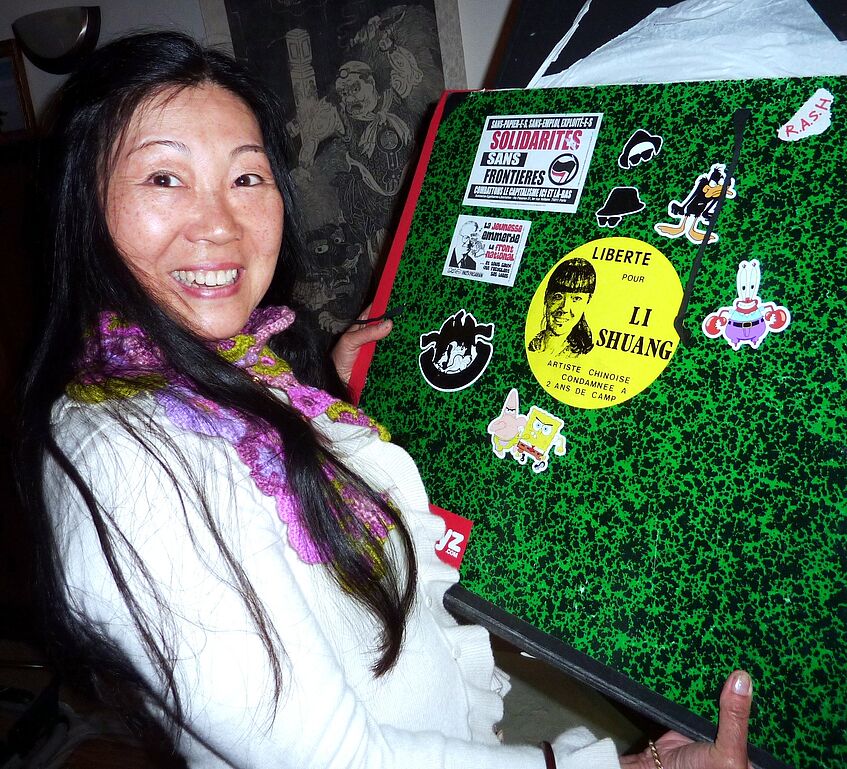
Li Shuang (2014)
Li Shuang
...was born in 1957 in Beijing, her father had been trained as a construction engineer, and was teaching at Tsinghua University. In the big purge of 1957 he was labelled a "rightist" and sent to work on construction sites, while Li Shuang's mother was transferred from Beijing to a post in remote Changchun (North-East China), and the three year old Li Shuang was left in a nursery in Beijing. Only in 1961 the family was reunited again.
When the Cultural Revolution began in 1966, Li's father was beaten and dragged to humiliating "criticism meetings", both parents lost their work, their home was ransacked by Red Guards, and Li Shuang's father was eventually put "under investigation" and locked up at his school.
At the age of fourteen, when she had entered middle school, Li spent time with some neighborhood gangs of unemployed youth who had returned from the countryside, at ninteen Li Shuang was herself sent for agricultural labor to a state farm outside Beijing. The close contact with nature though, made her start painting, and whenever possible she spent time outside to paint landscapes and people. In 1976 she found a job as a stage designer with the Beijing Youth Art Theater, that allowed her to move back to the city.
It was in the apartment of Bei Dao, a young writer then, that Li Shuang met in early 1979 the painter Huang Rui who was just about to plan an independent art exhibition. After inspecting Li's work at the home of Yan Li (who was her boyfriend at that time), Li Shuang was accepted to become a member of the "Stars" group of avant-garde artists. On September 27 they organized their first exhibition in the park outside the Fine Arts Gallery of Beijing. The show was quickly closed down by police, but in late 1979, and again in August 1980, the "Stars" were officially allowed to hold exhibitions in Beijing, and Li Shuang also participated in them.
In 1981, Li Shuang met the French sinologist and diplomat Emmanuel Bellefroid. They entered into a relationship and planned to get married, at a time when Chinese were not allowed yet to have intimate relationships with foreigners. One day, when Bellefroid was out of town, and Li was staying at his diplomatic apartment, waiting police managed to arrest her when she once came down to meet her visiting sister. Li was accused of "hooliganism" and sent to "re-education by labor" for two years, while Bellefroid had to leave China.
Numerous international media reported the "Li Shuang Case" at that time, French rights groups staged demonstrations in front of the Chinese embassy in Paris to press for Li's release. But only when French president François Mitterrand went on an official visit to Beijing in 1983, his conversation with Deng Xiaopoing resulted in the release of Li Shuang, just a week before her "re-education" term would have expired anyway.
When Li Shuang arrived at a Paris airport on November 26, 1983, she was met by a large crowd of supporters and journalists. In 1984 she got married to Emmanuel Bellefroid, and in the following years they had two sons. Li Shuang continued to pursue her artistic aspirations, together with her husband she also ran a gallery in Paris. Li was invited to show her works in many countries, more recently again in the People's Republic of China, where she also published (in 2013) an autobiography that has been warmly received by Chinese media. After almost thirty years though, she got divorced from Bellefroid. Li Shuang now lives near Fontainbleau, south of Paris.
Interview with Li Shuang (April 29, 2014 in her house near Fontainbleau, France)
(Here you find the Chinese text of the interview.)
Interviewer (Helmut Opletal): You've remained a painter all this time until today. But when you look back at those two Stars exhibitions, what significance do they hold for your life, more than thirty years later?
Li Shuang: I think thirty years is too short to remember a single event, but for a person growing up and maturing, it is long enough. The “Stars” exhibitions, the time with them, were probably the most crucial moments in my life. Young people then focused all their energy on creating their own life, without thinking too much about the future. So not thinking about the future, all our energy was focused on the present. The "Stars" period was the first time in my life that I took decisions. I decided to join this group, I decided what I wanted to paint, and I decided on the distance and relationship I would maintain with these friends, who were all boys. I was twenty-three years old then.
Before, except for my childhood, I had no control over my own destiny. I couldn’t analyze it; I was subject to others, to the environment, the society, family or school. My adolescence was a rebellious period, extremely rebellious. Among all the girls in China at the time, I was probably one of the most rebellious. But this rebellion stemmed from a desire to find myself, a refusal to live or act according to the lifestyles of others.
Interviewer: Does "others" here mean your parents?
Li: Parents and society. Actually my parents had suffered so much during the Cultural Revolution that they didn't have the energy to focus on their children's upbringing. They couldn't even take care of their own lives! So I think society was more important at that time.
Interviewer: Did you realize this already back then?
Li: No, I didn't, that’s why I was such a rebellious person. Rebellion is like a struggling animal. When I joined the “Stars”, I was very excited and happy in my feelings. I think this happiness came from the fact that I had chosen myself to do this; I wasn’t being forced by others. From a young age, I had always felt constrained, by my parents, by school and society. To avoid trouble, I always had to follow others without being able to express myself.
Interviewer: So how did you become interested in art? How did you start engaging in art and painting on your own?
Li: As a very young child, I was close to my grandmother, my mother’s mother. She noticed I loved to draw. If I had a book, I wanted to copy its pictures, or I wanted to color the book. My grandmother would say, "You've colored the whole book, but his is my book, you can't paint it for me, you should draw something yourself." So I started drawing. At one point, my granny insisted, "You should not use an eraser." I asked her why, and she said that way I could be strict with myself. I should draw whatever I wanted without regrets afterwards. Using an eraser always meant that I regretted something. From a young age, she has always supported my drawing. When I later discovered for the first time that I was a quite good at painting, I felt very proud of myself.
That year, when my father was held prisoner at the Academy of Architecture, we didn't know where exactly he was. We missed him terribly, and when I missed him, I would just look at his desk as if he were there. Our house had also been ransacked, we had nothing left.
Interviewer: When did all this happen? During the Cultural Revolution?
Li: It was in 1969. I started drawing with one of my father's pens, and I was drawing his desk. I was very satisfied with the result, I realized that without having ever had a teacher I was a natural talent at doing sketches. So I continued painting. I still have all my drawings from 1969 to 1971, when I was a child. I kept them in my art album, including this drawing of my father's desk. That's how it started, and I haven't stopped since. I started painting at thirteen, and now I'm over fifty, and I'm still painting…
Interviewer: Didn't you ever formally study art?
Li: I could never enter the art academy because of my family background. Later, I considered it. When China resumed the college entrance exams in 1977, I wanted to apply to the Film Academy. I had painted many landscapes when I was working in the countryside. So in the entrance exam, I obtained a very good score, but the points for my political background were zero, so I wasn't admitted.
I went back to the countryside. There I had a friend of mine, whose father was the director of stage design at the Youth Art Theatre. He showed all my small landscape paintings to his father who was impressed and said "Wow, these paintings are really good." They were just recruiting art designers, and I was hired. So I went straight back to Beijing at the end of 1977.
Interviewer: Where in the countryside had you been sent to work?
Li: To Shunyi, a town more than 100 kilometers from Beijing. It used to be all farmland, but now Shunyi is part of Beijing. I've returned to the place where I had worked. I had a very good relationship with the farmers then. It was my first time in the countryside, and I loved nature; I thought it was incredibly beautiful. I also loved animals, like horses and donkeys. So I had an excellent relationship with the farmers. I worked hard, I didn't care how much effort it needed. The farmers of course took me for a student from the city, but honest and hardworking. That’s why we got along so well. I went back to visit them several times, but now I can't find my village anymore; it's all become part of a city of concrete, with no fields left.
Interviewer: Did you have an art teacher back then?
Li: No, I didn't have an art teacher, and I didn’t have any money to pay for one. I was entirely self-taught. Back then, I used a small notebook, about the size of my hand, and colored chalk sticks, the kind children use. I could paint incredibly beautiful landscapes with these oil pastels, colorful and sentimental. I was completely absorbed. I thought that maybe I was made to become an artist.
When I was painting, I could forget about my poor health, my pain, fatigue and thirst, it made me forget everything. For me painting is entirely a spiritual activity that can guide your soul to a point of forgetting yourself. That's probably where the value of an artist lies. But back then, I didn't understand this, I only felt a passion. I was extremely tired from work every day, but didn’t sleep much at night because I wanted to paint. I would turn the small sketches I had made during the day into full paintings.
I usually found some rest during the day while working, and when I did, I would sit in the fields and immediately take out my little notebook to draw. In the evening I would return to our youth dormitory, and start painting again after dinner, sometimes until two in the morning, just to finish a little drawing. I was still able to go to work the next day. Painting seemed like a kind of nourishment, just like eating, giving me a lot of strength.
I drew hundreds of little sketches while I was working in the countryside, and it was probably because of these that the director of the Youth Art Theatre was impressed. He thought they were really good and beautiful. So I got accepted. I had not made it into the Film Academy before. But even if I had, my ideal job after graduation would have also been the Youth Art Theatre. Now I went straight there. So sometimes destiny is like that; there are many things you can't control.
Interviewer: Had you already seen art books from other people, or would you have liked to see some?
Li: There were no materials available at that time. When I was little, my grandfather ran an antique shop, a very famous one with many exquisite objects. He had a number of foreign friends, all businessmen, who presented him art books as gifts. I remember seeing some when I was little, including Soviet art books. The one I remember most vividly is a children's book series called “Barbar the Elephant”, I think it was French. Before the Cultural Revolution, my parents also possessed some art magazines and Soviet art books, but we didn’t have any other materials.
Interviewer: How did you eventually come into contact with the Stars Group?
Li: Before joining the “Stars”, I painted with the “No Name Art Group”. I would ride my bicycle alone to various parks in Beijing to sketch. I didn’t want to be seen, so I always hid. If I encountered a particularly beautiful place, I would hide nearby and paint it. Later, they also came to paint, but in a group, so they weren't so afraid. They would sit by the river and paint. That's how I got to know them. In the parks, at Zizhuyuan Park, Ditan Park or Yuetan Park. So I met Mang Ke and Yan Li.
During painting in different places, I first met Mang Ke. Young people always loved going out to have fun. So I'd bring my paint box and painting supplies and joined Mang Ke. Then I also got to know Yan Li. They'd hang out together, and I'd paint. With Yan Li, I ended up in a romantic relationship. Then Mang Ke knew Bei Dao, and Bei Dao knew Huang Rui; they were all in the same circle, and that's how we got to know each other.
Meeting the "Stars" members, my first feeling was, "Hmm, this organization is more ambitious than the No Name Society." Yes they were ambitious! The No Name Society had proclaimed that they wanted to follow the footsteps of Impressionism. I didn't even know then what Impressionism was. They just said we should paint like the Impressionists. We were all young then, more specifically the boys. I was the only girl in the group, they were all after me. But I always kept distance which gave me strength. I didn't want to join this organization as someone's girlfriend; I wanted to be myself without being attached to anyone.
Interviewer: So where did your ambitions lie?
Li: My ambition was that I really wanted to create something, not just paint a landscape. One can be attracted by the beauty of a sunset, but a sunset is just a sunset. It can evoke a desire to merge with the beautiful nature at such a moment. But while surrendering to nature, there might be something higher that I can depict. I couldn't put it into words at the time. Maybe something higher than nature was something within me, I thought. That’s what I wanted to paint. But what exactly, I didn't know myself. I just felt that the “Stars” didn’t only want to imitate, like the Impressionists. In a sense, they tried to paint starting out from themselves. That’s why I immediately agreed.
It was Huang Rui and Ma Desheng who came to examine my paintings. They were the organizers, and they wanted to decide, "Ah, we think this painter is good, he can join." When they looked at my paintings, they concluded they were very good, saying they showed inspiration. Then they asked me, "Would you like to join the Stars Art Group?" I said, yes, I would! Yeah, I was really happy. So I joined them, actively participating in all their exhibitions, creations and actions. What probably interested me most was when we were exhibiting on the streets. I felt like we were truly a group of rebels, using art as a political weapon against the authorities, opposing the current status of our society.
This approach suited me because I am not a violent person. I think everyone has a desire for a better, more peaceful society and to live in freedom. For us then, politics in China was not free, and we were not happy with this. The search for happiness and freedom is a human instinct. I personally didn't quite agree with the methods of some activists at the Democracy Wall. I listened to my own feelings. I said I am not a violent person, and using art to express one's desires for life and society, was more refined in my views.
When we held our Stars exhibition outside the venue of the Fine Arts Museum, this seemed an act of rebellion to me because the government at that time wouldn’t allow amateur painters like us into the Museum. This was clearly a challenge for us. I came from a background, where I had suffered a lot of discrimination and humiliation since childhood. Therefore I was unwilling to join the Communist Youth League or the Party because I had a feeling that I couldn't live up to their expectations of what kind of person I should be.
I wanted to make our society a better place. But if I were to vote, I would vote for the other side, not the Communists. So this was my only way out; I had no other choice. If I wanted to choose between contributing to this society or for myself, it would be first and foremost for me. I would strive for more freedom and a more fulfilling life, that's how I thought at the time. So when I was in school, I didn't want to join the Communist Youth League nor did I want to join the Party later, because I disagreed with how they ruled our country. Therefore, you could say that when I joined the "Stars," it was because I wanted to change China.
Interviewer: Did you participate in the October 1st march?
Li: No, I didn't participate because I was with Yan Li. My mother said that people from families like ours were all victims of the Cultural Revolution, where many people have died, "You've gone mad; you absolutely cannot participate in this," she said. So I ran away from home. I said I wouldn't participate, I wouldn't participate, but I wanted to go out. I went to Yan Li's home. His father was a Communist. He took a chair and put it in front of the door insisting, "You're not allowed to go out to participate in this kind of anti-Party and anti-social demonstration."
Interviewer: So you were both not allowed?
Li: Neither of us was permitted to participate in such an “anti-Party and anti-social” protest. We still went, but when we arrived at the venue, the procession had already left. So we rode our bikes directly to the Municipal Party Committee, where the other "Stars" had already gathered.
Interviewer: So you still participated after all. Weren't you afraid?
Li: I had nothing to be afraid of. For me it seemed the only way out to change my personal destiny and to change China.
Interviewer: Did you participate in both exhibitions later on?
Li: Yes, I did.
Interviewer: What did it mean for you to take part in such exhibitions?
Li: Like I just said, the Stars period was very important for me, a very happy phase. It wasn’t yet clear then that the "Stars" would become a foundation stone in the history of Chinese art.
From my personal perspective, the participation not only brought emotional joy for me, but also a great deal of creative freedom. No one said, "You can't paint like this." I could exhibit whatever I painted; that was freedom. Thirdly, to change our destiny, we had to start with culture. This was the kind of language to express what sort of society we wanted.
Interviewer: When did you realize that en exhibition had become a success? Was there a specific moment?
Li: It was quite specific when we took all our works to Huang Rui's home, and then leaders from the China Artists Association came to assess them. After looking at our creations, they thought they were acceptable. They checked whether the content wasn’t too extreme, whether there were nudes or any political overtones. Those they wouldn't allow to be exhibited. But it's hard to say if a painting has political overtones. Like Wang Keping's works, they wouldn't allow them to be exhibited at this time. But Wang Keping's put them into the exhibition anyway.
As for my work, a painting I later sold at Sotheby's, actually had a political content at the time. You may remember a woman named Zhang Zhixin. [She was executed [in 1975 in Liaoning Province for “counter-revolutionary crimes.”] Before the execution, it seems she was shouting slogans, so they would cut her throat before she was shot. This story was known throughout China.
When I heard this story, I felt deeply moved. As a woman, and I thought she was so brave. I had always believed that women in history were often courageous, when they stood at the forefront.
Because I was so moved by Zhang Zhixin's death, I later painted this “Red and Black”, the one that sold at Sotheby's. I painted a woman who was bound, her throat slit. It looked terrifying, with another woman screaming beside her. When I painted this, I was really thinking of this political background. When Jiang Feng [President of the Artists’ Association] saw it, he asked, "What is this? Why is it so terrifying?" I answered, "Nothing, just a dream I had, a very terrifying dream," and he didn't pursue it further. So I think the advantage of art is that you need not explain it very clearly.
Interviewer: Do you think he knew what it was?
Li: No, he didn't.
Interviewer: He didn't know, and he didn't expect it?
Li: That’s it. He didn't know and he didn't expect it. So it was exhibited. That's the power of art. It evokes emotions with others that language cannot express. The power of painting transcends that of just words.
At the opening of the exhibition, so many people had come. I thought, wow, so many are interested, we never expected this at all. We were very excited, and thought of follow-up ideas, such as printing some photos and raising funds by selling these. So in the evenings we went to [Zhong] Acheng's home, or rather his office. He had just returned from the countryside, now he worked at the [official magazine] “People's Literature” where he had an office. At night we could develop and print photos there. During daytime, we took them to the Museum to be sold. I'm talking about the second exhibition [in August 1980] where we were able to sell quite a number of these small photo prints.
The sensation caused by the "Stars Exhibition" was something we hadn't anticipated. Before we had founded the "Stars," we had never experienced such a personal motivation. We weren’t seeking fame or anything like that. It was simply a form of protest. But perhaps it was because the "Stars" had ignited some resonance in the hearts of Chinese that so many people came.
Interviewer: Later you met Bai Tianxiang [the Chinese name of the French sinologist and diplomat Emmanuel Bellefroid who Li Shuang fell in love with]?
Li: There were many foreigners at the time, and he was one of them, one of those interested in this whole movement. Our group was also meeting foreigners. I didn't think too much about it. Some friends had probably more contact than me, like Wang Keping, who knew many people. He probably understood that we could achieve more through foreigners. I didn't; I was probably still quite naive.
Later, I met Bellefroid because he was very close to the pro-democracy movement, but I didn't know much about his background. We were often socializing in foreign circles then, we were drinking, dancing and singing together. I was very fond of dancing then, which was new to me! [She laughs.] Even the French ambassador had fun with us, and he actually taught me how to dance.
Wang Keping also really loved dancing. When you're young, it's all about fun. When we met all those foreigners, we thought that they were completely different from Chinese. Our struggle at that time was about opening up our country; we didn't think about going abroad, because we didn't know what foreign countries were like. But this way we obtained a vague feeling about it. Foreigners, we thought, were more carefree, more romantic, more liberal, and perhaps more civilized and cultured than us. These were just imaginations, but that's why we enjoyed hanging out with outsiders. The entire “Stars” team was young people yearning for freedom and a better life. We experienced singing and writing poetry. The whole cultural scene was still very much blocked and stagnating at that time.
Interviewer: When you had so much contact and interaction with foreigners, did some Chinese criticize you?
Li: It wasn't a matter of critique. Chinese were divided into two groups then. One was completely afraid; they knew there could be danger in social relations with foreigners, so they didn't dare. But we didn't care at all.
Interviewer: Back then, I remember, the attitude towards the West was relatively positive in China. Deng Xiaoping visited the United States, many Chinese students went abroad. Was there a sense of openness and learning from the outside world at that time?
Li: Oh yes. Deng opened China's door a little bit. But we knew, especially me, that going abroad, it could never be myself. I came from a family that had suffered from the Cultural Revolution, and people like us were always under close surveillance. Going to Shanghai, meeting an ambassador or a foreign company representative, they always wanted to control what I say. So it couldn’t be me, no matter how open things became. Even if China were to open up, only standard Communist Party members would be allowed to travel abroad.
Interviewer: Later, when you were with Emmanuel Bellefroid, you got arrested and sent to prison. Do you think this was related to your participation in the Stars Art Exhibition?
Li: Oh yes, the whole thing was because of my connection to the "Stars". The other members probably have different opinions. But after having been arrested, I was detained in the "Paoju" [a nickname for a police detention center in Beijing] for three months. All their interrogations revolved around the "Stars" and the pro-democracy movement. They arrested me because one of my girlfriends had provided some false evidence. That's how it works in China. They may arrest you because of a testimony, regardless whether it's true or false.
After my arrest, they demanded all the time confessions from me so they could use them to detain also Wang Keping, Yan Li, Ma Desheng, and Huang Rui. Their goal was to destroy the entire pro-democracy movement. The "Stars" were very close to the movement and their street march [Oct. 1, 1979 to protest the ban of the “Stars” exhibition] had also been organized by pro-democracy members.
The Public Security Bureau knew this. Their goal was to use a confession by me to arrest other members of the "Stars". But they failed because I wouldn't speak. They deprived me of sleep for three days by shining bright lights on me. I thought about the bottom line of being a decent human being then. If I started telling all sorts of things, what would I do in the future? How could I face my friends after getting out? I would be out, but they would be in, they would get arrested.
I absolutely couldn't cross that line. That's why I continued to be detained there for three months. Finally, they locked me in a well. Later I painted a picture of such a scene, and strangely I painted this before I was arrested, just like a premonition. I painted three such prophetic pictures in total.
In October 1980, it was me who became locked up in that round well at the police detention center. I've described all this in my book. I didn’t know how long I was locked up; maybe one night, maybe fifteen hours, I didn’t know. When they let me out, they thought I had given in. They told me, either I write something they wanted, or I would get sentenced. I said, "Then sentence me." This was the last day; the next morning I was told the verdict. That’s how the "Li Shuang incident" is related to "Stars."
Interviewer: And what about Bellefroid …?
Li: It's also related to Emmanuel's efforts. Because he was a diplomat, he knew how to amplify an event and get people's attention. Otherwise maybe many more people in China or around the world would have been imprisoned and killed like this, and nobody would have known.
Interviewer: So it was also closely related to him and the pro-democracy movement?
Li: Yes, somehow. Because…
Interviewer: Because they couldn't arrest him, he was a diplomat.
Li: Yes, so they arrested me. Afterwards, the “Li Shuang incident” became a very big issue in China. The “Beijing Daily”, the “Youth Daily” and other papers reported it. It was on television, and later it reached the schools. Some friends have told me that they had to hold criticism meetings in schools, everyone had to write an essay, and everyone had to discuss the “Li Shuang incident.” So it became a huge issue in China. I call it “killing the chicken to scare the monkey,” which means punishing someone to spread fear to everyone.
Interviewer: What did they write in the newspapers? How did they analyze it in schools?
Li: They said that Emmanuel Bellefroid was a French diplomat who was using the guise of a diplomat to create a pro-democracy incident. At that time, they were almost going to blame everything on the “Stars” nationwide. They tortured me so much in prison to force me to tell them some things I had heard from the “Stars.” With such information, they would have publicly criticized the group in the newspapers all over China. But I didn't. And so they had no pretext to arrest anyone.
Interviewer: And at the schools, what did they say about Li Shuang?
Li: They said Li Shuang had a problem with her personal life, and she was living with a foreigner without being married. This is a method the Communist Party loves – using sex and personal issues…
Interviewer: When did you first return to China again?
Li: After June 4th [1989.]
Interviewer: And never before June 4th?
Li: They wouldn't let me go. I could only return after June 4th, it was my first time back. When I applied for a visa, they would refuse it. When I applied again later, the Chinese embassy made me sign a guarantee saying I wouldn't talk about politics, I wouldn't meet foreigners, and so on.
Actually, when the "Li Shuang incident" happened, the Public Security Bureau used various methods before the arrested me. There was also a French diplomat, who spied for the Chinese, a famous story about a relationship he had with a Chinese woman, who actually was a man. Maybe you heard that story? [Embassy employee Bernard Boursicot was seduced by the Chinese opera singer Shi Peipu into a sexual relationship, during which Shi obtained classified information from the embassy. They were both sentenced to prison terms in France and later pardoned by President François Mitterrand.]
Interviewer: Yes, yes, I know.
Li: China probably pulled some strings, before they detained me. Emmanuel was sent on a professional assignment to Hong Kong. Before he left, he strictly advised me, not to leave his apartment. I was really naive. He just told me not to go out, but as soon as he had left, one of his diplomat friends and that other man came to see me in the diplomatic compound. They said they just wanted to chat and hang out a bit, nothing more. But later they wanted to sleep with me, both of them. I was stunned. I didn't understand at all, how could these two Frenchmen be Emmanuel’s friends? The other person I didn't know was the one later imprisoned by the French [Bernard Boursicot]. I was angry. I didn't understand anything, so I opened the door and just pushed them out. I still didn't understand, but now I understand. China wanted to use this incident. Wasn't he a spy for the Chinese? They tried to frame me for prostitution, but they didn't succeed. Had they been successful, they could have easily accused Li Shuang of being a prostitute, and they would have had some evidence.
Interviewer: So, your first trip back to China was mainly to see your family?
Li: Yes, to see my family.
Interviewer: Didn't you see any other friends?
Li: No, because I had signed that document saying I couldn't see friends or foreigners, otherwise I wouldn’t be allowed to go to China.
Interviewer: And did you often go back afterwards?
Li: I actually returned to China quite frequently.
Interviewer: Since many people know about your case, what questions did they ask, or how did you discuss things with them?
Li: For some time, I was focused on painting and didn’t participate much in activities. So, I was quite reclusive for a while. I also had two children who kept me busy, so I didn't take part in many activities.
Interviewer: Last year you published a book in China and took part in some events there. How do people in China nowadays speak about the history of the "Stars"?
Li: The "Stars" movement is no longer an event that gets much official attention; it's history, thirty years ago. Although the authorities are still holding a grudge on the "Stars" movement and the "Li Shuang incident," they don't really need to, because there are many other things more important for them. The "Stars," for example, are currently included in a televised anthology on Chinese art. CCTV is producing it, and they are interviewing four or five of our people.
Interviewer: It is the Central Chinese Television, really?
Li: Yes. They're more relaxed about the "Stars" movement nowadays.
Interviewer: Have they already interviewed some?
Li: I have been interviewed. They talk about forty persons in the entire documentary, artists from many different periods, and I'm the only woman among them.
Interviewer: Who else from the "Stars" is supposed to figure there?
Li: There are also Wang Keping, Huang Rui, and Ma Desheng from the "Stars". But their interviews haven’t taken place yet.
Interviewer: Did you bring up political issues in your interview? Did you talk at all about the relationship with the pro-democracy movement?
Li: The interviewers asked us not to talk too much about what happened back then, just about art, not about the political motives at the time. So we got some restrictions, but it wasn't too strict. And anyway, they could cut things out as they pleased.
Interviewer: So do you talk about these political aspects in your book?
Li: Well, this is how I see it in my book: To this day, I have no resentment what the Chinese government did back then. I hold no grudges. Because I feel that this period was a sort of training for my life. These events allowed me to think about life's essence and to gradually learn to let go of past hatred. Things that happened in the past are all there, the good and the bad. Their only effect is that they have trained me to become a mature woman, and to forgive many things. If I hadn't had so many intense experiences in my life, I wouldn't be the carefree person I am today.
So in my book I am very clear: I can describe these things how they happened, but I don't comment them, I can't say whether they were good or bad. In the end, I make an appeal that everyone who experienced such injustices and pains back then should let go of the past. After all, it is the China of thirty years ago. The way we were learning how to be human, China was also learning to become a dignified great power. Life is like that; we need to experience certain things, some clashes, some conflicts, in order to grow together. And China has also been growing. For example, because I served two years in prison, because of my suffering, Chinese can now marry foreigners. So my sufferings could bring happiness to many others. I think everything is dialectical; it has two sides, a positive and a negative. So why should we focus on the negative? Why not focus on the positive side?
Interviewer: Before your book was published, did anyone ask you to change or delete anything?
Li: Hmm… China's policies are funny; it depends on the publisher. My book went to several publishers, and they all wanted to print it. For example, the largest one – Yangtze River Press – really liked it. Young people love my book, maybe because my perspective is different. I'm not trying to expose or criticize our society; I'm just talking about a woman in this very important historical period of China.
I'm only telling what I did together with my companions; that’s why young people are so fond of the book. But then this first publisher said, "Oh, this book is very good, we like it so much, but we don't dare to publish it." So I approached a second publishing house, Boji Tianjuan, a large private company. They said, "Wow, this book is really good, we really want to publish it." But after submitting the manuscript, it didn’t get approved despite many attempts. Then a third publisher, “Xinxing Press,” submitted it to their superiors, and … it was approved without any changes.
So it came out without any deletions. Now, the book is selling very well and getting excellent reviews. When the publisher presented the book, there were reports by Chinese media, but some major outlets didn't show up. Not that the book was bad, but they were afraid that they would be blamed for something, so they didn't want to write about it. My publisher also didn’t want to give it too much publicity first, to avoid provoking the government and reopening old wounds. There was no need for that.
Interviewer: On your trips to China, did any official tell you that arresting you back then had been a mistake?
Li: It’s too early, isn't it? It was unlikely. No. [Laughs] I think it's a bit early.
Interviewer: Thirty years have passed.
Li: Thirty years isn't much, hey, I think it's a bit early.