
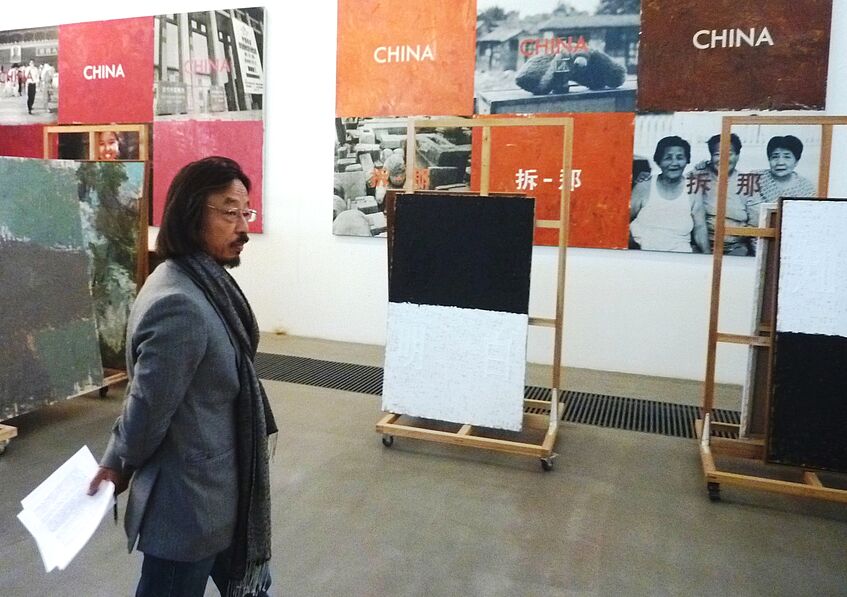
Huang Rui

Huang Rui (2013 in his Beijing studio)

... was born in 1952 in Beijing. In his youth he was already impressed by western styles like expressionism, fauvism, cubism or abstract painting. In 1979 he became himself a prominent representative of Chinese avant-garde art. Together with others like Bei Dao, Mang Ke, Wang Keping, Yan Li or Ma Desheng, he co-founded the independent literary magazine "Today" (Jintian) and the art association "The Stars" (Xingxing). When their first unauthorized open-air exhibition was closed down by police in September 1979, political activists and artists organized on October 1 (which was also the Chinese National Day) the famous street protest for political and artistic freedoms. Huang also took part and held a brief speech in front of the building of the Beijing Party Committee.

In 1984 Huang Rui got married to a Japanese and moved to Tokyo, where he spent ten years. In 1989 he helped to organize in Hong Kong a commemorative exhibition "The Stars - Ten Years". After his return to Beijing, Huang was regularly invited to exhibit his works in Europe, Japan and the US and also in China. From 2002 onwards, Huang Rui (together with others like his friend Ai Weiwei) was a driving force behind turning a widely abandoned factory district in north-eastern Beijing into a popular artist's quarter. Under the name of "798" it has since become a prominent cultural district with studios, galleries, museums, restaurants, bookshops and tourism facilities.

Huang Rui today lives and works in Beijing. Beside his artistic occupations, he also collects and publishes materials on the beginnings of Chinese avant-garde art.

Interview with Huang Rui (on October 30, 2013 in his studio and house in Beijing)

Here you find the Chinese text of the interview.

Interviewer (Helmut Opletal): Looking back at the situation in 1978, 1979, and 1980, how do you see it from today's perspective? And how do you feel about it?

Huang Rui: Because of many things that have happened afterward, especially in China, people come to define us in different ways. One basic perception is that we weren't just good artists, but rather artists with political motives who opposed the system and were considered "outsiders." I have made up my own ideas on this, because I personally took part in this movement, and I know how significant it was, and how it has influenced things that followed.

In fact, in terms of artistic form and individual independence, it helped liberate later artistic movements. Although they didn't directly refer to the "Stars," they still took over some of their methods, such as how to win a struggle and assert your own demands. This became a yardstick, a good reference for later artists. So we, who participated in the "Stars" group, feel very proud. We didn't easily accept their views on society, nor did we easily participate in politically charged, collectively-minded art activities that sought to integrate people into their system. That wasn’t easy.

Funny enough, I've observed that almost all the "Stars" artists, either because they carried this "Stars" brand mark, or they personally refused, despite the fact that the “system” offered them special conditions. The only exception was Bo Yun, who continued teaching at a school but didn't obtain a better position either. None of the other "Stars" artists has entered the official system for their artistic work.

Interviewer: Does "system" refer to the China Artists Association?

Huang: Yes, the China Artists Association and CAFA [the Central Academy of Fine Arts.] None of us were involved with them, nor were other artists like Zhou Xinqu, Wang Luyan [one of the earliest promoters of conceptual art in China] nor Li Shuang. Others in Beijing didn’t join either. Only after 2000, before the Olympics [2008,] the CCP system began to accept and acknowledge contemporary art, something they had previously disliked. They had systematically tried to avoid accepting contemporary art activities, and in some special cases even suppressed them.

Only later, they approved it. In their cultural policy, they now believed that contemporary art was progressive and could promote reform and opening up or economic development. It was a kind of power they needed for this process.

There were people with relatively open minds within the system, such as Xu Bing of the CAFA, or NAMOC [the National Art Museum of China.] Wang Huangsheng, the current director of the Central Academy of Fine Arts, is also considered to be relatively open-minded. Also Pan Gongkai, the new president of the Academy, cannot really be considered a conservative, but rather an enlightened figure in the traditional world.

They are like those enlightened personalities of the 1930s and 40s, a social elite who accepted Western intellectual ideas. As for them, their concepts have already been recognized today. So there was the conclusion that accepting contemporary art could contribute to China's development, even in a country under a communist party and socialism, and this wouldn't be a problem.

This situation also influences our view on the "Stars" and how we evaluate our own potential without giving up our identities. Even Shao Fei [another “Stars” artist] didn't collaborate.

This seems to me a very clear characteristic of that time. Having lived through this era, done all these things, bearing these experiences, it has become an identity that we must maintain. The spirit of the "Stars" has been passed on all those who had participated, and they are still keeping to independent creation. Later, whether you're active in society or developing your own identity, you'll always be reminded that you once were a "Star."

Interviewer: Back then, your Stars Art Group and the magazine “Today” maintained close ties with activists of the Democracy Movement. Looking back, do you think this was two sides of the same movement, or two movements cooperating and working together for a certain time?

Huang: I think the "Stars" still were quite special. In fact they were a movement for freedom. But isn't the struggle for freedom a very political issue? It's also a fundamental issue for art. If it doesn't enjoy freedom, what kind of art is it?

Creating works of art is like having a pen; when you use it to depict art, the name of that pen is freedom. Or you have an empty space; the name of that space is freedom. Otherwise, you will not be able to reflect, truly create a work of art and say it's your own creation. But I think all the rest is quite different from a political movement. Successful or not, politics has different forms and methods, not like the situation in art.

Successful politicians may not need much freedom; they can say there is no need to randomly talk about things. But artists who haven’t been successful yet, certainly need this freedom and the right to criticize.

So for those artists who demanded artistic freedom, the time was ripe, when they decided to hold their outdoor exhibition. It was a suitable time also because there was a three-day holiday around October 1st. We thought everyone would be celebrating National Day, the weather was good, people were happy, and they would have leisure time to come and see the exhibition.

But we didn't expect that the Communist Party would enforce particularly strict controls during this holiday. These celebrations were theirs, it was a politically charged holiday, and they wanted absolutely no problems during this period. So they ordered the police to call of our exhibition which had created a political impasse.

You have probably heard what happened afterwards. When we discussed the situation and voted on it, I opposed a gathering at the Democracy Wall and also opposed a protest march. I thought we had our rights as citizens, and as long as we didn’t violate any laws, we were entitled to openly communicate with people in such a public space.

This cancellation of the exhibition simply meant a public warning. The same happened yesterday with Tian’anmen. [There had been a violent incident with Uighur protesters the day before.] The square is a powerful political symbol for the leadership. Tian’anmen Square belongs to the country as a symbol of power and security.

But in the past, everyone took Tian’anmen for the square of the people, belonging to the citizens of Beijing. The thinking was different. When we were [in 1979] faced with this issue, my personal view was not to get involved in politics. Politics is complex; it has a very unsavory and dangerous side, so I voted against, in line with some other artists.

But everyone else wanted to go demonstrating, and I couldn't stop them. If I went myself, I would end up to be one of those speaking with the government as a representative of the "Stars" group. If I didn’t go, then those who went would be in even greater danger because they couldn't represent the basic opinions of our group, they would just be a few individual artists.

I was a spokesperson of the Stars Art Group, therefore I had no choice and I also went, although I had opposed the demonstration. The Democracy Wall Movement represented a democratic voice. It produced many positive effects then, and under the circumstances of that time, it also helped Deng Xiaoping to gain public support.

But our cooperation with the democracy activists was that they wanted to push us into becoming part of the Democracy Wall Movement. But we asked ourselves if such a cooperation was an inevitable development. Looking back now, I think there was nothing wrong with it; we've done it, and from a historical perspective it seems a very natural act. We got this opportunity and didn't run away. So it happened. Such occasion wouldn't come again. It was a historical moment that happened for many reasons.

Interviewer: Besides the issue of holding demonstrations or not, did you regularly discuss your links with the political Democracy Movement?

Huang: There were some debates, but even the members of the "Stars" and the "Today" magazine held different opinions on this. We were quite diverse individuals. I thought, when it had already happened, there was no point in discussing it any further. And things were not very clear to us either. Some said that this was a political event, but I didn’t agree. We didn’t consider it a political event, and rather thought it was a very natural demand, a passive resistance exercised through our individual freedom.

Interviewer: After the second Stars Art Exhibition, did you go separate ways or continue to have a close relationship?

Huang: People had different perspectives. One was that the "Stars" were originally independent, and we didn't want to become recruited or join the mainstream system. We didn't aspire to become “official” artists, only very few of us had that desire.

But very quickly, just a year later [after the open air show and the first “official” exhibition in 1979,] we held our second exhibition in the Fine Arts Museum [in August 1980.] In the past, this gallery was a sanctuary of the best. Now it's probably not like that anymore. But if you exhibited there, you were considered a great artist. We were successful artists quickly moving from outside the walls to exhibiting inside. This sudden change seemed very unnatural to us, and I personally had a feeling that after entering this art museum, we no longer had any further goals.

Actually, time for us was very short, and we also attracted some criticism from art circles. For the first exhibition, we were somewhat prepared. We showed clear characteristics, though our technique wasn't very mature yet. But the works themselves seemed fresh enough. For the second exhibition, our works were still fresh enough for the art world as such, but for my own progress, the preparation wasn't sufficient, because of the short time.

Others did quite well. Like Wang Keping who produced his works very naturally. The same was true for Ma Desheng. As for those who painted in oil, I felt time wasn't enough. Although I presented many new paintings, they were done very hastily. Some were quite good and showed progress since the first exhibition; others were still experimental.

After this exhibition, officially and publicly displayed in the authoritative temple of fine art, we had to pose ourselves the next question. When we heard criticism, we felt a necessity for us to do something, not to say things publicly, but rather to internalize these critical comments.

Twice already, our public statements had met considerable controversy that was also discussed by other people. Media coverage and widespread gossip meant that we received broad attention, and we became reluctant to organize further events after this exhibition. However, we arranged to travel to other cities to promote the "Stars" group. During three and a half months we visited dozens of cities, carrying photos of our works.

When we returned at the end of 1981, the campaign against “spiritual pollution” had begun. This made our situation extremely difficult. But there were other factors. Our group had become quite divided. The "Stars" had originally been a large collective where everyone had his place. You participate, I participate, or I don't participate. Later, it became more individualistic. Li Shuang's marriage [her relationship with a French diplomat] created some problems; Wang Keping's marriage to a foreigner also created difficulties; and my planned marriage to a Japanese girl was delayed for a long time.

After that, we began to disperse. Now, almost thirty-five years have passed since we became the "Stars," a very long time. So why did we cause such a huge political sensation back then? Why did it cause such a social uproar?

At the beginning, we saw a rapid transformation, including politics and the entire society. Everything seemed to chang at once. Mao Zedong had passed away, Deng Xiaoping came to power, and he focused on the economy, he opened China and took on to Western economic models.

Deng's two assistants were Zhao Ziyang, who implemented his economic policies, and Hu Yaobang, who restructured education and carried out ideological and cultural reforms. At that time, things moved much faster than they do now. Hu Yaobang was very straightforward when he changed China's education system that had originally come from the Soviet Union, but was now almost entirely brought into line with the American educational model.

There are no big changes nowadays, but back then things changed very rapidly. You see, China has always been a mix of fast and slow. Economic progress is still very rapid, a constant, swift change. As for the cultural process, every administration that came to power has been calling for deeper reforms. But deeper reforms require reforms of the political system, and they say they need systemic reforms to promote culture. This time it is no different as you can see.

From 1979 to 1989, Chinese society, especially in terms of ideas and culture, underwent rapid changes. But in recent years, I have the feeling that there has only been some superficial progress in culture. Unlike the 1980s, there's an art market now. Beijing went from having no galleries at all for contemporary art to having hundreds, nearly a thousand. This is a significant change.

There has also been recognition for the "798" art district. ["798" was originally the code name for a radio factory built by East Germany in the suburbs of Beijing. After its closure, starting in the 1990s, the cheap rent in the deserted buildings attracted many Chinese artists, gradually forming an “art district.”]

There are several other such art centers. You have visited Songzhuang [an "artists' village" in Tongzhou District] yesterday. These are all material changes. However, it began with the “Stars” that the real questions were raised and challenges to certain institutions, ideas and basic models were initiated.

We wanted to stress this again through the "1989 Art Exhibition." On the eve of our tenth anniversary, we held a "Stars 10th Anniversary Art Exhibition" in Hong Kong. However, many of our artists had gone abroad, mostly to France, and some like Ai Weiwei were in the United States. I myself had gone in Japan.

Given this background, things seemed difficult. Once abroad, people needed to manage their lives, focus on their creative work and look for opportunities to publish.

There have been examples in history, so time and obligations clearly made it difficult to continue, and it's not so easy abroad either. Fortunately, an opportunity for us arose in Hong Kong. In mainland China this wouldn't have been possible.

Interviewer: Did you sense at the time when you were active in China, that you received some support from within the system? Besides the art world, were there also politicians who supported you?

Huang: When you visited the "Stars" exhibition [in 1980,] there were indeed people within the system who supported us. One of them was Jiang Feng, the Chairman of the China Artists Association and the Dean of the Academy of Fine Arts. He had himself for a long time suffered as a victim of political struggles.

Interviewer: I suppose this was the Anti-Rightist Campaign and the Cultural Revolution?

Huang: Yes, the same happened to Liu Xun [another artist of the older generation.] Both of them were part of the system, holding high positions in Beijing and in the central government. Their situation and their ideas at that time were quite different from what China had become later. But later the system also had its difficulties. But you can't say that things haven’t changed. Right now there can be exhibitions at UCCA [Ullens Center for Contemporary Art,] a private museum. Wang Keping is holding an exhibition there. There are some others I have mentioned, like Fan Dingai, Wang Guangsheng, Pan Gongkai, etc., as well as Xu Bing, Tan Guobin or Zhang [… ?] who came after us.

They all advanced the history of Chinese contemporary art that has originally started with the "Stars." They are very outstanding artists, and they are all now Vice Deans of the Academy of Fine Arts. As I have said, the "Stars" were not easily integrated into the system. Even when members of the "Stars" became individually recognized, they could not easily adapt to such conditions.

And look at the time before the Olympics, when things were quiet and nothing important happened, and Ai Weiwei became a representative and spokesperson of many mainstream art media. So this situation isn’t black or white; it's often a mixture of both.

Interviewer: Did Ai Weiwei participate in the first Stars Art Exhibition?

Huang: Yes he did and the second time as well. He didn't participate much in our activities, but he has contributed works, all of which were paintings from nature.

Interviewer: Do young Chinese painters and artists today still show interest in the "Stars?"

Huang: In our system of education, young Chinese artists aren’t really told anything about the "Stars" because of our 1979 demonstration. The politicians don’t want any debate about this, so they avoid this subject. Their narrative is that the period of reform and opening up has been going on for 35 years, but they prefer to say that Chinese contemporary art has only been there for 30 years.

They believe that in Chinas historical tradition, only developments approved by the “system” can be considered legitimate. That’s why they speak of only 30 years of contemporary art.

An example is the Shanghai Museum of Contemporary Art that is currently holding an exhibition on 30 Years of Modern Art in China. Another exhibition in 2007, hosted by Fei Dawei, also started with contemporary art from 1985. So they all had the same message that contemporary art could only exist under the system, closely collaborating with its representatives. In fact, this is a very conservative viewpoint.

Interviewer: I know you are preparing to collect material connected to the events at the time. How do you want to do that?

Huang: I returned from Japan twelve years ago in 2001. After a few years, I started organizing my own materials. Most of my works were in Japan, but I have transferred everything from my depots in Japan to Beijing. Having everything with me again made me think about these endless debates within the art world.

In Beijing, I was looking for a studio of my own when I discovered the "798" art district. I actually became its spokesperson. At that time, people debated whether Chinese contemporary art had actually started with the "Stars." Notable figures like Li Xianting and Wu Hong thought so.

Others believed that contemporary art only emerged after the "Stars," fueled by institutional support and the educational reforms of 1985. Among them were many young people who didn't understand the situation surrounding the "Stars" and hadn't participated in it. Moreover, they were graduates of formal education. I was frequently invited to discuss with them, but the arguments made me feel uncomfortable. After a few such debates, they stopped inviting me. As I was a representative of "798," they thought I just played that role, and they were not happy when I tried to present the situation objectively.

Then I made that book that was published in Hong Kong in 2007. Later, I also worked with “The Beijing News” [a new Communist Party daily published since 2003] to publish an article on "The Open-mindedness of the Post-80s Generation" by Chen Danqing [an American-Chinese artist] and me. I did the first issue with a long interview and a comprehensive report that took up a whole page.

All this put some pressure on me: Was my own painting, expressed through my own words, objective? Others considered it subjective. I thought it would be a better way to collect all these materials in a database and document repository. It would be an open way of exchanging information that one can look at and compare. What happened in society at that specific time, even if it was sealed away, was still a real memory that could be analyzed. Then there would be no need for us to explain what we did, but these materials would speak for themselves. That's how the "Stars" project started.

There was also an increasing urgency, as we were getting older. If we didn’t do this now, what would become of all those materials? Now they are all in my cabinet, and I'm slowly organizing them – the original written records, for example, who presented which art works, and how they were submitted. There is also some correspondence; there are the feedbacks from the audiences, and so on.

Another reason for this urgency is that Chi Hsiao-ming, who filmed an independent documentary about the "Stars Art Exhibition," passed away in 2007 from cancer. Knowing he made this [16mm] film, I inquired if we could obtain it, if it could be sold to us, and how much would it cost. Eventually, this turned into a complex technical issue which meant that we needed a suitable platform to handle such things, because one person couldn't handle it alone.

Interviewer: How many of you have been working together on this project...?

Huang: Up until now, it's been just three of us: Ma Desheng, Wang Keping, and me. I have an office space, and everyone is supporting me to run it. Recently, we've also spoken with several other "Stars" members like Yan Li, Qu Leilei, Mao Lizi, and Yang Yiping.

Interviewer: Would it be possible to bring together the works from the "Stars Art Exhibition" from back then and re-exhibit them?

Huang: There's only a slight chance. Many of the works from the "Stars" group at that time have been dispersed. For example, Yan Li sold all his paintings from that period when he went to the United States, and many other artists did similar things. Restoring a complete "Stars" exhibition is possible, but it would rely more on historical materials to reconstruct what happened. Having some of the original works would be sufficient. However, it would be difficult to hold an exhibition gathering all the artists from the original "Stars" group. Maybe it's possible to have a few selected artists and works.

Interviewer: Do Chinese mainland media still mention the "Stars Art Exhibition" today? Have any reporters interviewed you about the situation then?

Huang: Yes, tomorrow will be such an occasion, an official TV team, probably from the Ministry of Culture, is making a documentary called "A History of Contemporary Chinese Art," which will also feature the "Stars." A couple of days ago, I had an interview with the State Council Information Office. They approved a budget for six films about typical contemporary Chinese cultural phenomena. "798" is one of them, which is why they interviewed me.

Interviewer: But the activities of the Stars Art Group also had a certain political and social aspect. Can these things be discussed nowadays?

Huang: It's fine to talk about "Stars" and publish it. But the street march we held on October 1st, cannot be mentioned, and it won't be published.

Interviewer: For example, you said that the first [outdoor] exhibition was shut down by the authorities. Could you talk about that?

Huang: You may talk about these things, but they won't publish it either. It’s ok to talk and publish about exhibiting outside, but not about the ban by the authorities, or our street protest. Just a few days ago, before the opening of Wang Keping's exhibition, we had a discussion at the UCCA gallery. I sent them all our materials, and they also projected the videos. But when I turned around to look myself, everything else was there except for the video on October 1st. They had cut out that part of the prepared materials.

Interviewer: Who did that?

Wang: The management committee of "798".

Interviewer: Can magazines nowadays publish works like Wang Keping's "Idol" and "Long Live"?

Huang: Official publications won't print them. Art magazines can publish it, and they have actually done so. I just bought a book by Michael Sullivan [a British sinologist and art historian,] published by the Shanghai Publishing Group. The Chinese version of his book includes the "Idol” and other works featuring Mao Zedong, but the text doesn't mention the "Stars." It also doesn't mention the 1989 Tian’anmen Square incident. His historical account of that period is censored. The original English version includes these events, but the Chinese translation doesn't.

Interviewer: Besides you, are there others in China who specifically studied the art movements of that period, such as the "Stars” exhibition"?

Huang: When Lü Peng was in charge of the Department of Art History at the Academy of Art in Hangzhou, they did some studies. He is now the director of the Chengdu Art Museum. He did this research when he was teaching in Hangzhou, studying the "Stars", the 1985 art revolution, the new wave of 1989, and post-1989 developments. His book could be published inside China.