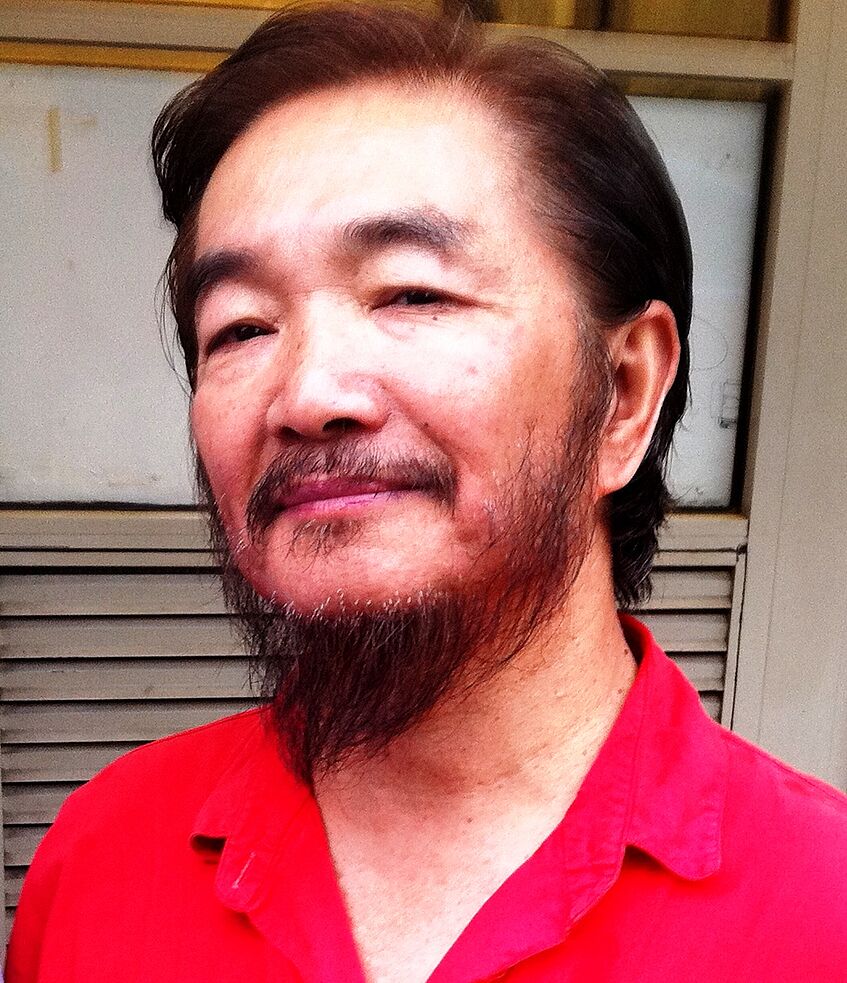
Xue Mingde (Samuel Huang)

Xue Mingde (2014 in New York)

... was born in 1955 in Sichuan. During der Cultural Revolution, at the age of 14, he was arrested for the first time. As a factory worker he started painting, and in the late 1970s he organized his first private exhibition called "Weeds". In early 1979 he went to Beijing where he held an open-air exhibition of his oil paintings right in front of the Xidan Democracy Wall. In Beijing he got in contact with a number of activists of the "Beijing Spring" activists, and he met several artists of the "Stars" Group. In the ruins of Beijing's old Summer Palace, Xue showed some of his works to the author of this website and also painted a portrait of him in June 1979.   

Back in Sichuan he got arrested several times for "hooliganism", a he had to spend a number of years in prison. In 1993 Xue Mingde moved to the United States and became a US citizen under the name of "Samuel Huang". With his new name and passport he managed to travel to Chongqing in 2000 to meet his ailing mother the first time after 17 years. Xue Mingde now lives in New your, he regularly holds exhibitions of his work, and he participates in activities of the Chinese democracy movement in exile.

Interview with Xue Mingde (on May 27, 2014, in his apartment in New York/Bronx)

Here you find the Chinese text of the interview.

Interviewer (Helmut Opletal):  I'd like to ask you, when you look back on this period between 1978 and 1980, now, more than 30 years later, what are your feelings and thoughts? What significance does it hold for you? 

Xue Mingde:  I was imprisoned seven times between 1978 and 1981and for a total of nine years of jail, and I believe that it was all worthwhile. I wasn’t “innocent” because I knew I had to pay a price for everything I did. I did pay the price, and I have no regrets. I didn't pay such a high price to gain fame, status, or renown; those are not what I wanted. What I wanted was to be a free person.

What does it mean to be a free person? I've loved art since childhood and painted for decades. Through painting, I've come to understand what it means to be a free person. Painting must be based on inner thoughts. Anything that goes against your wishes and thoughts is not art, but a betrayal of your character. This has been my understanding over the decades, and it's very important to me. I believe that my love for art, and art's love for me, has taught me not to betray. Betrayal is a betrayal of personal dignity. I have always adhered to this principle. Only art has handed me this banner of freedom, which I hold high. Therefore, I will not allow myself to betray my character.

Interviewer: You were originally from Sichuan? 

Xue: A native of Chongqing.

Interviewer: Why did you go to Beijing and take some of your paintings there? 

Xue: My father was a painter, and I was influenced by him from a young age to love art. When I entered the high school affiliated to the Sichuan Fine Arts Institute, I discovered that the education system of art academies in China suppressed humanity, personality, and human imagination and creativity. Art is about creation, but it suppressed creativity and instead forced people to follow certain rules.

This was incompatible with my aesthetic pursuits. So over the years, I suffered a lot of hardship, persecution, and setbacks until 1978, when China entered a period of transformation. After the death of the tyrant, China was facing a cultural spring. As an artist with forward-thinking ideas, I sensed that society was about to change. This change definitely needed some people to go ahead, so I stepped forward.

In 1978, I wrote to the Chongqing Municipal Government, requesting to hold a solo art exhibition. Of course, they strongly opposed it. My thinking was very simple. If people don't need approval to sing or dance in the parks, then I wouldn’t need an approval to paint in parks either, and I could hold an exhibition, because it is also culture and art! So I held an exhibition and then went to Beijing.

This was an inevitable result of this authoritarian society. You love your country, I love my country, but this country doesn't love you. You say you have ideas? But this country doesn't allow people with ideas to exist. Do you, Xue Mingde, speak the truth? If you speak the truth, it's not a sign of patriotism, and we'll imprison you. This was the lesson I've learned over the decades. Therefore, I dared to hold this exhibition in Beijing because I had already made the necessary preparations by holding an exhibition in Chongqing in January 1979.

Then on March 2nd, I held an art exhibition at the Democracy Wall in Beijing. I was prepared for the following: if anyone tried to sabotage my exhibition, I would perish along with my artwork. I had already come to terms with my life. Looking back today, if I had lived in the Mao Zedong era, I would have certainly had my head chopped off. But the tyrant had gone. And in 1978 [1979?], I survived my art exhibition. Had I lived before 1976 when the tyrant was still alive, I would definitely have been executed.

Fortunately, the reform and opening up began. After the Third Plenum of the 11th Central Committee in 1978, the Party's policies loosened, so society tolerated me now, allowing me to survive, although I eventually had to pay the price. My wife and children got separated from me, I served nine years in prison, having been detained seven times. I wasted so many years of my life.

Interviewer: You have mentioned to me that you went to Beijing in 1979 and met people from the Stars Art Group. What happened then? 

Xue: Because I held this art exhibition in Beijing, I got to know many painters there. In fact, before 1979, before my exhibition, , there was a show of French 19th-century rural scenes in Beijing in 1978. At that occasion, I gave a lecture on Western art at the art gallery. The Session of the 11th Central Committee of the Party had not yet been held, so my talks were a great sensation, and many painters in Beijing became friends with me, when I explained modern Western art to them. Chinese people were not at all familiar with Henri Matisse or Wassily Kandinsky. They didn’t know anything about them. So I explained their concepts and foundation, and only then could I hold my own exhibition.

Those involved in the pro-democracy movement and its publications during that era, were of course part of our group. After holding my exhibition, which garnered significant international attention, I became friends with Ai Weiwei, a student from the stage design department at the Beijing Film Academy, and I became also quite familiar with Wang Keping, a playwright at the Experimental Theatre. And then there were Huang Rui and Ma Desheng from the “Today” magazine, and Leng Ming [the pen name of the painter Li Shuang], a set designer at the Youth Theatre. Her boyfriend was Yan Li, and we were all very close.

Because of my exhibition, frankly speaking, I became the center of the group, with so many people gathering around me. We held meetings, wanting to expand and create a collective art movement. But later, when I was imprisoned, Huang Rui and Ma Desheng rejected me and distanced themselves.

Interviewer: Why? 

Xue: It's very simple, it’s because I was imprisoned by the communists. If they had allowed my paintings in their exhibition, it would definitely have had a negative impact on them. They must have had this in mind. Even today, they don't recognize me. When reporters in Europe asked them about me, they said they didn’t know Xue Mingde. Xu Wenli is the same; in all his articles, look at the two recent ones online, he doesn't mention me at all. They simply don't acknowledge that I was the first painter to hold a modern art exhibition in Beijing. Because I initiated, instigated, planned, and participated in the early work of the Stars Art Group, I was later arrested and imprisoned, and then I was completely cut off from the “Stars”.

Interviewer:  So you were arrested in 1979? 

Xue: On June 13th.

Interviewer: How long were you detained? Were you jailed in Beijing? And did you stay in Beijing the whole time? 

Xue: The first time it was for three months, then another three months in 1980. Both times I got arrested in Beijing, but I wasn't detained there, they sent me back to Chongqing. There I was detained for another three months. After my release, I opened an art shop in Chongqing without official authorization. So they shut it down, saying that commercial activities weren’t  allowed in residential areas and that it was “unsightly.”

In reality, after the art shop opened, delegations from the United States and France visited it, coming directly without asking the government's foreign affairs department. So I didn't participate in the Stars Art Group in Beijing. I was excluded, on the one hand, because the communists had imprisoned me, and on the other hand, because Huang Rui and Ma Desheng excluded me.

Interviewer: How did you get to know and connect with the people behind those independent publications at the Democracy Wall? 

Xue: It started in 1978. On January 28, 1979, I held a traveling open-air art exhibition in a park in Chongqing. There I also read the magazine “April 5th Forum”, which was posted on the local Democracy Wall. It had a contact address on it – “Xu Wenli, No. 2 Baiguang Road.” So I wrote to him, saying that I wanted to hold an art exhibition in Beijing and hoped to get his support. Xu Wenli replied, welcoming me and promising that they would send someone to receive me.

After being received, I quickly had an intense conflict with a certain Song Rentang. My views were completely different from those of their “April 5th” actions, and conflicts and frictions occurred. When I told Xu Wenli about my plan for holding an art exhibition, Xu talked to Mang Ke and others from the “Today” magazine about it. They were the ones who published the magazine at the Democracy Wall. Mang Ke said that “Today” was for poetry and cultural work, not political commentary, so if they received Xue Mingde, it wouldn’t be Xu Wenli’s affair.

Xu Wenli didn’t agree. So, it wasn’t “Today” that handled my reception, but Xu Wenli and his “April 5th Forum”. Then I got arrested, and the last time I was imprisoned for six years. In 1981, also my home was searched, but after a year in prison, I escaped.

Many things happened afterward. In February 1982, I was in Shanghai, where the “Xuhui District Workers' Club” wanted to organize an art exhibition for me. I had 70 paintings there. But the Shanghai Public Security Bureau found out and contacted the Workers' Club, telling them that holding an exhibition for me would have political consequences. They were scared and canceled my exhibition.

My home had been raided in June 1981, and a nationwide arrest warrant was issued for me. It became an amazing story. A month after my escape, I was captured in the Yandang Mountains near Wenzhou [Zhejiang Province.] On my way there, I had done dozens of paintings, over a dozen in Jiujiang [Jiangxi Province] and another more than a dozen in the Yandang Mountains. When I was brought back [to Chongqing,] I didn't know they had confiscated all my paintings. Only after I was released from prison, people in Wenzhou wrote to me saying that the Security Bureau had confiscated them as evidence of my escape. The Chongqing police hadn't confiscated anything from me and hadn't made me sign anything. These are still my works of art, but this issue has been left unresolved. There have been many more losses like this.

Most of my paintings from Chongqing were done in prison, hundreds of them. First, they wouldn't let me paint, that’s why I escaped. Things got out of hand then. An order came from the Ministry of Public Security demanding that I promise not to escape again. I told them I couldn't promise, and even if I did, they wouldn't believe me, and I had escaped because they wouldn't let me paint. I said I accepted my fate whatever it would be. I painted because I loved it, and if I died, I would be like my paintings – burned. I didn't talk on the quality of my art, I only said I loved painting, and if they let me continue painting, I wouldn't escape. They eventually agreed. I had won the right to paint and to prepare my own colors.

Interviewer: Was this in 1983? 

Xue: From 1982 to 1987.

Interviewer: Other people involved in art and literature apparently haven't been jailed. Why did they arrest you, but not others? 

Xue: Number one, I was the first person to venture out. “Those who dare to be the first in the world will be punished,” as the saying goes. I did what others dared not do. So when I did it, these people just observed, and afraid of being implicated, they distanced themselves from me. That’s what Huang Rui and Ma Desheng did. A second reason was that some of my views were not compatible with official tradition. They wanted art to serve politics and promote collectivism. But I said my art didn't serve politics, but was about personal struggle and expressing personal thoughts. I was the first one to hold this view.

The “Stars” were a group of people, and they couldn’t apply legal sanctions to a whole group. So they used me as an example, arresting me to scare them. “Killing a chicken to scare off the monkey,” as we say in China.

The situation in the society had changed, and there was no absolute authority like in Mao’s era anymore. After the first “Stars” exhibition had been shut down, they took to the streets to protest, and the authorities gave in. Before, the government had also been a person, and not an abstract concept, but a concrete person. That person was Mao Zedong. He was the absolute authority, and everyone feared him.

But Mao was gone now, and Deng Xiaoping had to consider various facts and pursue a flexible policy, unlike Mao who was ruthless and showed no flexibility. When such absolute authority had disappeared, they yielded, and the principle of "the law does not punish the masses" applied. A group of people had taken to the streets. There were reasons for this, including our artistic freedom. I've pondered about all of this during the many years that passed.

In Chongqing, there was another group of artists called the “Wild Grass Painting Society”, which I also initiated [in the autumn of 1979.] This Wild Grass Painting Society later also excluded me. Today, the truth has come out. The “Wild Grass” exhibition was held in Shaping Park, and the person in charge was also an artist named Li Dehong. He said, “Over the years, we really misunderstood Xue Mingde.” But what he meant was  that I was a fame-seeking, ambitious schemer, not an artist at all. Many others thought the same, he said, that I was not a real artist, and that the Communist Party was right to arrest me. He added, “If Xue Mingde's paintings are still in the Wild Grass exhibition, they will run into trouble.” That were exactly his words.

Thirty years later, they are saying now, "We know that Xue Mingde has been wrongly treated when we excluded him from the Wild Grass Painting Society and spread all these things about him.” That's how they have apologized to me. It's all in the past, so what can I say now? I have paid the price, and I'm the one who suffered, so I have no regrets.

Four years ago, I went back to Chongqing. Luo Zhongyi sent his assistant to negotiate with me, asking me to delete an article I had written. In exchange they offered me some benefits. He treated me to dinner twice. He is now the dean and vice chairman of the China Artists Association. To tried to cover up their past crimes of six or seven years, where they, like the Nazis, shaved my head and smeared ink on my face. That’s what I had written about in my article. Now he sent his assistant to negotiate with me to delete it.

The fact that he somehow bribed me, speaks volumes. Because from the beginning until now, I have been against them; this is my personality, my will, and my belief. I do not compromise, I do not betray. That’s why things have never worked out well for me in my relations with national policies and individuals alike. I only follow principles, not personal relationships. They didn’t allow me to hold an art exhibition, but I did. If you want to kill me, go ahead; I'll give you my life. My paintings, not to mention the “Wild Grass” art exhibition, were outside the system, not within it; they were independent, individual, not part of a group.

You have your style, I have mine; this should be a principle of modern art. When we organized this art exhibition, we feared suppression, so we brought in teachers and students from the art academies and the art department of Southwest Normal University to guarantee our safety. But this changed the original intention, and it became clear that I was completely incompatible with them.

One important reason for my multiple arrests and detentions, as it had been raised during numerous interrogations, was that I knew too much, that I went to places I shouldn't have like the Beijing Hotel, the apartments of diplomats and embassies; also that I contacted journalists, visiting scholars, businessmen, and many other foreigners, with whom I had very complex relationships. They suspected that I was acting as a secret spy for “enemy” forces. Moreover, they said that my paintings lacked artistic value and fundamental skills, and that I couldn't accurately depict things, therefore I wasn't really an artist.

They wanted me to paint “realism,” but I'm not a realist; I'm doing modern art. So they thought I wasn't a true artist, but had other motives. So they arrested me to find out who was behind me. In the background there were two other details. One was that in the government institutions, some people sympathized with me and supported me, such as Hu Deping, Hu Yaobang's son, and Wan Zhongxiang, who was the son of Wan Li. They had invited me to dinner and revealed internal information to me. Wan Zhongxiang told me, “Xue Mingde, you need to sever ties with Wei Jingsheng and his ilk. If the Party supports you, things will go smoothly for you; otherwise, you'll end up like them.” These were Wan Zhongxiang's exact words.

Back in 1979, Tang Xin, a reporter for the Beijing Daily, also interviewed me for an internal report. There he wanted to present me as a positive example of reform and opening up, a sign of a more open and diverse society.

Interviewer: Have you read this report? 

Xue:  I could read it in their “internal” publication. But they didn't give it to me, that wasn’t possibly. At this time, they called me a positive example. Later, Hu Qiaomu and Chen Yun issued instructions saying that Xue Mingde's case was intolerable. So Tang Xin from the Beijing Daily, whose father was a high-ranking official, also reported on these.

Afterward, Deng Xiaoping and some others issued instructions regarding my case. A month later, Tang Xin met with me again and apologized, saying, “I'm sorry; this situation went beyond my control. I had been asked by the Youth League Central Committee to interview you. We originally intended to report on you as a positive example, but during the editing process, Hu Qiaomu and Chen Yun treated you as negative case that was no longer tolerable. So it completely changed our original intention, and this was very important.”

Interviewer: So why did Tang Xin interview you at all? 

Xue: Because I held an art exhibition at the Democracy Wall.

Interviewer: What questions did he ask you? What was he interested in? 

Xue: On March 2nd, I had held that art exhibition at the Democracy Wall. Many Western news agencies, including Reuters and AFP, interviewed me there, and their reports started from March 4th. They said that Xue Mingde's modern art allowed the West to see Chinese modern art for the first time, and that this was a starting point for a renaissance of modern Chinese art. It was also reported in “Le Figaro” and “The Daily Telegraph”.

Against this backdrop, Tang Xin has been instructed by the Central Committee of the Youth League to interview me. His questions were for example: Xue Mingde, where are you from? What was your education? As an artist, what are your insights, viewpoints, and opinions? Why do Westerners like your paintings, but Chinese people don't? What is the meaning behind your paintings, and why do they like them?

He also asked me what requests I had to the Chinese government. Because I'm unemployed, and I've held an art exhibition with significant international impact, what were my personal expectations? To put it more bluntly, a job with good conditions and compensation? These were the questions he asked me to answer. I said these weren't questions he should be asking. Didn't you tell me about the superiority of the socialist system and how this should be reflected? It's about making the best use of everyone's talents and resources.

Am I a useless person or a useful one? Judge for yourself! “If I'm a useful person, you should put me in a suitable position so I can utilize my talents, contribute to the society, and create value. This isn't a request I'm making.” I have never expressed hatred towards society. I still love my art. I know that this society doesn't support or understand me today because there's a distance between us. Because I know about this distance, I must continue to strive. Otherwise, I'll end up like them, resigned to the fate.

I say that as a Chinese: There is still someone willing to strive for self-improvement. But this person is still considered a criminal, someone to be put into jail – this is the lesson I have learned from my past. That's why I am discussing this with Tang Xin.

Even before my art exhibition in 1979, I had already been imprisoned multiple times. When I was in school during the Cultural Revolution, I was detained for 47 days on charges of individualism and liberalism. I escaped by climbing over a wall, but was caught and severely beaten. My home was ransacked multiple times. So, even before my exhibition, I had experienced all these things. This society dealt such a heavy blow to a kind and upright young person like me who just wanted to pursue beautiful things. Later, I realized that I couldn't compromise. I had to follow this path as a person, no matter how much hardship it meant.

Interviewer: Do you think people like Tang Xin, judging from their words and attitude, did they agree with you, or rather oppose what you did? 

Xue: I think he was sympathetic. He interviewed me with understanding, he was not against me, even though his interview transcript was eventually altered and became unfavorable to me, contrary to his original intention. I was supposed to be a good example of reform and opening up, but it became chaotic. So he came to apologize to me. Later I went to prison again.

There were also several reporters from the “People's Daily”, who interviewed me at the time, but I can't remember their names. One’s surname should be Zhang. And there was another one named Xu, I think Xu Minghe. He was a very kind and open-minded person. Later, when I got out of prison, I found out that he worked as an editor at a magazine affiliated to the “People's Daily”, called “Shijie Guancha” (World Observation). But there are too many details when I try to recall that incident.