
Liu Shixian
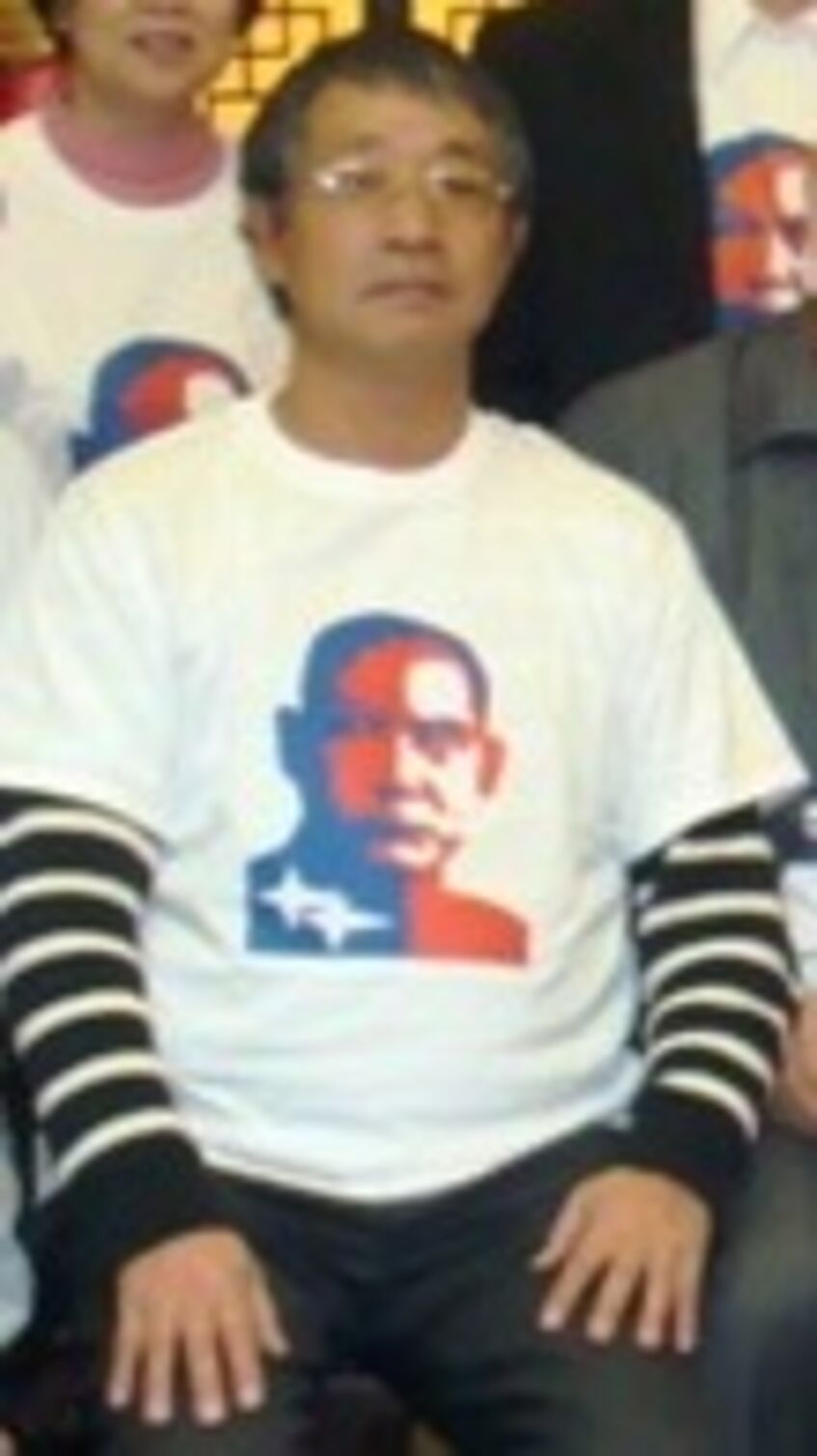
Liu Shixian (2010)
Liu Shixian
... was born in 1956 into a family of communist cadres in Tianjin. When he, during a trip to Beijing, got his first view of the Xidan Democracy Wall, he looked for contacts and met Xu Wenli and other activists. He brought informationen and copies of various issues of the independent journals back to Tianjin. Later he also helped to produce the "April 5th Forum" in Beijing and became the journal's Tianjin correspondent.
During the same year, Liu Shixian, together with others, founded "Reformer" (Gaigezhe), a "people's publication" in Tianjin, and he became a regular author of posters at the local Democracy Wall in this city, about 60 miles southeast of Beijing. It was also in 1979 that Liu founded, together with Lü Honglai, the journal "Bohai Shores" (Bohai zhi Bin).
In 1981 he was, like other prominent democracy activists, arrested. He was released only in 1984. In 1994 Liu Shixian left China. Today he lives in the San Francisco Bay Area in the United States.
Interview with Liu Shixian (on June 11, 2014, in a hotel in Berkley, California)
Here you find the Chinese text of the interview.
Interviewer (Helmut Opletal): Could you please tell us at the beginning how you came into contact with the Democracy Movement in Tianjin, and what did you do there?
Liu Shixian: I started to work in a factory in 1974. I went directly from school to an industrial unit. There I discovered that the education I had received was completely unsuited for actual life. What I had been taught did not match with reality. This made me rethink how to conduct myself in society.
I discovered many problems from what had been taught in the textbooks. They had told me for example, that there were many good people in society, and doing good deeds would bring good rewards. However, in reality, I found that doing good deeds did not necessarily bring good rewards, there was a huge gap between reality and ideals. This coincided with the rise of the Democracy Wall in Beijing in December 1978.
I originally came from Beijing, although I lived in Tianjin, but I often went to the capital. There, at the Xidan Democracy Wall, I read the big-character posters commenting on current events in society and also on the Cultural Revolution. With these in mind, I found one of the earliest publications in Beijing at the time, called “April 5th Forum” run by Xu Wenli, Liu Qing, and Yang Jing. I contacted them, and we chatted together and discovered that we shared many ideas and feelings.
Interviewer: Did you just meet them at the Democracy Wall, or did you look for them?
Liu: When I read their dazibaos on the Democracy Wall, I saw that there were their signatures and contact details. That’s how I found them for a chat and exchange of views. This was at the end of 1978, at Xu Wenli's home and Liu Qing's home, which was at No. 2 Baiguang Road.
After about two months of regular contacts, Xu Wenli said to me that he hoped I could bring this information from Beijing to Tianjin. I had copied some big-character posters in Beijing, and also obtained a few issues of the unofficial publications, for example the journal of the “Human Rights Alliance” or “Exploration" which were relatively early publications, as well as the “April 5th Forum”. I took these publications to Tianjin and posted them on the wall outside the Municipal Government, where the original Tianjin Democracy Wall was located then.
Interviewer: How did the Tianjin government react?
Liu: In the early stages, from late 1978 till early 1979, things were actually quite relaxed. No one interfered too much. Also, some articles and publications were not all that radical, focusing on historical issues without criticizing the current society or leadership. Such criticism was rare, so they didn't care much. Thus, the Democracy Movement went on vigorously for about a year, from the end of 1978 to 1979.
During this period, besides serving as the Tianjin office of the “April 5th Forum”, I also organized a small local group of people from Tianjin, and I published a magazine called “Bohai Shores”. This journal had several main leaders and authors, including Lü Honglai, Wu Shujiang, Wang Zhiqiang, Tang Gedan, and myself. At that time, this was quite a big event in Tianjin. More than forty people participated in our first meeting of the “Bohai Shores”. This included university students, factory workers, and even government officials.
Interviewer: Really?
Liu: Yes, there were some, but they didn’t want their names published. They were government officials and people working for newspapers. All these people made up our Tianjin-based publication, “Bohai Shores”.
Interviewer: You are talking about people from the official newspapers?
Liu: Yes, they were official editors, and there was also a specialized writer. That’s how we published the first edition of our “Bohai Shores”. We sent also sent it to privately-run journals all over China and exchanged publications with them. They sent us theirs, and we sent them ours to be publically posted in other cities, as we posted theirs in Tianjin.
Interviewer: What you're saying still seems quite unusual to me. The meeting you mentioned had over forty participants, including some officials. How long did this meeting last, and what kind of topics were discussed there?
Liu: The meeting was held outside in a park called Water Park. We mainly discussed our publication plans and how to promote the Democracy Wall Movement in Tianjin. There were other independent publications from Tianjin who participated. One was the “Sacred Axe Society”, run by Li Zhanyuan and his group. Another was “Tianjin Review”, run by Wang Weiyuan; and “New Awakening” that was published by the Nankai University. They had all come to discuss together with the “Bohai Shores” how to promote the Democracy Movement in Tianjin and how to apply to the government for registration of our publication. These were the main issues discussed.
Interviewer: Did you all basically agree, or were there different opinions?
Liu: Most people supported the starting of publications. The only difference lay in the degree of radicalism of the viewpoints. Some were rather radical, while others preferred a more moderate approach. But there weren't any major differences.
Generally speaking, the goal was to establish a Democracy Wall in Tianjin and to integrate with the nationwide movement of independent publications. There wasn't much disagreement on this.
However, as the Cultural Revolution had been not too long ago, the thinking of many people was still very much blocked in their heads, and they were afraid of trouble, afraid of being arrested or losing their jobs, so many feared about consequences. I was relatively young and naive, unaware of fear, so I took on the responsibility of handling the communication. This meant publishing my address nationwide, telling where I lived, my name, and how to contact me. This was very dangerous then because the authorities could find me at any time. But as I was so young, only in my twenties, I didn't worry too much.
Interviewer: What year were you born?
Liu: In 1956. When I had published my address, I essentially became the contact person between Tianjin and the other places. I was the only one to publish contact details, everyone else worked behind the scenes writing articles, engraving stencils and printing. No one else could be contacted directly, and people had to talk to me first.
Interviewer: Did you use pseudonyms in the magazine?
Liu: Basically yes, only very few used their real names.
Interviewer: Was that because of the fear you had?
Liu: No. It was rather because there's a custom in China that when writing articles or books, people rarely use their own names, but a pen name. My name is Liu, but when I was writing, I used the name "Xiao Siwen". Only my address and contact information were real. But everyone knew my real name.
As proposed, we submitted an application to officially register our journal, but the government didn't respond. They gave no reason, neither agreeing nor disagreeing. But regardless of their reaction, we published our application letter through journals or big-character posters. Once having applied, it became their problem; they had to tell whether they approved it or not. But we needed to go through this formality, and not just us, I think all the magazines followed this procedure.
In the end, when I was arrested, I was still prosecuted on this pretext and they said that I had violated the relevant "Provisional Regulations on Periodicals" promulgated by the State Council in 1952. This was one of the pieces of evidence against me.
In reality, I had already printed the journal; I had applied for registration without receiving an answer. In the end, they still prosecuted me on this basis. Another allegation was that I had established extensive contacts. This included interviews and trying to find out public sentiments, and exchange of information between different regions.
Later in 1981, when there were some democratic elections, we didn't participate. But we promoted and publicized these ideas. People like Hu Ping, Zhou Weimin, and Fu Shenqi, participated in that election campaign, and our journals across the country supported them, published their articles, and actively promoted this movement.
Interviewer: So how was the Democracy Movement in Tianjin different from that in Beijing?
Liu: In Tianjin it was relatively small because it's not the capital. The one in Beijing had a much greater impact, and Tianjin was not so far away. Therefore, compared to Beijing, Tianjin's impact was quite limited.
Interviewer: You said the Democracy Wall in Tianjin existed all that time?
Liu: Yes, it existed until 1981. Later, when the the Democracy Wall in Beijing was moved from Xidan to Yuetan Park, Tianjin's Democracy Wall was also moved from the Municipal Committee Avenue to an inconspicuous side street, to Tai'an Road, which was still next to the Municipal Party Committee. When the Xidan Wall was moved from a very prominent location to a park, it didn't attract as many visitors any more. The same happened in Tianjin. Originally, many people had gathered there, but when postings were not allowed anymore, only in a different location, this was just a first step, before the place was gradually closed down.
Interviewer: Were the contents of Tianjin's publications and big-character posters more or less the same as in Beijing?
Liu: There were several types of publications related to the pro-democracy movement. Taking Beijing as an example, publications like “Exploration”, the “April 5th Forum”, or “Human Rights in China” were quite politically oriented. Others, like “Fertile Soil” and “Today”, focused more on art and literature. This was similar in Tianjin. “Bohai Shores” was as a comprehensive magazine focusing on politics, with local commentaries, texts from dazibaos, and some literary poems.
Interviewer: What kind of issues did such local commentaries raise?
Liu: For example, they exposed the bureaucracy of the Tianjin municipal government and wrongful convictions and misdeeds by the security authorities. These were all local issues. But we also reprinted long articles on issues from other places, abuses that happened at a national level. And there were news reports from various cities, for example, who were the election candidates, or about interesting interviews conducted by other magazines. Such information was sent to us, and we also passed information to them to reach a greater audience.
Interviewer: How many copies per issue did your magazine print?
Liu: About 400.
Interviewer: Were they mostly sold or exchanged?
Liu: Some were exchanged, and some were just distributed. Very few were actually sold.
Interviewer: People were also arrested in Tianjin in 1981, right?
Liu: Yes.
Interviewer: Including you?
Liu: That’s right. The Party Central Committee had published the so-called “Document No. 9”. It claimed it was to ensure stability and unity and eliminating all factors of instability. Massive roundups were then carried out across the country from April 9-11, also in Tianjin. I was one of the three persons arrested there. The others were Lü Honglai and Tang Gedan. I was sentenced to three years in prison. Later, I escaped, but was caught again and given a few months extra sentence. I had been arrested on April 10, 1981, and released in September 1984.
Interviewer: Did you continue to participate in political activities afterward?
Liu: When I got out, all those independent publications had disappeared. Most of the elderly were still in prison. Our sentences in Tianjin were not so severe, but by the time we got out, some others were still in jail.
Interviewer: Why were the sentences in Tianjin shorter?
Liu: Tianjin isn't a big city like Beijing, so its influence wasn't as widespread as elsewhere. Beijing, Shanghai, and Guangzhou had a strong international importance. Guangzhou and Shanghai had many contacts with Hong Kong, so their international impact was more significant. Beijing as the capital had many foreign envoys stationed there, so its influence was considerable. The same was true for Shanghai. Although Tianjin was so close to Beijing, its influence wasn’t all that great.
Interviewer: Wasn't there anyone in the leadership protecting you?
Liu: No. […]
Interviewer: Looking back on all what you've done, what are your thoughts today?
Liu: First, I don't regret anything, I never have. I've always acted according to my own ideas. Therefore, I should also bear the responsibility for my actions. Even now, my beliefs haven't changed. I still hope that the people can be masters of their own destiny, that they can live better lives, and that they can obtain broader rights. This belief remains unchanged.
If you were to ask me how much the 1979 Democracy Movement has contributed to history, I would say this: from 1979 to my arrest in 1981, as the founders of the Democracy Movement, we had completed our mission. We were the foundation stones, the paving stones for fulfilling our due mission. Although we continued to work hard afterward, we didn’t achieve anything more. We were truly efficient only from 1979 to 1981, when we laid a cornerstone of history. After 1981, this historical mission was already completed, and we played no role in history any more, to put it bluntly.
Interviewer: Anyway, you all paid a considerable price. Do you think this price was worth it?
Liu: It was worth it, definitely worth it! Later, it just wasn't very effective any more.
Interviewer: Why, do you think?
Liu: I was released in 1984. But up to 1986, although some of us might have received lighter sentences and were gradually released, people were still a bit terrified, scared of being persecuted more severely. Furthermore, we were under very strict control; they watched us very closely, so we couldn't play any role. Then in 1986, a new student movement arose, and this new group of people continued to advocate “science and democracy.” So it went on, and a lot of attention shifted to these new people and we were somehow replaced by the 1986 student movement. Then came 1989. These new waves of movements also rendered us ineffective.
Interviewer: In 1978 and 1979, there seemed to be some differences inside your Democratic Movement. Some wanted to reform socialism and create a better socialism. Others completely opposed the Communist Party and Mao Zedong. What were your thoughts at that time?
Liu: Actually, when I first joined this movement, my political awareness wasn't very high. I didn't have any political ideals; I was just swept up in it out of sheer enthusiasm. I didn't have much theoretical knowledge either. But one thing was certain: Although I hoped the people could enjoy more rights, more democracy, and more freedom, I didn't think about overthrowing the Communist Party at that time. I really didn't. Later, after the 1989 Tian’anmen Square protests, I felt the Communist Party had gone too far, and I lost trust in it. Before that, I just thought about reform, not about overthrowing the communists. But after having been sentenced and imprisoned, and after the events of 1986 and 1989, I gradually lost my faith.
Interviewer: I think you were you still in China in 1989?
Liu: That’s right.
Interviewer: So, did you also go to Beijing?
Liu: Yes, I did.
Interviewer: And did you participate in the movement?
Liu: No. I was mostly observing, watching, and trying to understand.
Interviewer: So, why didn't you participate?
Liu: It was a movement of students back then. Although we didn't participate, we still constantly cared about what happened. Even though we didn't sit there on hunger strikes, or take part in demonstrations, we were all the time following the events.
Interviewer: Going back to 1978 and 1979 again, how did you think about Mao Zedong then?
Liu: My assessment of Mao wasn’t different from what you could read in the big-character posters, and I was probably influenced by them. From what I later recalled, they certainly didn’t exaggerate. Later I also made up my personal view of Mao. That was that he has done a very bad job. In the Party history he's said to have been 40 percent good and 60 percent bad, and that he made many mistakes. I think this is true.
Interviewer: Were there Party members in your family?
Liu: Yes, my father was.
Interviewer: What was his job?
Liu: He used to be a party secretary at district level.
Interviewer: So did you discuss these things at home?
Liu: No. My father had already passed away by then. It was just my mother and my children.
Interviewer: Did your family suffer persecution during the Cultural Revolution?
Liu: No, because my father had been ill since 1965, they let him in peace. He had already stopped working, so no one bothered about him. Later, his illness worsened, and he eventually died. So he wasn't subjected to criticism or struggle sessions.
Interviewer: How did you come into contact with ideas like democracy, freedom, and human rights, in such a family? When did you become interested in these things?
Liu: Around 1978, as I have mentioned.
Interviewer: But not before the Democracy Wall?
Liu: There were many things I disapproved of, but I wasn’t really able to articulate why. Later, when I got inspired by the movement, I started to gradually understand. That’s how I got involved. It was the Xidan Democracy Wall that inspired me.
Interviewer: In what year did you leave China?
Liu: In 1994.
Interviewer: Why made you then decide to leave?
Liu: It was because I felt harassed all the time which made me really uncomfortable. So I didn't want to stay in China any longer. When I went to see friends in Beijing, I was often watched and followed, and there was always the possibility of getting arrested, as the people I met with were considered “dangerous individuals.” I had been arrested before, and the Communist Party knew how to give a hard time to people. If they've arrested you once, they'll target you again. I didn’t feel safe there anymore, so I left China and went to Hong Kong, not illegally, but as a tourist. From Hong Kong to the United States I traveled illegally by a boat. This was also reported in the newspapers at the time.
Interviewer: After arriving in the US, did you participate in the Democracy Movement in exile there?
Liu: Yes, I did, more at the beginning, when I had just arrived, and less later, because I was occupied by with my job. But I participated in all the major events, in the large commemorations of June 4th, in the marches and demonstrations and bigger conferences, but not so much in the smaller events.
Small groups are prone to conflict although they don’t have much to say, just like grassroots organizations in the United States. Besides the Democrats and the Republicans, there are other parties, like the communists, the Greens, and quite a few others. There are also many community groups, hometown associations and student unions, they are all quite small. Still there are always people who like to take the lead and play the boss.
In the pro-democracy movement, if your ideas are different from mine, then you do your thing and I do mine. This leads to all sorts of factions. Still, no matter how many factions they establish or how many flags they wave, everyone agrees that they don’t want to be ruled by the Communist Party.
Interviewer: So, this diversity in opinions doesnt affect the overall outcome?
Liu: Actually, none of these groups can accomplish great things. Organizations remain insignificant as long as they don’t unite. But I think it's impossible to unite, because there is no unified ideology or common goal, due to the differences in understanding and theory. One person might be more radical, while another is more conservative, so they can't work together on an issue. But regardless of whether they are radical or moderate, they all disapprove of the Communist Party's method of rule.
Interviewer: Looking back at the period between 1978 and 1980, did any official leaders or cadres talk to you or discuss your activities?
Liu: It seems that some official institutions like the Central Committee of the Youth League or major newspapers, organized seminars where they also invited some people and sympathizers from the independent publications. In fact, this was very selective and there were specific intentions behind, like finding out what those people thought.
Interviewer: Did you go to such events?
Liu: No, I haven't been at any. But some in Beijing and Guangzhou did participate.
Interviewer: Have you ever gone back to China since?
Liu: I’ve been back in the past, but then they wouldn't let us in again. I went back twice. I sneaked in, and they weren’t aware. Later they found out and wouldn't let me in anymore.
Interviewer: So how could you sneak in?
Liu: It was because I had changed my name.
Interviewer: Do you think there is any hope that the situation in China will change?
Liu: Change is inevitable, and it's just a matter of time. Judging from an overseas perspective, from papers and magazines, and – because I work in tourism – from mainlanders describing the situation in China, I can see that the regime is in difficulties. There is high pressure in the society, and it has become difficult to maintain stability. Their only answer is suppression and more suppression, blocking, and finding ways to block even more. That's the only way they know, and they don’t have any better solution. Once the containment no longer works, it will just collapse.
Interviewer: And what do you think about the fact that you can't go back to China?
Liu: Actually, if I wanted to go back, I could find other ways. It's not impossible, but there are risks involved. To be honest, if you go in illegally, they may arrest you anytime. So I'm not in a hurry to go back now, it doesn't matter. My parents are gone, I only have my children. Now phone and video communication have become convenient, so it doesn't really matter. My family, my wife and children, they are here with me.
I do welcome the changes in China, but I don't have any particular proposals or ideas. I'm just optimistic and hope the interests of the citizens will soon be taken into account; and that there will be a legitimate government recognized by the people. Can this government gain the people's recognition? They can say “I represent you,” but are the people willing to be represented by them? So I hope for a government that represents its citizens, and that will be recognized by the people. That's the only idea I have.
Interviewer: Do you see any hope of success within a few years?
Liu: There is hope. I think it could take about three to five years. Because people are clearly aware of their rights now. If others restrict or bully them too much, they will organize to defend their rights. This happens all over China every day. In the end, it will lead to the regime’s complete collapse, and give rise to a government that represents the people. The government will either change itself and gain approval, or it will be forced to change.