
Yan Li
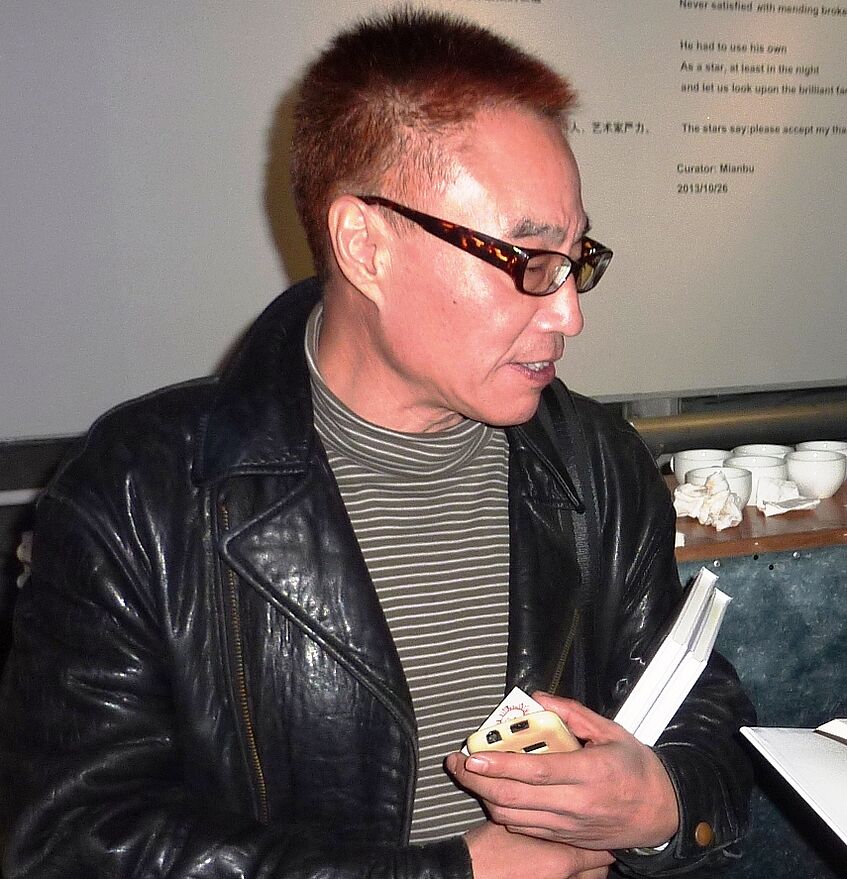
Yan Li (2013 in Beijing)
Yan Li
… was born in 1954 in Beijing. He started writing poems privately in 1973 and taught himself painting from 1979, becoming a member of the "Stars" group the same year, and publishing some of his poetry in the independent journal "Today". Yan Li participated in the two regular "Stars" exhibitions in Beijing in November 1979 and August 1980 where he became known for his daring works tinged with abstraction and surrealism. As a writer, he is identified with the Misty Poets, a group that gained notice in the late 1970s for their subversion of social realism via personal emotions and private imagery.
In 1984 he was allowed to organize an individual exhibition in Shanghai’s People’s Park. In 1985 he moved to New York meeting up with other Chinese artists like Ai Weiwei. In 1987 he founded the quarterly journal "First Line" (Yi Hang / 一行, later continued as a net publication) that featured works of contemporary Chinese poets as well as translations of American poetry. He participated in many exhibitions in China and abroad, his poetry and novels were translated into several languages. Yan Li now lives between China and the United States.
Interview with Yan Li (on October 27, 2013 in Beijing's "798" cultural district)
Here you find the Chinese text of the interview.
Interviewer (Helmut Opletal): Please tell me first, how did you get the idea to start painting?
Yan Li: It was like this. I had a desire to express myself, and my friends around me used language or art material to do this, so I also wanted to give it a try.
Interviewer: When was that?
Yan: It was in 1979.
Interviewer: You had not painted before?
Yan: No, I didn't paint before, but I was somehow influenced, already when I was a child. My grandfather was doctor of traditional Chinese medicine and also an art collector. He possessed many ancient Chinese paintings and works of calligraphy. When I was little, every year I would help him move some of his paintings because in the south they were easily affected by dampness, and they needed to be aired out in the spring. So from the age of five or six until I was eleven or twelve, I often got to look at classic paintings and calligraphy.
Interviewer: You were in Shanghai, right?
Yan: Yes, I come from Shanghai. Later, in 1970, when I was at the Beijing No. 2 Machine Tool Plant, one of my colleagues was an overseas Chinese from Indonesia. He was two or three years older than me and my roommate in the dormitory. He liked to draw and paint, and he would often make sketches of me in the dormitory, for example when I was smoking, drinking, and thinking about girls. Sopainting has accompanied me since childhood as a way to record things, just like writing.
Interviewer: I know you come from an intellectual family.
Yan: Yes. My parents both attended college before liberation. During the Cultural Revolution, my grandfather was imprisoned for four months and then committed suicide. My father was also isolated and investigated at that time, and he was detained for four years. We didn't even know where he was. Isolation and investigation were common during the Cultural Revolution. If someone was a political suspect, but they couldn't find much evidence, they isolated him and made him write down what he had done before to force a confession. During those four years, we didn't know where my father was, and they didn't tell us.
So, for me, the Cultural Revolution was a crazy, lawless, and immoral period. During this time, from age twelve to twenty-two, I was definitely traumatized. Before the age of twelve, I was still at home, with certain rules and moral boundaries, and my grandparents and parents provided me with moral and ethical education. But suddenly, everything was gone, and the people I loved most were suffering, imprisoned, and they committed suicide. So, for me the Cultural Revolution constituted a crime against humanity.
That's what I think about it now. At the time, I just couldn't understand why it could be like this, I absolutely couldn't understand. For me, my family members were all good people, so how could they suddenly become bad elements just because they were well-known in their profession?
My grandfather, as a doctor, was not allowed to choose his patients. He wouldn’t say, “You're a bad person, so I won't treat you,” as he was ordered to do. No doctor would first investigate a patient's political records to decide whether to treat him or not. His “crime” back then was that he also treated many “bad” elements.
Interviewer: You started painting in 1979. Did you also start writing poetry around that time?
Yan: I had started writing poetry even earlier, in 1973.
Interviewer: What kind of poems did you write in 1973?
Yan: Most were about feeling depressed, because I couldn't see my family, and they were suffering. I just wrote about painful things. But were still in the Cultural Revolution, and I knew that my writing shouldn't be read by others, or there would be problems for me.
Interviewer: So you only wrote these poems for yourself. Have you ever shown them to your friends?
Yan: I noted them in my personal diary. Some I also showed to close friends. I was friends with Mang Ke and Duoduo back then, and we exchanged our poems. We knew we were all in the same group. They started writing poetry a little earlier than me, back in 1970. I'm about three or four years younger than them. I met Mang Ke and Duoduo in 1970, and their poetry influenced me.
I did have a lot of inner thoughts that I wanted to express, and poetry was a good way to do that.
With painting I started because Li Shuang was my girlfriend at the time. She painted at my apartment because there wasn't enough space in hers. It wasn’t very big where I lived, but I had my own room, where she could do her canvasses.
Later, Huang Rui and his group were organizing an exhibition. We already knew each other then, because we were all with the “Today” magazine. Many members of the Stars Art Group initially joined “Today”. That included Huang Rui, Qu Leilei, Ma Desheng, Zhong Acheng, and myself. We were all connected to “Today” and had published some works there.
After painting for two months, Huang Rui came to my apartment to see Li Shuang's paintings. He looked at the walls covered in paintings and thought they were strange. He said, “Very good.” When Li Shuang wasn't around, I had used her painting box to paint myself.
Actually, I didn't learn painting from anyone, but I had seen many works of art when I was young, and I also had that friend in the factory dormitory who painted, so I knew how it had to be done. It was easy to imitate; just put a board there, have some colors, and start painting. That's how I figured it out, and I used the imagination I had for writing poetry to paint.
Interviewer: So how did you organize the exhibition then?
Yan: I recall it was when we were at the Democracy Wall. We saw many people posting dazibaos and political appeals, and some painters hanging creations there. I remember the first person to hang a painting there was a guy from Chengdu named Xue Mingde who showed his inks.
Later, there were five young people from Guiyang, one who we knew was named Yin Guangzhong. Around that time, in June, there was also a group called the “No Name Painting Society” who had their works exhibited at the Huafangzhai Gallery. This was in June 1979. We asked them how that could happen. They said they had applied to the Beijing Artists Association and it had been approved.
Of course, their paintings were relatively moderate, ninety percent were still lifes and landscapes. Among them were also two grayish canvasses, by Zhang Wei and Feng Guodong, and two more rather shocking ones. When Huang Rui and the others saw this, they thought we could also do an exhibition.
So they applied to the Beijing Artists Association for an exhibition space, but Liu Xun [then Chairman of the Artists Association] said they were already full and there was no way. That’s why we decided to exhibit outside the museum, and we invited about a dozen artists to participate.
Interviewer: When you think about it now, what was the importance of doing that back then, and what impact did it have later on?
Yan: We had not really thought about the impact it would have later. But we considered we needed to express ourselves, our feelings and thoughts, because we had been suppressed for so many years, only reading Mao’s quotations and the “People's Daily” every day during the Cultural Revolution.
After all, I had received five years of primary school education before the Cultural Revolution, so I knew about math, Chinese literature, and geography, although those subjects were later discontinued. Then my family was affected, so you may understand that I had a lot to say, a desire to express myself.
Why did so many people in society want to do literature and art? It’s because they needed a medium to express themselves. There are also many people who appreciated art, not necessarily create it. So we created for others to see and to share. First, you satisfy your desire to express yourself; if you do it well, you can share it with others. Actually, I had the aspiration to express my thoughts already for a long time.
Interviewer: In 1979 and 1980, it seems you were the youngest member of the group.
Yan: I was among the youngest, only Li Shuang was younger than me.
Interviewer: So you were relatively young in the art group, and you had just started painting. What did this mean for your status within the group? Did they respect you?
Yan: Of course they respected me, also because I painted the strangest topics. I had never received any formal training, and ironically, I painted the strangest, the most novel, and funnies themes. We are not restricted in any way, and I liked my friends, so they also liked me.
Because I also wrote poetry, my imagination was richer, and maybe more than that of the average painter. Many avoided a narrative aspect in their paintings. But for me as a poet, it didn't matter; I wanted to narrate, and there were no constraints. As long as the painting was interesting to others and people thought they could understand my messages, there were no limitations. This has proven to be right.
Interviewer: You mentioned that many activities of your Stars Artists' Association were related to the Democracy Wall and the Democracy Movement. What did these political activities mean to you at that time? And did you participate in them?
Yan: Yes, yes, they were important for me, and I also expressed this in my poems. Actually, I thought the same way. They expressed it in articles, but I thought that poetry was a bit more sophisticated. Or maybe it was subconscious, because poetry was harder to write. Everyone's talent is different. For one it might be easier to express feelings through poetry, but others might feel more rational, and the logical thinking of prose might be more suited for them.
I never tried to avoid anything. If I had wanted to distance myself of something, I wouldn't even have participated in “Today” or the “Stars”. I know that many people were afraid of the situation at the time. They came to participate with “Today” or the “Stars” once or twice and then left again.
Interviewer: Weren’t you also afraid because your family had suffered persecution during the Cultural Revolution?
Yan: I have been afraid. But in 1979 and 1980, the situation was much better than during the Cultural Revolution. Since even the Democracy Wall was allowed to exist, the pressure we felt wasn't as high as during the Cultural Revolution. Things had somewhat improved.
Furthermore, we had nothing left to lose. It just didn't matter. My monthly salary at that time was 18 or 21 Yuan [about 5 US dollars] in the factory. I was living in a dormitory. What wealth did I have? My grandfather had committed suicide, and my father was released after four years of imprisonment. There he had fallen seriously ill and he passed away in 1981.
Especially after my father's death, I thought I had nothing to fear, nothing to lose. At worst, I would be jailed myself. So, I had nothing I needed to protect, which prevented me from participating in anything “dangerous.”
If you look at it in that historical context, it was precisely because of this that we weren't afraid. Our whole generation had experienced similar situations on a larger scale. And on a smaller scale, it's also human nature. Some people aspire to become famous poets or painters. They may engage in some degree of self-promotion, but this is forgivable and human nature. However, in the grand scheme of things, we all lived under the umbrella of the same destiny.
Interviewer: Did you participate in the protest march on October 1, 1979?
Yan: Yes, Li Shuang and I both participated. We're not seen on the photos because we marched more in the back. Why? I can explain it, and Li Shuang will certainly too.
It was Huang Rui who notified me about the march. He had come to my apartment and left a note saying we'd meet at the Democracy Wall the next day for the demonstration, specifying the time. But I wasn't home when he left the note, so my dad saw it first.
The next day, my father wouldn't allow me to go out. Then Li Shuang came to see me and said we should go together. But when Li Shuang had entered the apartment, my dad sat down at the door and said, “You can't go. It's too dangerous. Such a protest march has never been allowed to happen before.”
Huang Rui had informed that we'd meet at 9 o’clock. So at 9:30, I told my dad, “Look, the time's already passed, they've already started.” So we could leave. When we got there, they had just set off, and we rushed over to catch up with them. We arrived just as they started, that’s why we were at the back.
We kept marching from the Democracy Wall, passing Qianmen. Because Tian’anmen Square remained closed for us, we went around to the back. That wasn't a problem. After the march, we felt victorious. We were told to return home and wait for more news.
The outcome was that they'd arrange an exhibition venue for us. Then our group – mainly the Stars members plus some friends – went to the second floor of the Dongfeng Market, and I paid a lunch for everyone using the money that people had donated at our open-air exhibition which had remained in my hand.
Interviewer: Did you continue painting later?
Yan: The demonstration of our Stars Group was ultimately labeled a counter-revolutionary act. We only learned later that internally we had been categorized as such. So, members of the Stars later encountered all sorts of trouble, including Mao Lizi. If we wanted to change jobs or do anything else, we were bound to run into difficulties. And after our second exhibition [in 1980], we were no longer allowed to hold more presentations.
At that time, things were also becoming more open to the outside world. Chinese could go to study abroad at their own expenses, and they were now allowed marrying a foreigner.
So gradually, one by one, we left for abroad. We didn’t see any space for developing anymore; they were suppressing us, and we couldn't hold exhibitions. We had tasted the sweetness of exhibiting to the public, we had tasted that freedom, and we were unwilling to give it up.
Later, when more openness in China allowed us to travel abroad, we all wanted to leave of course. It was that simple a thought. But most people didn't have much money back then. Those who initially went – between 1980 and 1987 – just had this dream, but couldn’t really afford it. Still they didn't want to stay, simply because of the many political problems in China.
Ai Weiwei was one of the earliest; he left in 1981. Then Zhao Gang, also quite early. Then Huang Rui and Wang Keping who both married foreigners. They were followed by Li Shuang. Then I, then Ma Desheng and Qu Leilei. Mao Lizi also went, and Zhong Acheng followed a little later.
Between 1981 and 1987, most core members of the Stars Group went abroad. Some people still traveled back and forth, such as Wang Keping, myself, and Li Shuang. Huang Rui became a Japanese citizen. He also traveled to Japan and sometimes back. Many had acquired foreign passports. For them it wasn’t difficult, and they could stay wherever they wanted.
But there was a problem, the “Stars” had somehow disappeared from history, and you didn’t find much concrete information published about the “Stars” overseas. There was a tenth-anniversary exhibition held by Zhang Songren [head of Hanart Gallery in Hong Kong,] but even that was limited and not visited many people.
But our only relatively formal and comprehensive record started with Zhang Songren. When I went abroad in 1985, I met him in Hong Kong and told him the story of the Stars Art Group. He was interested and said he would see if we could hold an exhibition for our tenth anniversary. So I gave him everyone's contact information.
He started getting in touch with others, and this exhibition was made possible in the end. He invested over two hundred thousand US dollars, and I'm sure he had high ideals back then. He really put a lot of effort into it, and the exhibition traveled from Hong Kong to Taipei, and then to France.
Interviewer: How do media in China refer to your Stars Art Group nowadays?
Yan: We are regularly mentioned as individuals. For example, if one happens to have a solo exhibition, it will be mentioned that he or she participated in “Stars” exhibition back then. The “Hunan Fine Arts Publishing House” has published a booklet introducing the “Stars”. It was a relatively small book compiled from Zhang Songren's descriptions. That was the only officially published account introducing the “Stars” in China. And that was many years ago, in the early 1990s.
Later, Huang Rui compiled a few things about the “Stars” in Japan, but they were all small-scale, just talking about five or six artists, but not Mao Lizi, Yang Yiping and others. For the 15th anniversary of the “Stars” we did a small event in a gallery in Tokyo.
Huang Rui also organized a 20th anniversary exhibition. So all of this is to be recognized, and he did try his best. But in 2007, I wanted to prepare another “Stars” retrospective. I had asked Huang Rui before if he wanted to do it. But he said he didn't want to because he was busy with the “798” Art District Festival. Already in 2003 he had told me, “I need time, Yan Li, give me two years.” […] In 2005, he still said he wasn't ready, “I want to find funding abroad.” I replied, “Do you want to wait for money? But we're not doing this for money.”
So this is where our conflict started. […] More than three years later, I told him I would organize it, and I did. So he wasn't actively involved, but two of his paintings that belonged to friends were included in the exhibition.
Huang Rui is still trying to find foreign funding. But the problem is, he doesn't keep us informed about many details. I, on the other hand, always informed about the progress and where things were at. But he doesn't tell us and does whatever he wants. I met him the other day and asked him to prepare a catalog of all the materials he possesses. And if I could contribute anything that he was missing, I certainly will, because our history belongs to our collective, not just to individuals.