
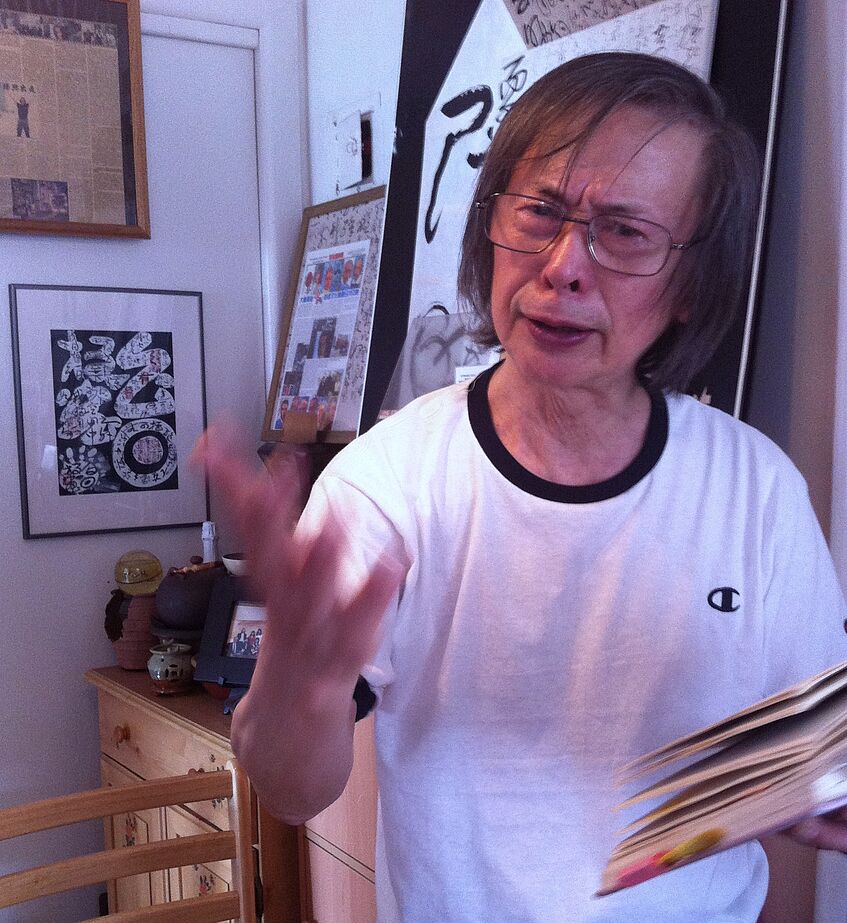
Huang Xiang

Huang Xiang (2014 at his home, reciting his Poem "Tribute to the Democracy Wall"

...was born in 1941 in Hunan Province. His father was a Guomindang general, who was executed by the Communists briefly after the founding of the People's Republic. In 1956 his Family moved to Guizhou, Huang became an apprentice and factory worker. 1958 he wrote his first poems, some were selected for a national poetry competition. He became member of the provincial writers' association, but was excluded again in 1959.

In October 1978 he traveled to Beijing together with some friends to post his poems and political texts in Wangfujing street and at the Democracy Wall. On Tiananmen Square they founded an "Enlightenment Society" and also created an independent journal called "Enlightenment" ("Qimeng"). In 1980 he co-founded another literary magzine in Guizhou.

Between 1959 and 1990 Huang Xiang, under various accusations that were mostly politically motivated, spent several times in prisons and "re-education camps". After his final release in 1990, he continued his literary work, he was briefly allowed to publish and present some of his poems in China. In 1997 he received permission to move to the United States together with his wife. He was then regularly invited to recite his poetry in the US, in Europe and in Australia, only once he was allowed a brief visit to China. Huang Xiang now lives in Queens, New York City.

Interview with Huang Xiang (on May 27, 2014, in his apartment in Queens/New York)

Here you find the Chinese text of the interview.

Huang Xiang: What should I tell you? Maybe your first question will be about the “Story of the Guizhou Enlightenment Society“ that was written by two reporters from the People's Daily. One was Wang Yong'an, a well-known influential reporter who had even accompanied President Hua Guofeng on a state visit. The other was Zhou Xiuqiang.

Interviewer (Helmut Opletal): But Zhou Xiuqiang seems to have died already?

Huang: Yes, Zhou was the head of the paper’s International Politics Department at the time. They interviewed me, and they were very friendly the way they talked to me.

Interviewer: What year was that?

Huang: In 1979, before the Democracy Wall was closed down. The People's Daily, Guangming Daily, China Youth Daily, and Xinhua News Agency, all conducted interviews. At that time, the Propaganda Department let me read that “Story of the Guizhou Enlightenment Society“. But only the first part was shown to me; the rest was missing.

Interviewer: Why that?

Huang: Many years later, the introduction to “The Story of the Guizhou Enlightenment Society“ that I read in the media [published by various websites] was different from my original one. There were things that I had not said, and they were not my views. So I wrote something on the web to refute this.

I'm telling you the truth, I won't lie. […] I'm still working on enlightenment; before, it was enlightenment during the Cultural Revolution, and now it's for all of humanity. I'm expressing Eastern culture as I just told you, there's an Eastern philosophy called the unity of heaven and humanity, the universe and the human body. That's what I'm expressing now.

My poetry, my calligraphy, my paintings, they all express this. I'm not a politician, I have no ambition, no desires, but I want to advance the civilization of the Chinese nation and the civilization of humanity, to participate in this cause. So, the “The Story of the Guizhou Enlightenment Society“ hasn't ended; they've just suppressed me, preventing me from articulating my opinions.

During my most tragic period, from my teens, from seventeen until now, not a single book of mine could be published. You so many books here, countless books, unable to be published. The younger generation in mainland China today lives in the internet age. They can see so many things, so that’s different from our time. […]

Shortly after the publication of “The Story of the Guizhou Enlightenment Society“, I was imprisoned. But I never said things behind their backs. […] My thinking is quite open and free.

I, Huang Xiang, I do love my motherland, China, Chinese culture, and the great Chinese nation more than any Communist Party member. Huang Xiang is not an enemy of China. Why was I repeatedly persecuted? Why are so many corrupt and lecherous officials allowed to make so much money and transfer it abroad so freely? […] Is it fair that I was persecuted because of my bad birth and because of my freedom of thought? As a member of the Chinese nation and a citizen of the People's Republic of China, why don't I have my freedom of publication?

[…] So the propaganda people called me over and showed me the original document on the Guizhou Enlightenment Society, which was printed and later published in the People's Daily internal reference materials. They let me see a part of it: Huang Xiang has the mind of a child, a child's mind. […] That Huang Xiang's thoughts were very simple. About how Huang Xiang was persecuted, his family background as son of a Kuomintang general, and his grandfather being an old landlord.

These things were written very truthfully, and I was very moved and shed tears, but they wouldn't let me read the rest. […] It's not only a record of the Enlightenment Society's history but also a history of the People's Republic of China. […] The Democracy Wall wasn't initiated during the Beijing Spring. It was started by a poet from the Guizhou Highlands who ignited the first spark. Why the Guizhou Highlands? Because Beijing is the imperial city, with its courtyards and enclosed walls, while Guizhou is full of high mountains, great waterfalls, and forests.

So, like a wild man, or even an alien, I had expressed my thoughts. During the Cultural Revolution, others thought I was very brave, but I was just telling the truth. […] The history of the People's Republic of China was first told by a provincial group that attracted nationwide attention. The poet Huang Xiang and others had founded the Enlightenment Society in Guiyang, it was said. That was incorrect, because we announced our founding in Tian’anmen Square. We first published it in Beijing, then in Guiyang. […]

On November 24, 1978, we went to Beijing first, and then returned to Guiyang. The Enlightenment Society posted two slogans in very impressive large characters on the east side of Tiananmen Square. The characters said, “The Cultural Revolution must be re-evaluated,” and “Mao Zedong must be judged 30/70.” [meaning 30 percent bad, 70 percent good]  This caused a widespread reaction, forcing the Communist Party to issue a statement. […]

The earliest [independent] publications were our journal “Enlightenment”, that of the “Chinese Human Rights League”, and the “April 5th Forum”, followed by publications like “Beijing Spring”, “Exploration”, and “Today”.

Why did I create this magazine? My idea was that after the Cultural Revolution, these walls – brick walls in the past, like at Xidan – had now become online democracy walls. My initial idea was a humanistic democracy wall, a cultural and artistic democracy wall. Today, it should be a Chinese studies democracy wall. […]

Historically, changes in human society haven't been about politicians rising up – you overthrow me, you come to power; I overthrow you, I come to power. It's not about overthrowing emperors to become new emperors. It's about the foundation of thought and spirit in culture and art, like the Italian Renaissance, which brought about change in the world. First and foremost, there are thinkers and artists who shared their ideas with others. This was true of the French Enlightenment and China's May Fourth Movement. Therefore, I wanted to inherit the good things from our predecessors, laying a spiritual foundation. I want to play my role in promoting change in Chinese society and advancing human history.

[…] Another issue was why was I one of the first to raise questions about Mao Zedong and the Cultural Revolution, which the Chinese Communist Party later also called a catastrophe. Others dared not speak, but Huang Xiang dared; others couldn't think of it, but Huang Xiang could. The things I wrote during the Cultural Revolution have now been published in China, so why am I now considered an enemy? […] I would never act for my own benefit. […] Huang Xiang will always be Chinese. That's perhaps where I differ from others. […] 

Some narrow-minded people might think I have a tacit understanding with the Communist Party; that I've surrendered, or been co-opted. That's a ridiculous view. I'm a poet, an artist. My mind is free, and my language is truthful; I don't tell lies. Think about it: Dante was exiled from Italy, but he still remained an Italian poet. […]

I was one of the first to raise questions about Mao, the Cultural Revolution, and human rights in China, without ambitions, but only feeling responsible to history and to telling the truth. So when I went back to China in 2008, I still told the truth, not lies. After returning from the 2008 Olympics, I wrote an article, which is called “The Physique and Heartbeat of the Chinese Nation”. […]

Huang Xiang was also one of the earliest Chinese performance artists. Why? At Tian’anmen Square, our people were chanting “Long live the Emperor!” And Huang Xiang and three of his friends conspired to urinate on the statue of the Saint. Urinating in Tian’anmen Square became a massive waterfall, a fart became thunder [Huang Xiang making a loud noise,] and it spread throughout Beijing.

So Huang Xiang's performance art, Huang Xiang's poetry, Huang Xiang's painting art – I also used painting at the time – wasn’t understood by the foreign journalists, and they asked me what it meant. I told them then, it was “art between humanity and the universe.” It was so ahead of its time. […]

Interviewer: Artistic expression is related to society, so doesn’t it also involve political issues?

Huang: Yes. That's a good question. Political issues are one level, but there are deeper levels, so we need to transcend them. I've also written poems about Mao and the Cultural Revolution; I wrote them earlier than anyone else. I was writing poetry in the 1960s, before the Cultural Revolution, very freely. “Solo song” was written in 1962, and there was also one in 1959. But I can't just stay within these limits; I have a much larger world to explore. Look at my paintings; what do they express? We are Earthlings, and we shouldn't just express things on Earth; we should also express things on other planets, exploring the mysteries of the universe. That's me. […]

Interviewer: I understand what you mean, but I want to go back in time again. I would like to know why you went to Beijing in 1978 to found the Enlightenment Society?

Huang: A good question, so let me tell you. First, why did I go to Beijing? Huang Xiang published poetry in Chinese magazines in 1958. Then came the year 1959. You can read it in my autobiography. I loved the vast grasslands, the Mongolian grasslands, the Xinjiang grasslands, where the wind blew across the grass plains of cattle and sheep. I dreamt of Tibetan girls singing on snow-capped mountains, their songs drifting down to meet me on the grasslands. Do you understand?

Before my dream even ended, I was handcuffed and thrown into prison. Actually, it was just a dream. Since first being jailed in 1959, I've been imprisoned six times in my life. I've been detained because of my poetry, because of my dreams. The best years of my life have been trampled on by them. Now I'm over seventy years old, and not a single book of mine is allowed to be published in mainland China. […]

You also ask why I went to Beijing. In 1959, I loved the grasslands, so I went there to have fun with the shepherdesses. What crime did I commit? I was arrested and imprisoned. I was only eighteen or nineteen, not even twenty. […] Why did I want to promote enlightenment? Why did I go to Beijing? My books couldn't be published, so I went to Beijing to turn them into big-character posters and plaster them on walls – at Tian’anmen Square, at Xidan, or Wangfujing Street. It was as if I were writing my life in the sky, writing my poems in the sky, letting the whole world see that Huang Xiang was writing poetry, Huang Xiang was dreaming. […] When I arrived, you know, Wangfujing Street was packed with people, the traffic was completely jammed, there were many bicycles at night, and flashlights were shining over my poems, and many were copying them.

But Hua Guofeng's government thought something like the Hungarian Revolution was about to happen, declared martial law, and urgently sent a Trident aircraft to Guizhou to retrieve my files. It turned out to be a false alarm. It was a poet who had arrived, not a troublemaker, not a terrorist, just a poet. […]

Of course, I also have positive views of Mao Zedong; I think he was remarkable, with a stronger personality and greater power than others. However, I disagree with his autocratic and dictatorial ideology because he rejected many of his contemporaries, including Lin Biao, Liu Shaoqi, and Deng Xiaoping, right? I don't like that kind of person. […]

And I have to tell you, it's strange, but I used to write poetry because of my grandfather, who was a very good poet when I was young. I was influenced by him. After elementary school, they wouldn't let me continue my studies. They were afraid I would become too smart and change my destiny, so they wouldn't let me go to school. I didn't go to junior high school; I only finished elementary school.

My father, who had studied in Japan and also visited the United States, later became a general in the Kuomintang army. He left behind many books, which I secretly read. He also left behind a literary diary, which had a great influence on me. In it were Walt Whitman's [a 19 th century American poet] lines: “Youth is beautiful, but old age is more beautiful.” I didn't understand it then, but later I understood: old age is the beauty of wisdom. […]

My life's fate, even at over seventy years old, still won't let me return to the land that gave me birth and nurtured me. I miss China so much. From the very first moment I left China, I began to miss it. In my poems, I wrote about my love for China; there are two strings stretched within my body: the Yellow River and the Yangtze. And when I pluck these strings, they will forever make China vibrate.

Interviewer: In what year did you leave China?

Huang: I’ve left twice. In 1993, I was chosen to participate in a “World Who's Who,”, so I came to the USA. At that time, everyone expected I wouldn't go back. But I did go back. Someone had even arranged a meeting with President Jimmy Carter for me, but I didn't meet him, I went back to China instead. […]

But after I returned in 1993, Guizhou added another charge against me, saying I had taken up a human rights mission for the United States and I was to cause sabotage after returning to China. They wanted to sentence me to another 15 years. I had already been to prison six times. If I were to serve another 15 years, I would spend the rest of my life in a dark prison. I really had no choice but to leave China again in 1997. I am still Chinese and have not become a US citizen. So why does my country refuse me? […]

My wife was also influenced by me. She's the daughter of a high-ranking Communist Party cadre; her background is better than mine. I'm a son of a Kuomintang member. Her father often said, a Communist Party daughter can't marry a Kuomintang son. But she still married me. Once they arrested her, wanting to add another charge against me – “rapist” – and sentence me to death and charge her five cents for each bullet after my execution. When they asked her to sign the indictment against me in court, she refused. That's why Huang Xiang is still alive today; otherwise, he would have died long ago. […]

[Huang Xiang – with strong and emphatic voice – recites a poem:]

I
am a cry
from the raging years piled around me;
I am a shattered diamond,
a sun in every fragment;
I am myself, I am the obituary of my own death;
I will redeem myself from death.

My second poem “Tribute to the Democracy Wall” is quite long. When I recite it, the young people, both men and women, all like it.

[Huang Xiang recites again:]

“Tribute to the Democracy Wall”
dedicated to the Fighters of Democracy.
Oh China! I see you standing up on the Democracy Wall.
You stand here, loudly shouting and speaking out.
You carry a mimeograph roller or a freshly printed poem,
your body is stained with blue and black ink.
You are surrounded by countless people,
yes, more and more people – men, women, elderly, children.
You loudly proclaim democracy, proclaim the future,
while simultaneously answering questions.
Doubts and accusations pouring in from all directions.
Your voice is calm, your gaze frank, passionate, and confident.
Although you are surrounded by a cacophony of noise and chaotic sounds,
filled with all sorts of eyes – trust, support, doubt, and worry – 
you have just broken free of your shackles, your wrists still bearing the marks of red blood.
You have just stepped out of prison, the creaking echoes of the two iron gates still reverberating behind you. 
But China, you have not retreated – turning a blind eye to your conscience. 
Today, you are no longer confined within the walls of isolated palaces,
no longer tossed into the private bags of despots and dictators; 
you have returned yourself to the people. 
You are an ordinary worker, an ordinary farmer, an ordinary soldier; 
you are a passionate orator, refuted and then refuted again; 
you are an upright poet, singing praises of blue freedom and white light; 
you are a thinker, an awakener, a speaker, a judge, a chooser, 
an ordinary citizen who dares to expose and equally dares to sing praises. 
Oh China! Perhaps you will fail, suffer setbacks,
be drowned in the waves of misunderstanding, distortion or slander, 
and be imprisoned again along with freedom. 
But China, whether you are the victor or the vanquished, 
you will forever stand – standing on the Democracy Wall,
falling – falling beneath the Democracy Wall,
and leaving your great signature on the constitution of a newly born republic – the people's new constitution.


This is what I recited on the Democracy Wall years ago.

Interviewer: Thank you!

Huang: My art is different from American and Western art, and also differs from Eastern art. I tell you what I think about art. In the West, they started to paint big buttocks and big breasts in ancient times, right? Later, this became art, conceptual art or abstract art, very abstract, and performance art. What Eastern thinking is, I already told you.

When I was in Spain, they explained to me that Picasso's paintings were distorted, putting the buttocks in front. That was surrealism. How did Huang Xiang respond? Huang Xiang said that Chinese culture, Eastern culture, was not about distortion, but about representation. Representational thinking encompasses everything. We are surrealists from thousands of years ago. It has been lost by the Chinese themselves. This is the surrealism I express. […]

Interviewer: Where did the People's Daily reporters interview you in 1979?

Huang: That was in Guiyang.

Interviewer: Did they specifically go to Guiyang?

Huang: Yes. Guiyang wasn’t open to foreigners then, but they could go.

Interviewer: What did they talk to you about? What did they ask you? What did they want to know?

Huang: Questions just like yours. Why did you engage in enlightenment? Why did you go to Beijing? Why did you raise so many questions there? Later, I was persecuted, I had a bad family background, and they emphasized that too. […]

Interviewer: How long did they talk to you?

Huang: It seems like it's been a few days.

Interviewer: Did they come every day?

Huang: Yes, and it wasn't just them; Xinhua News Agency also came, China Youth Daily came, and Guangming Daily came too. […]

Interviewer: Were they just to you alone?

Huang: Just me. Originally I had three friend friends who had come with to me to help me put up the big-character posters. But I wrote my own things.

Interviewer: Was their report published in the papers?

Huang: Just in the internal publication of the People's Daily.